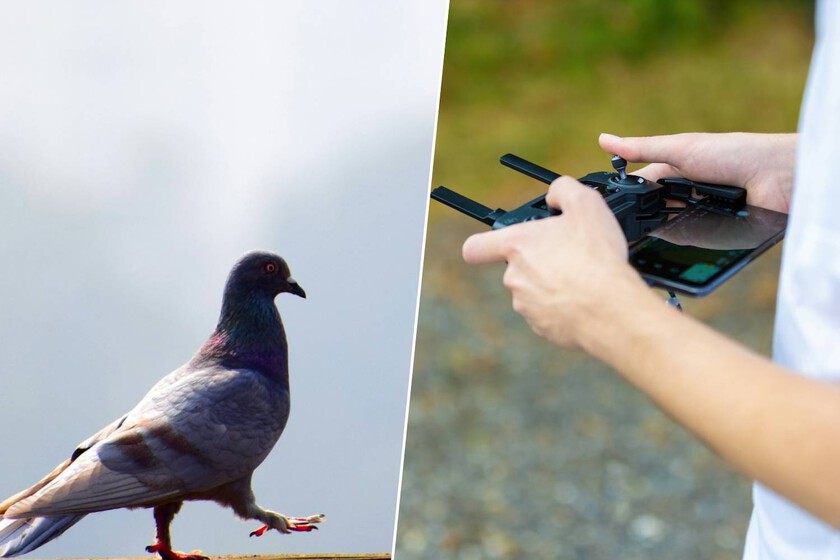
Nothing more a priori innocent than a pigeon flying over the buildings of a city or perched in a square. Or not, because in addition to being another inhabitant of cities (sometimes in excess, which becomes a problem), pigeons have been used as discreet express messengers since the ancient Sumerian and Egyptian civilizations. And also in war scenarios: in World War I, the United States Army created a carrier pigeon service called the United States Army Pigeon Service for tactical messaging when everything else failed or was destroyed. Now the Russian startup Neiry claims to have given them one more twist: it has turned pigeons into biological drones.
An electrode in the brain. What the Russian company proposes is not to biomimic a drone so that it resembles a pigeon, but to convert this animal into a transport vector by equipping it with implanted neural interfaces. More specifically, they implant electrodes in the brain, which are then connected to a stimulator attached to the head. That is, a kind of GPS that speaks with the brain of the bird.
Neiry explains that the interface provides mild stimulation to certain brain regions, thus causing the bird to (artificially) prefer a certain direction. Otherwise, the bird behaves naturally. This system does not replace the bird’s will, but rather biases its sense of orientation to follow pre-established routes.
Why birds? According to the Russian startup, the goal is to use biological carriers in situations where drones have limitations in range, weight or others such as a restricted area. Alexander Panov, CEO of the company, explains that birds can maneuver in complex environments, fly for long periods and operate in places where drones are restricted, as reported by Bloomberg.
Anyone who has handled a drone knows that there is one critical element: the battery. Unlike unmanned aerial vehicles, a pigeon does not need to change its battery nor does it require frequent landings: its nature gives it everything necessary to carry out a long-distance flight. Millions of years of evolution make a bird beat any commercial drone and its 20-minute battery life in terms of flight stabilization and energy efficiency. In fact, up to 400 kilometers a day without stops.
Pigeons with backpack. In the test flights that Neiry has carried out with these pigeon drones, the birds were equipped with this neural interface, in addition to a small backpack with the controller, solar panels mounted on the back and a camera. Of course, without giving as much singing as a drone, they did not go unnoticed, as can be seen in the video provided by the company.
Pigeons are just the beginning. Panov explained that although they currently focus on pigeons, “different species can be used depending on the environment or payload.” Bloomberg echoes other similar implantations, such as the brain of cows for NeuroFarming, so that they produce more milk. And a rather spooky ultimate goal: “to create the next human species after Homo sapiens: Homo superior.”
Possible applications. After the tests, the company ensures that the system is ready for practical implementation. According to Neiry, they have no plans to use these birds for military purposes despite the fact that in a war or surveillance scenario their use is disruptive: the radars are programmed to filter out winged fauna as ‘noise’ or false positives. In short: they would go unnoticed.
Among the ideas of use where they see an opportunity are infrastructure inspection, support for search and rescue, coastal and environmental observation or monitoring of remote areas in places like Brazil or India.
Where is the ethics?. Mechanical drones are easier to control, they are capable of carrying larger loads and obviously, they do not need to feed nor will they defecate on you. And that’s not to mention the ethical implications of altering an animal’s behavior. Gizmodo details that after the surgery to implant the chip, the pigeons are almost ready to fly, so the risk “is low for the survival of the birds.”
Of course, the startup has not provided independent third-party reviews, which makes specialists question the ethical implications of its technology. Bioethicist and law professor at Duke University Nita Farahany says, “Any time we use neural implants to try to control and manipulate any species, it’s disgusting.”
In WorldOfSoftware | The war in Ukraine has become something absurd: there are drones shooting at Russian soldiers dressed as “penguins”
In WorldOfSoftware | We had seen everything in Ukraine, but this is unprecedented: Russia is not launching drones, it is launching “Frankensteins”
Cover | Sanjiv Nayak and Andreas Schantl