The fridge is one of the key appliances in every home, and one most people take for granted. We use it to keep all sorts of foods fresh for longer periods and prevent them from developing dangerous bacteria that can cause foodborne illness (food poisoning), which can be deadly. However, some bacteria can grow even at low temperatures. That’s why it’s critical to ensure your refrigerator is set at the right temperature to significantly reduce microbial growth. That temperature is 40 degrees Fahrenheit (4.44 degrees Celsius) or below, according to the U.S. Food and Drug Administration (FDA) for refrigerated foods. The freezer temperature should not top 0 degrees Fahrenheit (-17.77 degrees Celsius). Consumer Reports (CR) recommends even lower temperatures for refrigerated foods than the FDA: 37 degrees Fahrenheit (2.77 degrees Celsius).
FoodSafety.gov provides the same guidance as the FDA, noting that food should be stored at 40 degrees Fahrenheit (4.44 degrees Celsius) in the refrigerator and 0 degrees Fahrenheit (-17.77 degrees Celsius) in the freezer. The French national food safety agency ANSES mentions a similar 39.2 degrees Fahrenheit (4 degrees Celsius) maximum temperature for the refrigerator, noting that a recent EU-wide study showed that the average temperature of refrigerators in Europe is slightly higher than recommendations at 43.52 degrees Fahrenheit (6.4 degrees Celsius).
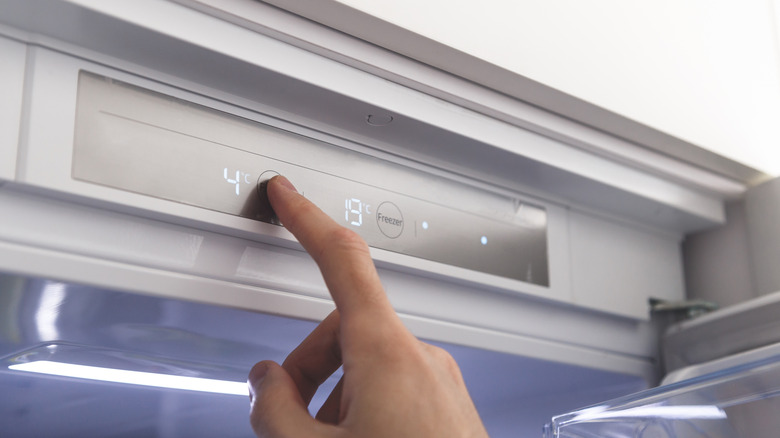
Consumer Reports warns that some fridges may not always offer accurate temperature controls. Some feature dials with numbers (1 to 5) instead of temperature values, while others have digital controls; in this case, a more basic unit might be better than an expensive smart fridge. CR recommends that users place a refrigerator thermometer in their fridges to ensure correct temperature settings. The FDA and FoodSafety.gov also advise users to rely on an appliance thermometer to check temperature readings.
Why is 40° F (4.44° C) the recommended maximum?
The 40 degrees Fahrenheit (4.44 degrees Celsius) limit isn’t arbitrary. It’s the recommended temperature to slow down the growth of dangerous bacteria that are present on foods and can multiply significantly at higher temperatures. The FDA notes that “at room temperature, the numbers of bacteria that cause foodborne sickness can double every 20 minutes.” FoodSafety.gov calls the 40 degrees Fahrenheit (4.44 degrees Celsius) — 140 degrees Fahrenheit (60 degrees Celsius) interval the “temperature danger zone,” where microorganisms grow rapidly. Similarly, ANSES explains that a bacterium like Listeria monocytogenes can multiply at temperatures as low as 35.6 degrees Fahrenheit (2 degrees Celsius), or below the recommended maximum for refrigerated foods, with the bacterium growing even faster at higher temperatures. ANSES points out that a temperature below 39.2 degrees Fahrenheit (4 degrees Celsius) stops “the growth of most micro-organisms, including Salmonella, which is a major source of foodborne illness in Europe.”
Salmonella is also a major cause of concern for the U.S, leading to food recalls in the past. The FDA’s statistics indicate that the Salmonella causes “millions of cases of foodborne illness annually and is the leading cause of foodborne deaths.” As of March 2024 estimates, about 48 million cases of foodborne illness happen every year in the U.S., caused by various bacteria. Of those, about 128,000 cases need hospitalization, and around 3,000 people die each year following an infection. The agency also highlights a key detail about pathogenic bacteria that may lead to a foodborne infection. They also don’t spoil the food in any detectable way — the food may not look, taste, or smell bad, which would otherwise warn a person to avoid consuming it.
Put food in the fridge as soon as possible

Pathogenic bacteria are already present on various foods, including raw meat, poultry, seafood, milk, eggs, water, fruit, and vegetables. Undercooked food can also allow dangerous bacteria to multiply. That’s why it’s important to store both raw and cooked food at the correct temperature in the fridge and freezer appropriately. The FDA advises people to refrigerate or freeze foods within two hours of purchasing or cooking them. If the environment temperature is above 90 degrees Fahrenheit (32.22 degrees Celsius), you should put the food in the fridge within one hour. Leaving foods in the car for longer periods is not recommended, as the vehicle may be even warmer than typical room temperature.
The same two-hour rule applies to home cooked meals, doggie bags, and take-out foods. The FDA says that putting hot food in the refrigerator will not harm the fridge. Leftovers should be refrigerated or frozen within the same two-hour period. FoodSafety.gov echoes that guidance, noting that food that’s not going to be served right after cooking should be kept out of that dangerous temperature zone by using a heat source to keep it above 140 degrees Fahrenheit (60 degrees Celsius) until it’s served. Even an inexpensive cooking thermometer can help monitor food temps.
The thermometers in your fridge and freezer can also help you determine whether food is still safe after power outages. The FDA says that if the readings are higher than the 40 degrees Fahrenheit (4.44 degrees Celsius) recommendation, you may want to throw out food. Setting the fridge’s temperature at the slightly lower level that Consumer Reports recommends, 37 degrees Fahrenheit (2.77 degrees Celsius), may be a way to ensure the appliance chills the food at lower temperatures than the FDA’s recommendation.