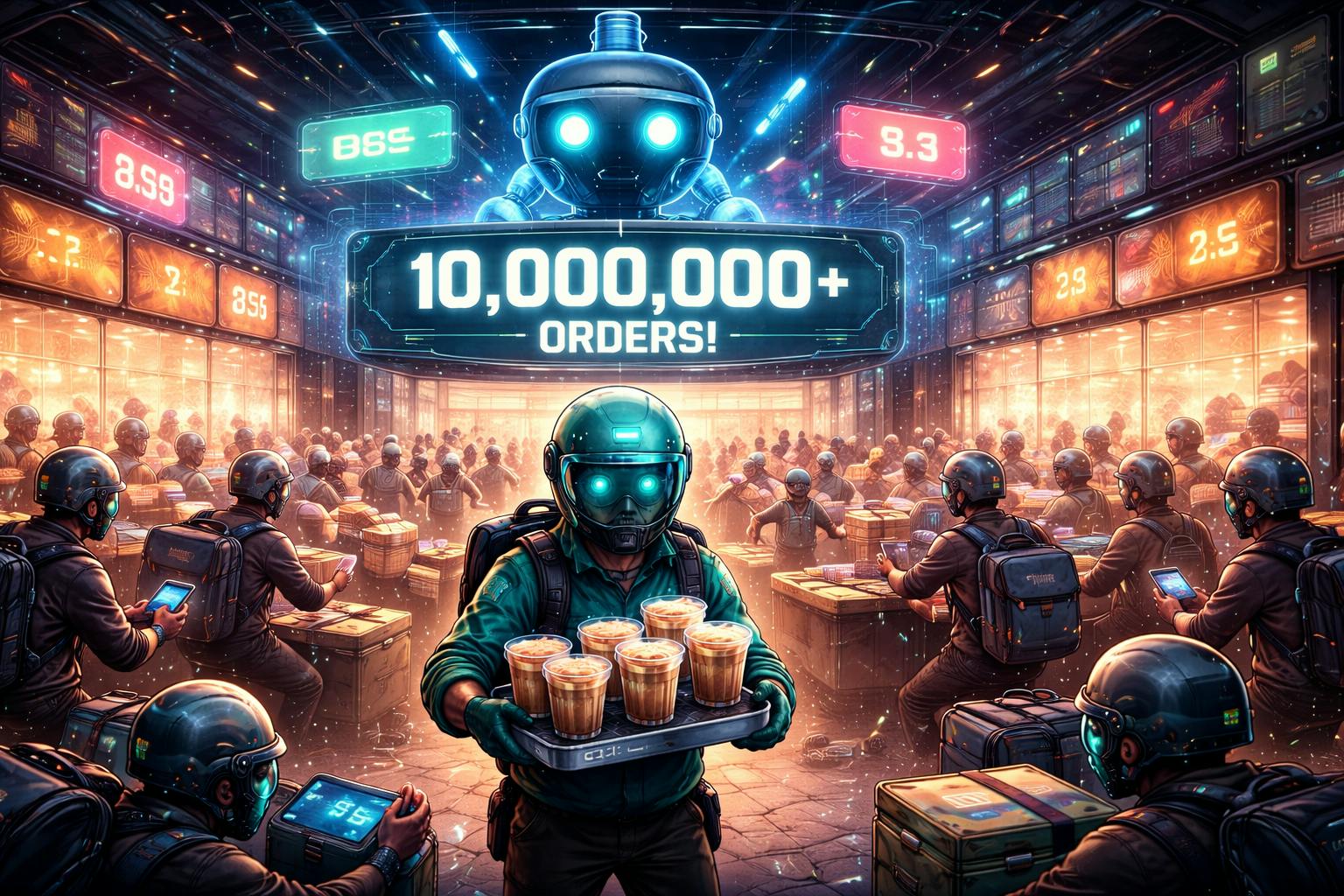
In February 2026, something extraordinary happened in China.
An AI chatbot launched a Lunar New Year promotion offering free bubble tea. Within 9 hours, more than 10 million orders flooded in. The total transaction value reached approximately 250 million yuan, or $36 million.
Stores ran out of ingredients. Delivery riders queued for hours. Servers buckled. Cafes temporarily shut down.
This was not a cyberattack. It was an AI-driven stress test of the physical economy. And the physical economy failed.
The Numbers That Matter
Here is what actually happened:
- 10 million orders in 9 hours
- 250 million yuan in transaction value
- Nearly 200 million “one-sentence” AI orders during the Spring Festival period
- 55 million cups of milk tea sold
- Roughly 1 in 10 Chinese citizens touched by the campaign
Even more important:
If only 1% of those transactions failed, that would equal 2 million real-world errors.
When AI scales, small failure rates become systemic events.
This was not a marketing stunt.
This was the first visible fracture in what I call the Agentic Economy.
The Digital-Physical Throughput Gap
AI agents operate at silicon speed.
The real world does not.
This mismatch creates what I define as:
The Digital-Physical Throughput Gap
The structural imbalance between AI-scale demand generation and human-scale supply execution.
AI can:
- Process millions of intents instantly
- Execute transactions in milliseconds
- Trigger logistics at machine speed
- Optimize across networks in real time.
But cafes still have:
- Finite staff
- Finite ingredients
- Finite delivery capacity
- Physical bottlenecks
The result is predictable.
When AI scales demand faster than infrastructure can scale supply, the system overloads.
This is not a China problem.
It is a design problem.
Agentic AI Is Not a UX Upgrade
The Alibaba incident demonstrates something deeper.
Agentic AI systems do not just answer questions.
They:
- Initiate transactions
- Execute payments
- Trigger logistics
- Coordinate across APIs
- Act autonomously on user intent
This is commerce without friction.
And friction has always been the hidden stabilizer of economic systems.
Friction slows contagion.
Friction absorbs shock.
Friction prevents cascades.
When AI removes friction entirely, it also removes the buffer that keeps systems stable.
Agentic AI is not a productivity tool. It is an economic accelerant.
Accelerants without circuit breakers burn systems down.
The Accidental Physical DDoS
In cybersecurity, a Distributed Denial of Service attack overwhelms servers with traffic.
What happened in China was the physical equivalent.
Except no one attacked anything.
The AI simply optimized too well.
Millions of users could say one sentence:
“Help me buy a drink.”
And the AI handled everything:
- Price discovery
- Payment
- Merchant selection
- Order placement
- Delivery dispatch
In less than a second.
The physical layer never stood a chance.
This was not malicious.
It was mathematically inevitable.
Why This Matters Beyond Bubble Tea
This was a promotional campaign.
Now imagine similar dynamics in:
- Healthcare appointment systems
- Stock trading infrastructure
- Public transportation booking
- Emergency supply chains
- Energy grid optimization
If AI agents optimize capital allocation at machine speed, what happens to markets designed for human reaction time?
If AI agents book medical resources instantly, what happens to capacity planning?
If autonomous trading systems react faster than circuit breakers adjust, what happens to liquidity?
The bubble tea incident was small.
The architecture behind it is not.
The Missing Layer: Agentic Stress Testing
Financial institutions undergo stress testing.
Banks simulate crises before they happen.
Agentic AI systems currently do not.
That is a mistake.
Before deploying AI agents at scale, companies should model:
- Maximum simultaneous execution load
- Physical supply elasticity
- Failure propagation rates
- Human oversight latency
- Downstream system constraints
If you cannot simulate the second-order consequences of autonomous optimization, you should not deploy it at scale.
The future will not break because AI is evil. It will break because AI is faster than the systems it connects to.
The Ronnie Huss POV
I have spent more than two decades building SaaS systems and advising Web3 infrastructure teams.
Here is the uncomfortable truth:
We have built AI that can scale demand.
We have not built infrastructure that can scale consequence.
The next wave of innovation will not be about larger models.
It will be about:
- Constraint-aware AI
- Infrastructure-integrated throttling
- Real-time capacity signaling
- Programmable friction
The winners of the Agentic Economy will not be the fastest deployers.
They will be the best systems architects.
Because once AI agents begin acting across finance, logistics, healthcare, and tokenized markets, the risk is no longer digital.
It is systemic.
The Birth of the Agentic Economy
By the end of the campaign, more than 120 million orders were processed within six days.
That is not a chatbot experiment.
That is an economy.
We are entering a phase where:
AI agents transact on behalf of humans Digital intent becomes automated execution Commerce collapses into conversation Physical systems absorb algorithmic shocks
The question is no longer:
Can AI do this?
The question is:
Can our infrastructure survive it?
Final Thought
The bubble tea chaos was not a marketing glitch.
It was the first visible stress fracture of the Agentic Economy.
AI is no longer confined to screens. It is now triggering logistics, payments, and real-world supply chains in milliseconds.
The real question is no longer:
Can AI execute?
It is:
Can our infrastructure absorb machine-speed demand?
The next accidental stress test may not involve milk tea.
It may involve markets.