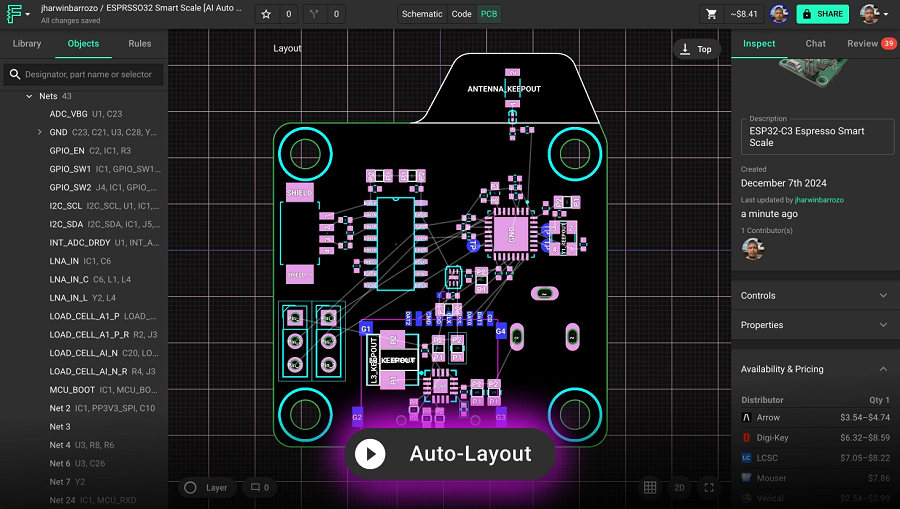
Flux, a startup with a platform that speeds up the development of printed circuit boards, has raised $37 million across two funding rounds.
The company disclosed the investments today. Flux, officially Defy Gravity Inc., raised about two-thirds of the capital through a recent Series B deal led by 8VC. It received the remaining $10 million earlier in the form of a seed round backed by Outsiders Fund and Bain Capital Ventures.
A printed circuit board, or PCB, is a flat rectangle that holds electronic components. Every computer’s processor sits on a PCB. PCBs can also function as standalone devices: companies often use them as sensors, while hobbyists sometimes turn them into computer accessories such as keyboards.
Flux offers an artificial intelligence platform that enables users to design PCBs with prompts. A manufacturer looking to monitor its production line could request a PCB with temperature and pressure sensors. A robotics startup, meanwhile, might use Flux to design an autonomous vehicle’s main computer.
A PCB not only functions as the substrate on which a device’s components sit but also enables those components to exchange data. Information is transmitted via copper tracks called traces. The most advanced PBCs have multiple layers of copper tracks stacked atop one another.
After users enter their project requirements, Flux determines how many layers the requested PCB should include. The platform also recommends relevant components. If a user is building a PCB with an artificial intelligence accelerator, Flux could scan manufacturer databases for chips that fit the bill.
Interoperability considerations limit which components can be placed on a PCB. For example, a temperature sensor that would be suitable for a project in theory might not be compatible with a PCB’s onboard processor. Flux says its platform automatically addresses interoperability challenges to save time for users.
If a component is out of stock, the software recommends compatible alternatives. It also identifies opportunities to cut costs. Flux also determines if a component that an engineer places to use in a project could be replaced with a more affordable alternative from a different manufacturer.
After a company completes its PCB design, it can use Flux to develop firmware for the device. The software maker says that its platform can significantly speed up the process.
Creating firmware for a new PCB requires developers to understand its hardware properties. That involves a steep learning curve because programmers usually have limited proficiency in circuit design. According to Flux, its platform eases the task by distilling PCB schematics into a more easily understandable form. It also automates certain coding tasks such as firmware compatibility testing.
“Historically, building hardware has been insanely difficult,” said Chief Executive Officer Matthias Wagner Wagner. “By bringing the cost of design down to near-zero, we’re giving millions of non-experts the ability to build for niche audiences—or make something for themselves.”
Flux will use the capital to enhance its platform’s core AI engineering capabilities. In addition, the company plans to add more integrations with third-party PCB simulation tools and component databases.
Image: Flux
Support our mission to keep content open and free by engaging with theCUBE community. Join theCUBE’s Alumni Trust Network, where technology leaders connect, share intelligence and create opportunities.
- 15M+ viewers of theCUBE videos, powering conversations across AI, cloud, cybersecurity and more
- 11.4k+ theCUBE alumni — Connect with more than 11,400 tech and business leaders shaping the future through a unique trusted-based network.
About News Media
Founded by tech visionaries John Furrier and Dave Vellante, News Media has built a dynamic ecosystem of industry-leading digital media brands that reach 15+ million elite tech professionals. Our new proprietary theCUBE AI Video Cloud is breaking ground in audience interaction, leveraging theCUBEai.com neural network to help technology companies make data-driven decisions and stay at the forefront of industry conversations.