At the time of writing (February 25), there are only three companies with a market capitalization above $3 trillion: Nvidia, AppleAnd Alphabet. Microsoft once had a valuation of $3 trillion, but in the past month its stock price has fallen enough to knock the Windows maker out of the exclusive club.
Ahead is the list of trillion-dollar stocks Metaplatforms (META 1.34%)which is currently valued at approximately $1.6 trillion.
I’m going to explain how Meta is transforming its advertising empire thanks to AI. From there, I’ll make the case for why Meta could potentially reach a $3 trillion market cap within the next two years.
Image source: Getty Images.
How does Meta use AI?
At the heart of Meta’s AI roadmap is a new machine learning product called Advantage+. Advantage+ helps marketers automate their ad campaigns, streamlining ad creation and demographic targeting.
The core idea is that AI helps marketers get a better sense of which ads resonate with different customer types. From there, advertisers can strategically allocate their budgets across Meta’s apps – Facebook, Instagram and WhatsApp – depending on what they’re trying to sell and to whom.
One thing you should know about Advantage+ is that it is a relatively new product that Meta is constantly iterating and adding new features to. For this reason, management tends to provide sporadic updates on Advantage+’s progress.

Today’s change
(-1.34%)$-8.83
Current price
$648.18
Key data points
Market capitalization
$1.6 tons
Day range
$638.12 -$649.44
Range of 52 weeks
$479.80 -$796.25
Volume
16M
Avg. full
16M
Gross margin
82:00%
Dividend yield
0.32%
During the third quarter, Meta CFO Susan Li said Advantage+ had reached $60 billion in annual revenue. While no new headline figure was revealed during its fourth-quarter earnings call, Meta management shared just enough to suggest its AI efforts continue to pay off.
In the fourth quarter, Meta’s video generation tools, part of the Creative suite under the Advantage+ umbrella, reached $10 billion in annual revenue. The growth of this specific segment exceeded the increase in total advertising revenue by three times quarter-over-quarter.
Additionally, Meta’s next-generation attribution tool delivered a 24% increase in incremental conversions compared to the company’s standard model. This new attribution feature has already achieved a multi-billion dollar annual run rate since its launch seven months ago.
Insight into Meta’s valuation
In 2024, Meta spent $39 billion on capital expenditures (capex). Last year, the company accelerated its spending by 85%, bringing total capital investments to $72 billion. During the Q4 earnings call, management revealed that Meta could spend up to $135 billion on capital expenditures this year – almost double the amount compared to 2025 levels.
I bring this up because, despite the company’s advances in AI, I think most investors still don’t understand how Meta uses artificial intelligence. Therefore, investors are primarily focusing on the effects that rising AI infrastructure costs will have on free cash flow. This dynamic is reflected in Meta’s valuation.
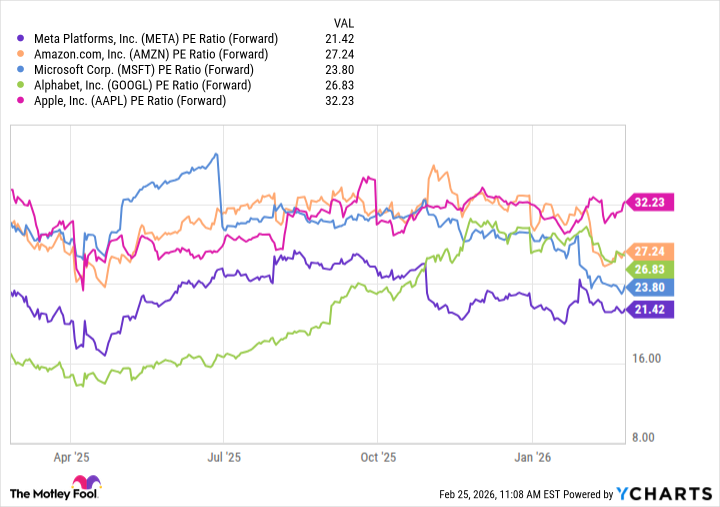
Meta currently trades at a price-to-earnings (P/E) ratio of 21 – essentially in line with its three-year average. In my view, Meta’s price-to-earnings ratio reflects a degree of uncertainty, driven by skepticism about the company’s rising infrastructure budget.
Can Meta Reach a $3 Trillion Valuation?
As the chart below shows, Meta is valued at a significant discount to its hyperscaler cohorts on a forward price-to-earnings basis. I think there are two factors at play here.
Data per YCharts.
First, Meta’s discount likely reflects its reputation as a glorified advertising platform, rather than a pure play AI specialist. Second, while Apple may not be known for its AI efforts, the company is able to maintain a premium valuation thanks to its ability to generate robust cash flows year after year. While Meta has done this too, investors don’t seem to be giving the company the same level of credit.
For this year, Meta’s consensus earnings per share (EPS) estimate among Wall Street analysts is $29.60. Analysts predict earnings per share will grow 16% to $34.34 in 2027.
To reach a $3 trillion valuation, Meta’s price/earnings would have to rise significantly, reaching the mid-30s. Admittedly, this is quite a task.
However, I think Meta can still achieve this level of growth in the coming years. As the company continues to roll out AI-driven features across its ecosystem, I believe the return on investment of Meta’s infrastructure spend will become increasingly apparent as the company has robust unit economics.
As Meta transitions from a social media advertising platform to a more comprehensive AI services company, investors may begin to change their perception of the company and value it more in line with other leading AI developers.
For this reason, I think Meta stock looks like an attractive buy-and-hold opportunity at its current price, as meaningful AI-driven valuation expansion could be on the horizon.