
By using this site, you agree to the Privacy Policy and Terms of Use.
Accept
World of SoftwareWorld of SoftwareWorld of Software
  • News
  • Software
  • Mobile
  • Computing
  • Gaming
  • Videos
  • More
    • Gadget
    • Web Stories
    • Trending
    • Press Release
Search
  • Privacy
  • Terms
  • Advertise
  • Contact
Copyright © All Rights Reserved. World of Software.
Reading: The Proof Expression Problem, Reimagined Through Object-Oriented Lenses | HackerNoon
Share
Sign In
Notification Show More
Font ResizerAa
World of SoftwareWorld of Software
Font ResizerAa
  • Software
  • Mobile
  • Computing
  • Gadget
  • Gaming
  • Videos
Search
  • News
  • Software
  • Mobile
  • Computing
  • Gaming
  • Videos
  • More
    • Gadget
    • Web Stories
    • Trending
    • Press Release
Have an existing account? Sign In
Follow US
  • Privacy
  • Terms
  • Advertise
  • Contact
Copyright © All Rights Reserved. World of Software.
World of Software > Computing > The Proof Expression Problem, Reimagined Through Object-Oriented Lenses | HackerNoon
Computing

The Proof Expression Problem, Reimagined Through Object-Oriented Lenses | HackerNoon

News Room
Last updated: 2026/03/04 at 2:23 PM
News Room Published 4 March 2026
Share
The Proof Expression Problem, Reimagined Through Object-Oriented Lenses | HackerNoon
SHARE

Table Of Links

ABSTRACT

1 INTRODUCTION

2 DEPENDENTLY-TYPED OBJECT-ORIENTED PROGRAMMING

3 CASE STUDY

4 DESIGN CONSTRAINTS AND SOLUTIONS

5 FORMALIZATION

6 DE/REFUNCTIONALIZATION

7 FUTURE WORK

8 RELATED WORK

9 CONCLUSION AND REFERENCES

CASE STUDY

We will now further illustrate the benefits of dependently typed object-oriented programming in a small case study. For this, we create a mockup of a dependently typed web server. We will observe that we can conveniently extend both the supported routes of the web server and the supported methods to access these routes. We will also see how we can conveniently state and enforce properties in intrinsic as well as in extrinsic style.

3.1 A Functional Web Server

We start in the familiar realm of functional programming. For the purpose of this demonstration, we will create a simple web server that allows all users to read, but only authenticated users to increment a counter. For this, we track user sessions using the State type shown below. As an instance of intrinsic verification, we track on the type level whether the user is authenticated. Possible responses from the server are specified by the Response type.

Our web server should accept a couple of HTTP request methods (get, post, …) for a set of routes (Index, Admin, …).

Adding support for a new request method is as simple as adding a function. For instance, we want to handle post requests, even though we forbid them for the Index route:

3.2 Adding New Routes in Object-Oriented Style

While adding new methods is a local change, adding a new route in the functional representation requires touching all pattern matches on Route in the program. Therefore, before adding a route to increment the counter on a POST request, let us refunctionalize Route to its object-oriented decomposition:
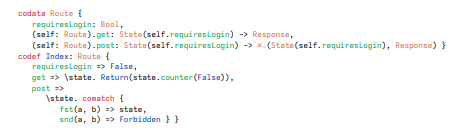
In the object-oriented decomposition, adding the following Admin route is now a local change. Note that the rearrangement works both ways: we could transpose the program back into functional decomposition to add another method.
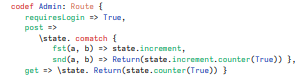
Similar problems of modularity appear in many applications. Functional languages force us to always choose the same extensibility dimension for every type: We can extend data types with new observations, but we cannot easily extend types with new constructors. If the programming language would support both programming paradigms equally well, this choice would not be forced on the programmer by the language, but the programmer would have the choice for each type.

3.3 Verifying Properties on Routes

In addition to the ability to increment the counter by sending a POST request to the Admin route, we may also want to allow explicitly setting a counter value. Updating the counter to a value should be idempotent, i.e. calling the route more than once should have the same effect. The HTTP PUT method is supposed to capture this behavior, but how can we enforce it in our code? This leads us to another benefit of the object-oriented style in that we can express such properties extrinsically but still as part of the interface (compare 2.2):

3.4 The Proof Expression Problem

The classical example of the expression problem [Wadler 1998] concerns extending implementations of term languages by new constructors as well as functions on expressions like print or eval. Very similar problems arise when formalizing programming languages in proof assistants, where one might want to extend the formalization both by new syntax and by new theorems. In Appendix C, we explore how the proof expression problem manifests differently in an object-oriented proof assistant as opposed to a functional one.

:::info
Authors:

  1. David Binder
  2. Ingo Skupin
  3. Tim Süberkrüb
  4. Klaus Ostermann

:::

:::info
This paper is available on arxiv under CC 4.0 license.

:::

Sign Up For Daily Newsletter

Be keep up! Get the latest breaking news delivered straight to your inbox.
By signing up, you agree to our Terms of Use and acknowledge the data practices in our Privacy Policy. You may unsubscribe at any time.
Share This Article
Facebook Twitter Email Print
Share
What do you think?
Love0
Sad0
Happy0
Sleepy0
Angry0
Dead0
Wink0
Previous Article Yes, My Orange iPhone 17 Pro Turned Pink After I Did This. Here's How Yours Could Too Yes, My Orange iPhone 17 Pro Turned Pink After I Did This. Here's How Yours Could Too
Next Article Google and Back Market partner to help breathe new life into your old laptop Google and Back Market partner to help breathe new life into your old laptop
Leave a comment

Leave a Reply Cancel reply

Your email address will not be published. Required fields are marked *

Stay Connected

248.1k Like
69.1k Follow
134k Pin
54.3k Follow

Latest News

the United States delivered the magnetic core of the fusion reactor
Computing
Sovereign payment service Wero is still stuck with AWS, but vows to improve
Software
7 good reasons to use Vivaldi
News
now generate Excel files, PDFs and much more directly
Gaming

You Might also Like

the United States delivered the magnetic core of the fusion reactor
Computing

the United States delivered the magnetic core of the fusion reactor

6 Min Read
When Meta replaces its moderators with… the AI ​​they trained
Computing

When Meta replaces its moderators with… the AI ​​they trained

3 Min Read
the electric city car at 25,000 euros is official
Computing

the electric city car at 25,000 euros is official

5 Min Read
the new smartphone reference is already being prepared!
Computing

the new smartphone reference is already being prepared!

4 Min Read
//

World of Software is your one-stop website for the latest tech news and updates, follow us now to get the news that matters to you.

Quick Link

  • Privacy Policy
  • Terms of use
  • Advertise
  • Contact

Topics

  • Computing
  • Software
  • Press Release
  • Trending

Sign Up for Our Newsletter

Subscribe to our newsletter to get our newest articles instantly!

World of SoftwareWorld of Software
Follow US
Copyright © All Rights Reserved. World of Software.
Welcome Back!

Sign in to your account

Lost your password?