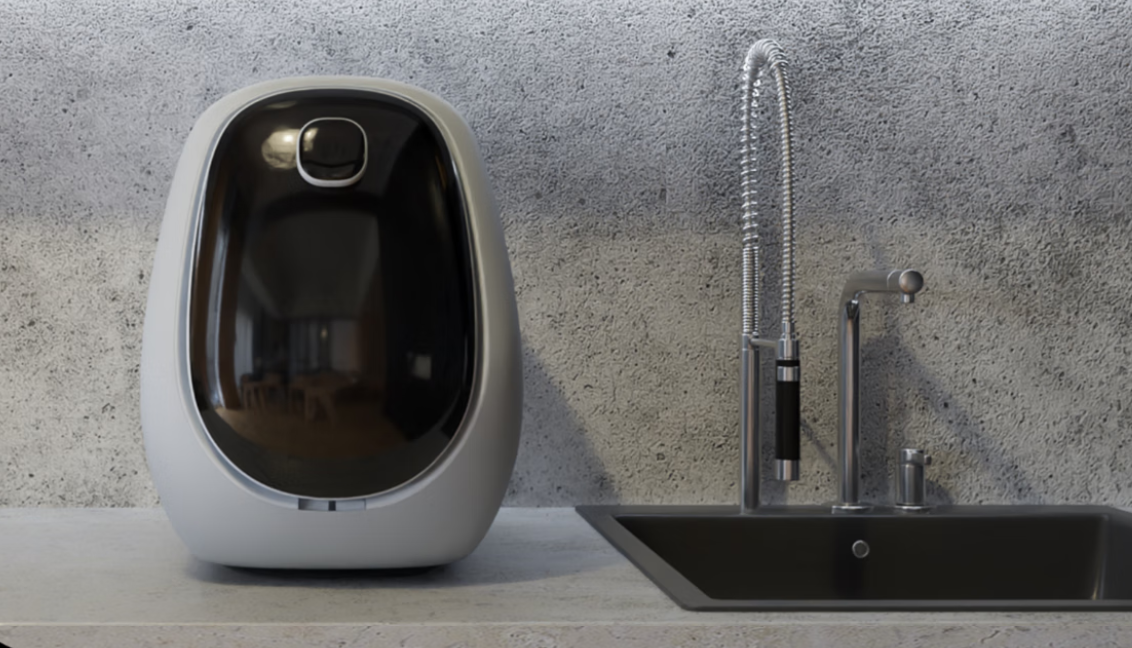
As traditional dishwasher products continue to focus on large capacity and built-in installation, smaller and more immediate cleaning solutions are emerging as a new direction in the market. Chinese tech startup LICURV has introduced a compact dishwasher that attempts to offer an alternative approach for household kitchens through a different technical design.
The company says a single plate can be cleaned in about five seconds, compared with the 30 minutes to two hours typically required for a full cycle in traditional dishwashers.
The product’s core feature is its rapid cleaning mechanism. The device uses a water-flow technology known as cavitation jetting, in which high-speed water generates tiny bubbles. When these bubbles collapse on the surface of tableware, they create localized micro-jets that help dislodge attached residues.
Combined with water temperatures of around 75°C, the company says the system can achieve relatively efficient cleaning in certain scenarios without the need for additional detergents, while also providing a degree of sterilization. Compared with traditional dishwashers, which typically require tens of minutes per cycle, this type of device focuses more on the immediate cleaning of individual items.
In terms of design, the compact dishwasher has a relatively small footprint, measuring roughly 30 to 40 centimeters on each side. It can be connected to a tap or operated with an external water tank, which lowers installation requirements.

The device also features a plug-and-play, portable design that requires no complex installation and can be placed directly on a countertop. The company positions the product for use in small kitchens, rental apartments, or office spaces with limited room, as well as for single-person households and small families.
In addition to cleaning tableware, the device also offers modes for washing fruits and vegetables, as well as small items such as teaware and baking utensils. Its fruit and vegetable mode uses lower water pressure and water temperatures of around 45°C to help reduce potential damage to the surface of produce while enabling quick rinsing.
However, based on current user feedback, the product still has some areas for improvement. Water residue may remain on the surface of dishes, and cleaning times can be longer when dealing with heavily greasy items. Overall, this type of compact device is closer to an instant cleaning tool rather than a full dishwasher solution in the traditional sense.

As kitchen appliances increasingly move toward more compact and scenario-based designs, products like this reflect new attempts by the industry to explore different product formats. Such devices aim to fill the gap between traditional full-size dishwashers and manual washing, offering a potential solution for immediate, small-batch cleaning.
However, their market prospects will likely depend on several factors, including technological reliability, actual cleaning performance, product pricing, and consumers’ willingness to adopt new types of kitchen tools.