The industry is vibrating with a specific kind of anxiety.
You feel it. I feel it.
Every week, a new large language model drops, and someone on X confidently declares that it writes Python better than a senior developer on their third espresso. Tools from OpenAI, Anthropic, and GitHub Copilot aren’t novelties anymore. They’re table stakes.
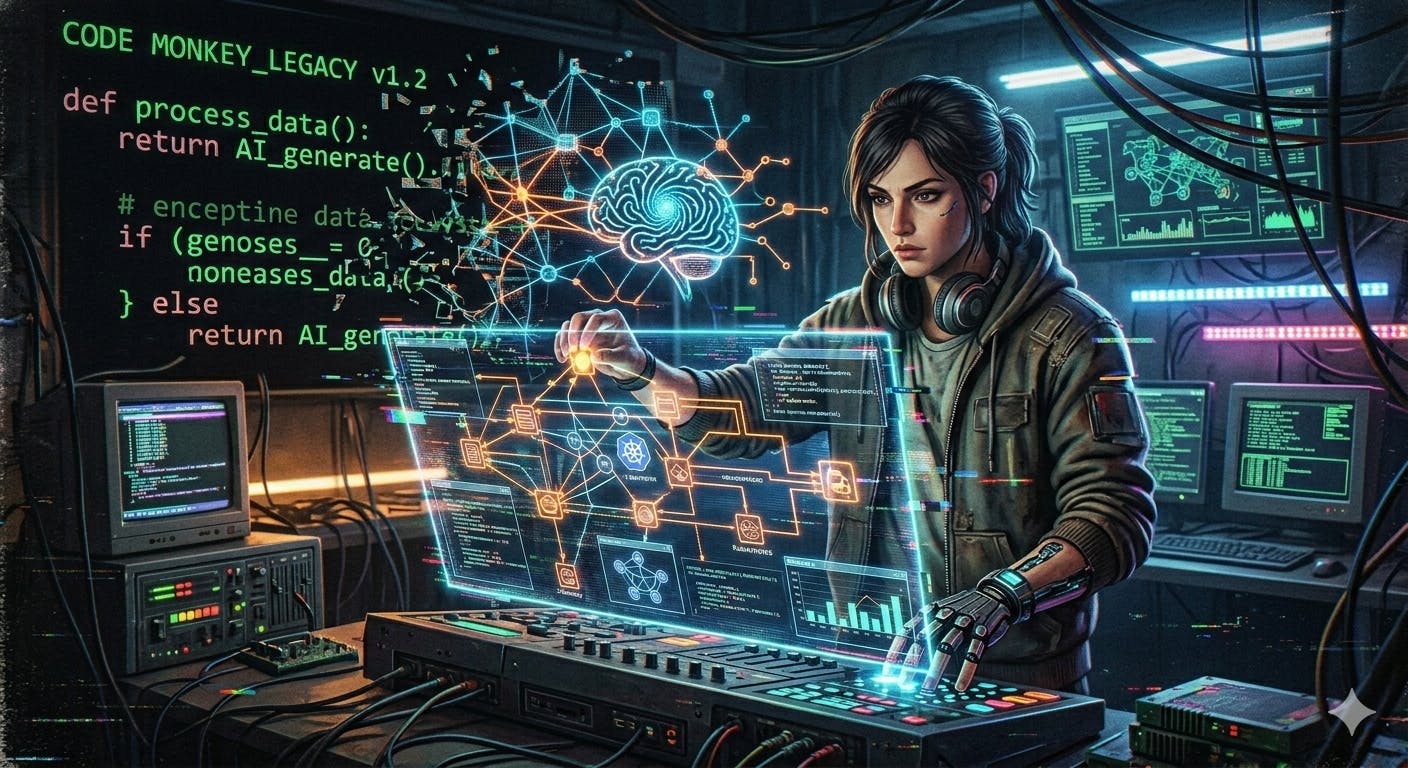
The “code monkey” – the engineer who survives by translating Jira tickets into syntax – is becoming an endangered species.
But here’s what the doomers skip: this isn’t the end of software engineering. It’s the end of shallow software engineering.
We’re not entering extinction. We’re entering evolution.
If you want to stay relevant, stop competing with AI on its home turf – speed and syntax – and start dominating where it still hallucinates: complexity, context, and consequences.
Welcome to the era of the Architect-Operator.
1. Own the Moat of Low-Level Complexity
AI is exceptional at generating React components and boilerplate APIs. It can scaffold CRUD services in seconds. Refactor obvious code smells. Even write decent test suites.
But it struggles when things get weird.
Performance cliffs. Race conditions that appear once a month under peak load. Memory fragmentation in long-running services. Debugging that requires understanding how the hardware actually breathes.
If you want to be hard to replace, you need depth. That might mean diving into concurrency models in C++, understanding how garbage collectors behave under pressure, or mastering distributed systems. While the industry runs toward higher-level abstractions, the engineers who understand what lies beneath become disproportionately valuable.
Here’s a simple rule:
If an AI can generate the solution in one clean prompt, your job is at risk. If solving the problem requires understanding race conditions across microservices deployed in multiple regions, your job is a fortress.
Abstractions rise. Complexity doesn’t disappear – it shifts downward.
2. Move From “How” to “Why” – Become a Product Engineer
In the old world, 80% of your job was answering: “How do I implement this function?”
Today, that question is often answered in seconds.
Your value now lies in asking: “Why are we building this at all?”
AI can implement a feature. It can’t validate whether the feature should exist. It doesn’t understand your churn metrics, pricing experiments, or that your users in Barcelona behave differently from those in New York. It doesn’t feel the weight of technical debt compounding quietly in the background.
Engineers who develop product intuition move from being cost centers to revenue multipliers. They think in terms of user journeys, trade-offs, and business impact.
This shift – from “how” to “why” – separates someone who writes code from someone who shapes outcomes.
3. Build the Operational Edge
If AI can write 1,000 lines of code in ten seconds, who ensures it doesn’t melt production?
The future belongs to engineers who master the process of deployment, not just the act of development.
Telemetry. Not just “Is the service up?” but “Why is the 99th percentile latency spiking in this specific microservice?” You need to understand logs, metrics, traces, and how they connect.
CI/CD pipelines. Engineers who design robust pipelines, enforce quality gates, and automate intelligently become leverage multipliers for entire teams.
Security and compliance. AI can introduce subtle vulnerabilities without realizing it. It doesn’t instinctively understand data residency constraints or regulatory nuance. Humans do.
When code generation becomes cheap, reliability becomes expensive.
4. Edge-Case Reality Over LeetCode Intuition
Many engineers spend hundreds of hours on algorithmic puzzles. There’s value in that.
But AI can solve “Median of Two Sorted Arrays” in milliseconds.
The real world isn’t a tidy algorithmic playground. It’s an edge-case jungle. The happy path is easy. The unhappy path is where careers are made.
What happens when a database connection drops halfway through a write? A user loses Wi-Fi during payment? A background job runs twice because of a retry storm?
These aren’t contrived puzzles. They’re messy, context-rich problems with business implications.
AI is strong at generalized patterns. Humans are strong at context-specific judgment.
5. The Soft Moat: Trust and Communication
We sometimes joke that we became engineers so we wouldn’t have to talk to people.
That luxury is gone.
In a world where code is abundant, trust is scarce.
Your ability to explain trade-offs to non-technical stakeholders, lead calmly during incidents, navigate ambiguity, and mentor junior engineers isn’t a “nice to have.” It’s a differentiator.
During downturns, companies don’t just retain the most technically competent engineers. They retain the ones who elevate the room.
Your network becomes a career shock absorber. The stronger it is, the softer the landing when the market shifts.
6. Use AI Relentlessly – or Be Outpaced
Here’s the paradox: to survive AI, you must embrace it.
Engineers who use AI tools daily will dramatically outpace those who resist. AI should be your pair programmer, refactoring assistant, documentation generator, and test scaffolder.
But remember: AI amplifies taste and judgment. It doesn’t replace them.
A weak engineer with AI becomes faster at producing mediocrity. A strong engineer with AI becomes unfairly productive.
The gap between the top 20% and everyone else is about to widen.
The Verdict
AI is the bear. You don’t have to be faster than the bear. You have to be more adaptive than the engineer who refuses to learn it.
Use AI aggressively. Let it handle the boilerplate. Let it make you faster.
But double down on what it still lacks: deep systems thinking, product judgment, operational excellence, edge-case resilience, and human trust.
The code monkey is fading. The Architect-Operator – the engineer who understands systems, outcomes, and consequences – is rising.
In 2026 and beyond, relevance won’t belong to those who type the fastest.
It will belong to those who think the deepest.