By using this site, you agree to the Privacy Policy and Terms of Use.
Accept
World of SoftwareWorld of SoftwareWorld of Software
  • News
  • Software
  • Mobile
  • Computing
  • Gaming
  • Videos
  • More
    • Gadget
    • Web Stories
    • Trending
    • Press Release
Search
  • Privacy
  • Terms
  • Advertise
  • Contact
Copyright © All Rights Reserved. World of Software.
Reading: DoorDash Builds LLM Conversation Simulator to Test Customer Support Chatbots at Scale
Share
Sign In
Notification Show More
Font ResizerAa
World of SoftwareWorld of Software
Font ResizerAa
  • Software
  • Mobile
  • Computing
  • Gadget
  • Gaming
  • Videos
Search
  • News
  • Software
  • Mobile
  • Computing
  • Gaming
  • Videos
  • More
    • Gadget
    • Web Stories
    • Trending
    • Press Release
Have an existing account? Sign In
Follow US
  • Privacy
  • Terms
  • Advertise
  • Contact
Copyright © All Rights Reserved. World of Software.
World of Software > News > DoorDash Builds LLM Conversation Simulator to Test Customer Support Chatbots at Scale
News

DoorDash Builds LLM Conversation Simulator to Test Customer Support Chatbots at Scale

News Room
Last updated: 2026/03/13 at 10:48 AM
News Room Published 13 March 2026
Share
DoorDash Builds LLM Conversation Simulator to Test Customer Support Chatbots at Scale
SHARE

DoorDash has developed a simulation and evaluation flywheel to accelerate the development and testing of large language model (LLM) powered customer support chatbots. The system allows engineers to run hundreds of simulated conversations within minutes, significantly speeding experimentation cycles. Context engineering improvements validated through this framework reduced hallucination rates by roughly 90 percent before deployment.

As DoorDash noted in a LinkedIn post, sharing this work,

The fundamental challenge is validating LLM-based support systems before production: How do you test a chatbot that never answers the same way twice?

Customer support automation has traditionally relied on deterministic decision trees, where users follow predefined paths based on menu selections or keywords. Such workflows allowed developers to validate changes with conventional tests. LLM-powered agents, however, handle natural conversations, meaning small adjustments to prompts, context, or backend integrations can produce unpredictable outcomes across multiple conversation paths.

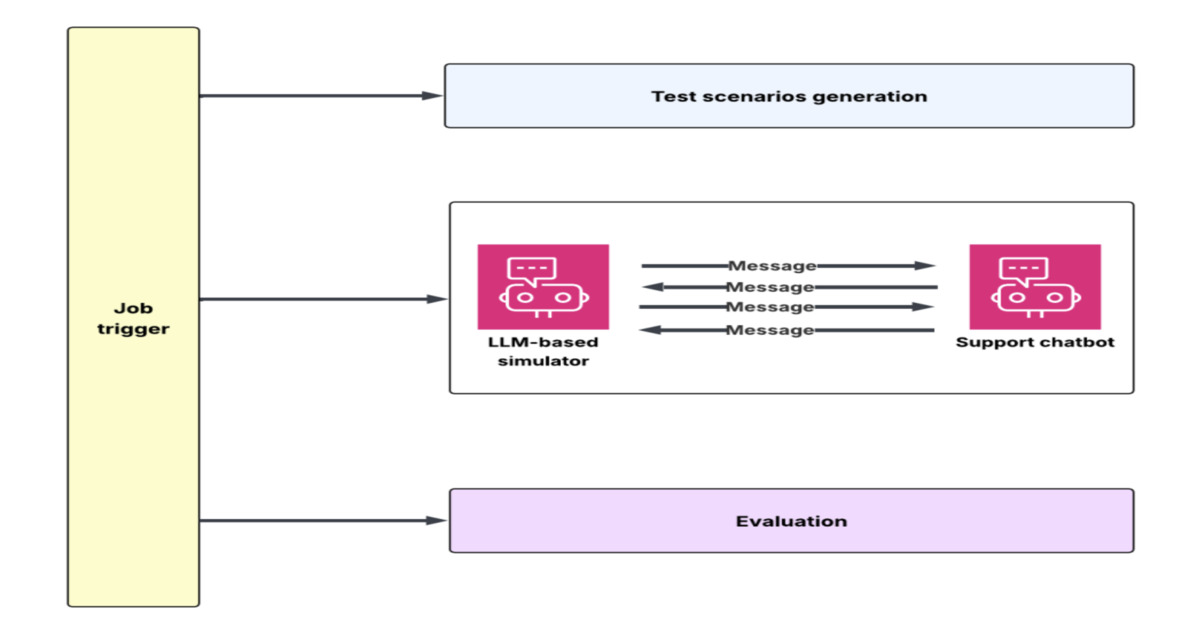
To address this, DoorDash built an offline experimentation framework combining an LLM-powered customer simulator with an automated evaluation system. The simulator generates multi-turn conversations reflecting real customer interactions, using historical support transcripts to derive customer intents, conversation flows, and behavioral patterns. Backend dependencies, such as order lookups or refund workflows, are reproduced with mocked service APIs, enabling realistic operational scenarios.

Simulation Workflow Overview (Source: DoorDash Blog Post)

In the simulation environment, an LLM plays the customer while the production chatbot responds as it would in a real interaction. The simulator adapts to the chatbot’s responses, handling scenarios such as clarification requests, frustration signals, or repeated issues. Alongside the simulator, an automated evaluation framework classifies outcomes against predefined policies and metrics, including compliance, hallucination rates, tone, and task completion accuracy. Simulator and evaluation together form a continuous development loop. Engineers identify failure cases, add evaluation checks, and generate additional simulations targeting those scenarios. Prompt adjustments, retrieval strategies, or context improvements are validated across hundreds of conversations before deployment.

The flywheel also addressed hallucinations caused by overloaded context windows. Early launches revealed that excessive raw events and logs could mislead the chatbot, producing errors such as misinterpreted fields or invalid policy suggestions. Engineers implemented a binary hallucination metric and test scenarios derived from observed failures. Iterating with the flywheel, they developed a case state layer that structures tool history for the chatbot. The simulator enabled rapid testing of multiple context configurations and prompt strategies, quickly exposing failure modes and validating improvements.


Simulation-Evaluation Flywheel (Source: DoorDash Blog Post)

The DoorDash flywheel follows a structured problem-to-production workflow. Engineers begin by identifying a customer issue, often through manual review of support cases or early simulations. They then create an LLM-as-judge evaluation to detect the failure mode, calibrating it against human judgment to ensure accuracy. Once the evaluation is trusted, the simulator generates conversations representing the current system, and evaluations identify failures. Engineers analyze errors, adjust prompts, context handling, or tool outputs, and iterate until the evaluation pass rate reaches acceptable thresholds. Before deployment, guardrails such as hallucination detection, tone assessment, and issue classification are validated with the full evaluation suite, ensuring improvements hold in live traffic.

Sign Up For Daily Newsletter

Be keep up! Get the latest breaking news delivered straight to your inbox.
By signing up, you agree to our Terms of Use and acknowledge the data practices in our Privacy Policy. You may unsubscribe at any time.
Share This Article
Facebook Twitter Email Print
Share
What do you think?
Love0
Sad0
Happy0
Sleepy0
Angry0
Dead0
Wink0
Previous Article A near-20% price cut brings the Nintendo Switch 2 + Mario Kart World bundle into must-buy territory A near-20% price cut brings the Nintendo Switch 2 + Mario Kart World bundle into must-buy territory
Next Article The End of the Copilot: Why 2026 is Seeing a Shift From “AI as a Sidekick” to “AI as a Teammate” | HackerNoon The End of the Copilot: Why 2026 is Seeing a Shift From “AI as a Sidekick” to “AI as a Teammate” | HackerNoon
Leave a comment

Leave a Reply Cancel reply

Your email address will not be published. Required fields are marked *

Stay Connected

248.1k Like
69.1k Follow
134k Pin
54.3k Follow

Latest News

7 Iconic 20th-Century Ad Campaigns and What Today’s Marketers Can Learn From Them | HackerNoon
Computing
iPhone 17 Pro is Now Part of MLB History
News
Anker Solix power station deal: 58% off at Amazon
News
Taylor Soper named director of Seattle’s AI House after remarkable run at GeekWire
Computing

You Might also Like

iPhone 17 Pro is Now Part of MLB History
News

iPhone 17 Pro is Now Part of MLB History

3 Min Read
Anker Solix power station deal: 58% off at Amazon
News

Anker Solix power station deal: 58% off at Amazon

2 Min Read
USB-C Solved The Biggest Problems The Creator Had With USB Connectors – BGR
News

USB-C Solved The Biggest Problems The Creator Had With USB Connectors – BGR

4 Min Read
This foldable phone could support modular camera lens add-ons
News

This foldable phone could support modular camera lens add-ons

3 Min Read
//

World of Software is your one-stop website for the latest tech news and updates, follow us now to get the news that matters to you.

Quick Link

  • Privacy Policy
  • Terms of use
  • Advertise
  • Contact

Topics

  • Computing
  • Software
  • Press Release
  • Trending

Sign Up for Our Newsletter

Subscribe to our newsletter to get our newest articles instantly!

World of SoftwareWorld of Software
Follow US
Copyright © All Rights Reserved. World of Software.
Welcome Back!

Sign in to your account

Lost your password?