Some ads sell products. The rare ones change culture. The 20th century gave us both kinds, and the gap between them is everything. Before social media, algorithmic targeting, and A/B testing, the campaigns that broke through did so with nothing but a sharp idea, honest copy, and a deep understanding of what people actually wanted to feel.
In 1999, Ad Age ranked the 100 greatest campaigns of the century. What’s striking about that list isn’t how dated it looks. It’s how relevant it still is. The principles behind the best work haven’t changed. Only the platforms have.
Here are 7 campaigns from that era that every marketer should know, why they worked, and what they can still teach you right now.
1. Volkswagen, “Think Small” (1959)
Agency: Doyle Dane Bernbach · Ad Age ranking: #1
There is no campaign more studied, more referenced, or more deserving of the top spot. In 1959, Volkswagen needed to sell a small, odd-looking German car to an American market obsessed with size, chrome, and Cadillacs. In post-war America, that was a nearly impossible brief. And not just commercially, but culturally.
Doyle Dane Bernbach (DDB) did the opposite of everything the industry expected. Art director Helmut Krone placed a tiny photo of the Beetle in the upper left corner of a full page, surrounded by nothing but white space. Copywriter Julian Koenig wrote two words underneath: Think small.
Ad Age described DDB as having given “advertising permission to surprise, to defy and to engage the consumer without bludgeoning him.” The campaign worked. According to Ad Age’s historical record, DDB created six of the greatest 100 campaigns of the century, and Think Small was the crown jewel. Annual U.S. Beetle sales climbed from 120,000 units in 1959 to over 423,000 by 1968.
Why it’s timeless: Truth delivered with confidence is more persuasive than any exaggerated claim. In a feed full of loud creatives and inflated promises, this lesson is more relevant now than ever.
2. Coca-Cola, “The Pause That Refreshes” (1929)
Agency: D’Arcy Co. · Ad Age ranking: #2
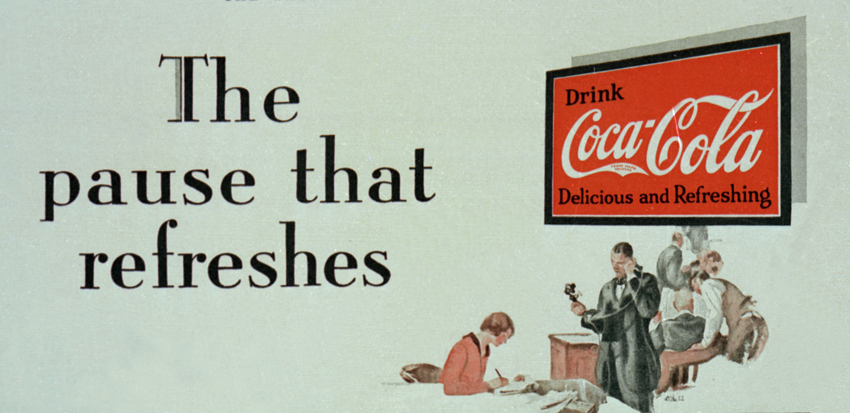
Long before “emotional branding” had a name, Coca-Cola was already doing it. “The pause that refreshes” wasn’t selling a drink; it was selling a moment. A feeling. A permission to stop, breathe, and enjoy something small.
The slogan was developed by Archie Lee at D’Arcy Advertising, working closely with Coca-Cola president Robert Woodruff, who — according to the Coca-Cola Company’s own historical archive — believed the role of advertising was “making people like you,” not selling a product. That philosophy shaped everything. Launched in 1929, as the Coca-Cola Company’s advertising history confirms, the slogan became the anchor of the brand’s identity through the Depression era, positioning Coca-Cola as a democratic, affordable pleasure available to everyone at any moment of the day.
According to the Coca-Cola Company’s historical archive, Woodruff and Lee also commissioned artist Haddon Sundblom in 1931 to paint the now-iconic red-suited Santa Claus for Coca-Cola ads, further cementing the brand’s connection to warmth, shared moments, and human feeling. Everything that followed built on this emotional foundation.
Why it’s timeless: People don’t buy products, they buy feelings. Coca-Cola figured that out in 1929. Every brand building emotional campaigns today is working from the same playbook.
3. Marlboro, The Marlboro Man (1955)
Agency: Leo Burnett Co. · Ad Age ranking: #3
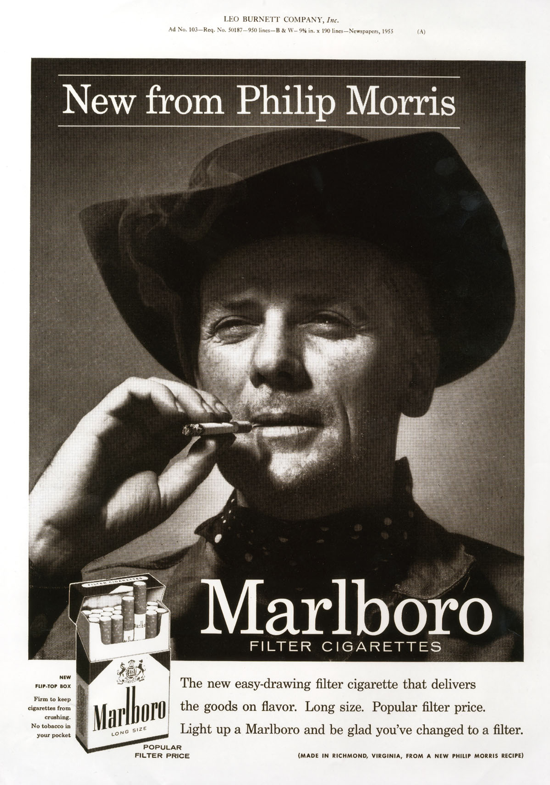
Marlboro was originally marketed as a women’s cigarette, sold under the genteel tagline “Mild as May.” Philip Morris hired Leo Burnett in November 1954 to fix that, and what Burnett created was one of the most dramatic brand repositionings in advertising history.
According to Ad Age’s encyclopedia entry on Leo Burnett, the agency “took a personal role in repositioning the brand from a women’s cigarette to a men’s with the introduction of the Marlboro Man campaign.” The first ads featured cowboys. As documented in Ad Age’s tobacco marketing archive, Burnett told Philip Morris:
“The cowboy is an almost universal symbol of admired masculinity.”
Research had found that smokers considered filter cigarettes “slightly effeminate,” so every element was designed to counteract that perception. By 1962, Philip Morris settled on the cowboy as the exclusive Marlboro image; by 1963, he had a home: Marlboro Country.
In 1999, Ad Age named the Marlboro Man campaign the third most important of the century and the cowboy the top advertising icon of the century, one of four icons created by Leo Burnett to make the list. As Ad Age noted, no other single agency had more than one. Philip Morris itself later called Marlboro “the No. 1 trademark in the world.”
Why it’s timeless: People buy who they want to become, not what a product does. The Marlboro Man sold an identity so completely that it transcended the product itself.
4. Nike, “Just Do It” (1988)
Agency: Wieden+Kennedy · Ad Age ranking: #4
In 1988, Nike was losing ground to Reebok, which had dominated the aerobics boom of the mid-80s. Wieden+Kennedy co-founder Dan Wieden needed a single line to unify a series of very different TV spots, and he wrote it the night before the client presentation.
The origin is surprising. As reported by NPR in their tribute following Wieden’s death in 2022, the phrase was inspired by the last words of convicted murderer Gary Gilmore before his execution: “Let’s do it.” Wieden changed two words and stripped it of its darkness. The first ad to carry the line featured an 80-year-old man named Walt Stack jogging across the Golden Gate Bridge — not a superstar athlete, just a person doing it. That deliberate inclusivity made the campaign speak to everyone.
As NPR documented, Nike grew its worldwide sales from $877 million in 1988 to $9.2 billion by 1998. Its share of the North American sport-shoe market climbed from 18% to 43% over the same decade.
“For some reason that line resonated deeply in the athletic community and just as deeply with people who had little or no connection to sports.”
Wieden said of the response. More than 35 years later, “Just Do It” is still running.
Why it’s timeless: The best slogans aren’t about the product, they’re about the person using it. “Just Do It” is a philosophy, not a tagline, and it speaks to something universal in human ambition.
5. De Beers, “A Diamond Is Forever” (1948)
Agency: N.W. Ayer & Son · Ad Age ranking: #6
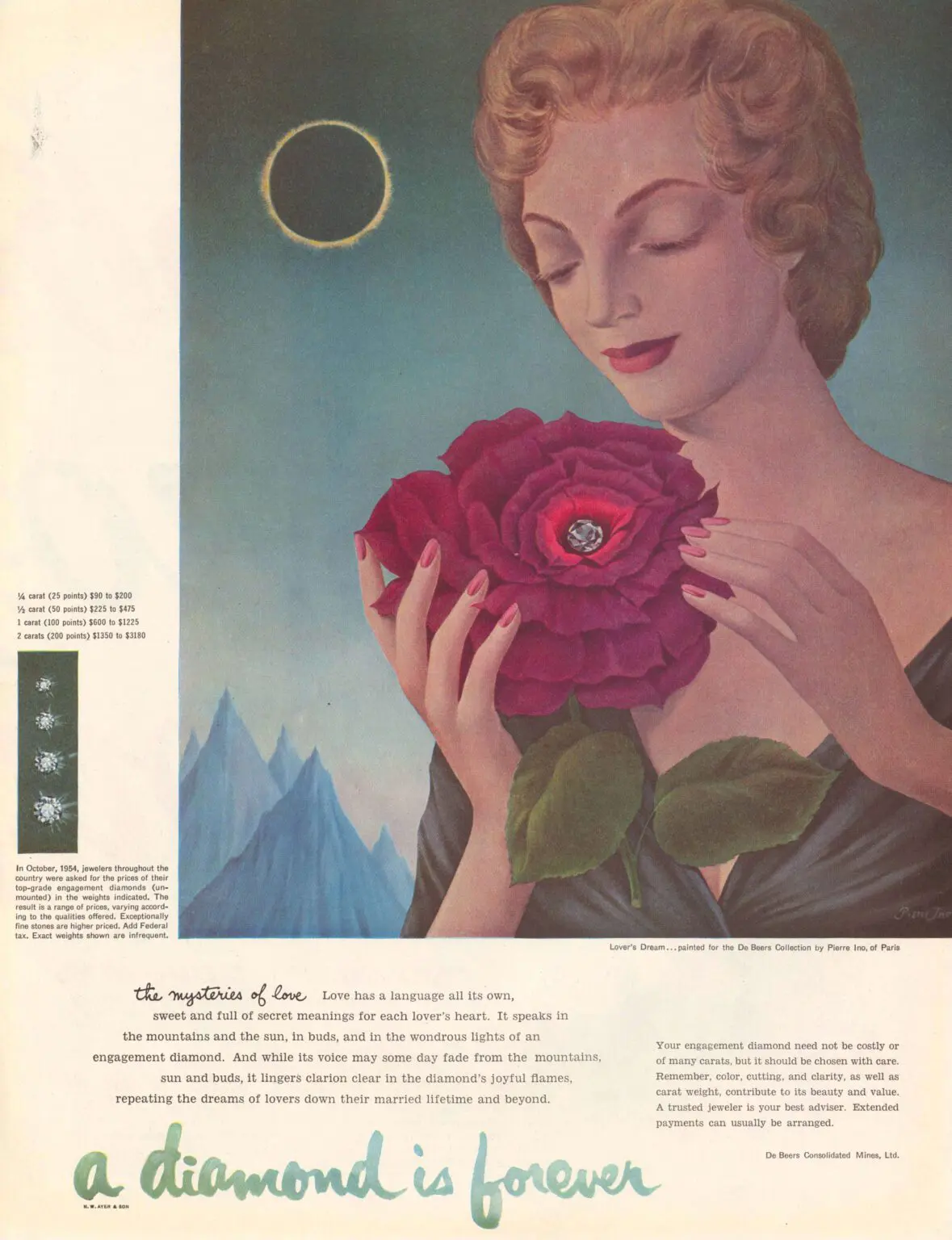
Few campaigns have shaped human behaviour as profoundly as this one. Before De Beers, diamond engagement rings were not a cultural norm. Fewer than 20% of American brides owned one by the end of the 1930s, as documented in Ad Age’s encyclopedia entry on De Beers.
In 1948, before a major agency presentation, N.W. Ayer copywriter Frances Gerety scribbled the line “A diamond is forever.” As Ad Age reported in its De Beers encyclopedia entry, the slogan “captured both the durability of the stone and the romantic aspirations of couples entering into marriage” and immediately became the mainstay of De Beers’ U.S. campaign. At the same time, N.W. Ayer developed the “Four Cs” of diamond buying — cut, color, clarity, and carat weight — framing the entire purchase category in De Beers’ own language.
The numbers are staggering. By the end of the 1940s, the share of married U.S. women who owned diamond engagement rings had risen to 60%, according to Ad Age. By the 1980s it surpassed 70%. When De Beers took the campaign to Japan in 1968, a market where fewer than 5% of women received diamond engagement rings at the time, that figure reached 60% by 1981, as documented by Ad Age. De Beers was spending $200 million a year in advertising across 34 countries at peak. Ad Age later voted “A Diamond Is Forever” the most iconic advertising slogan of the 20th century.
Why it’s timeless: It’s the ultimate proof that advertising can create cultural norms, not just reflect them. De Beers didn’t sell diamonds, they made diamonds feel necessary.
6. Avis, “We Try Harder” (1963)
Agency: Doyle Dane Bernbach · Ad Age ranking: #10
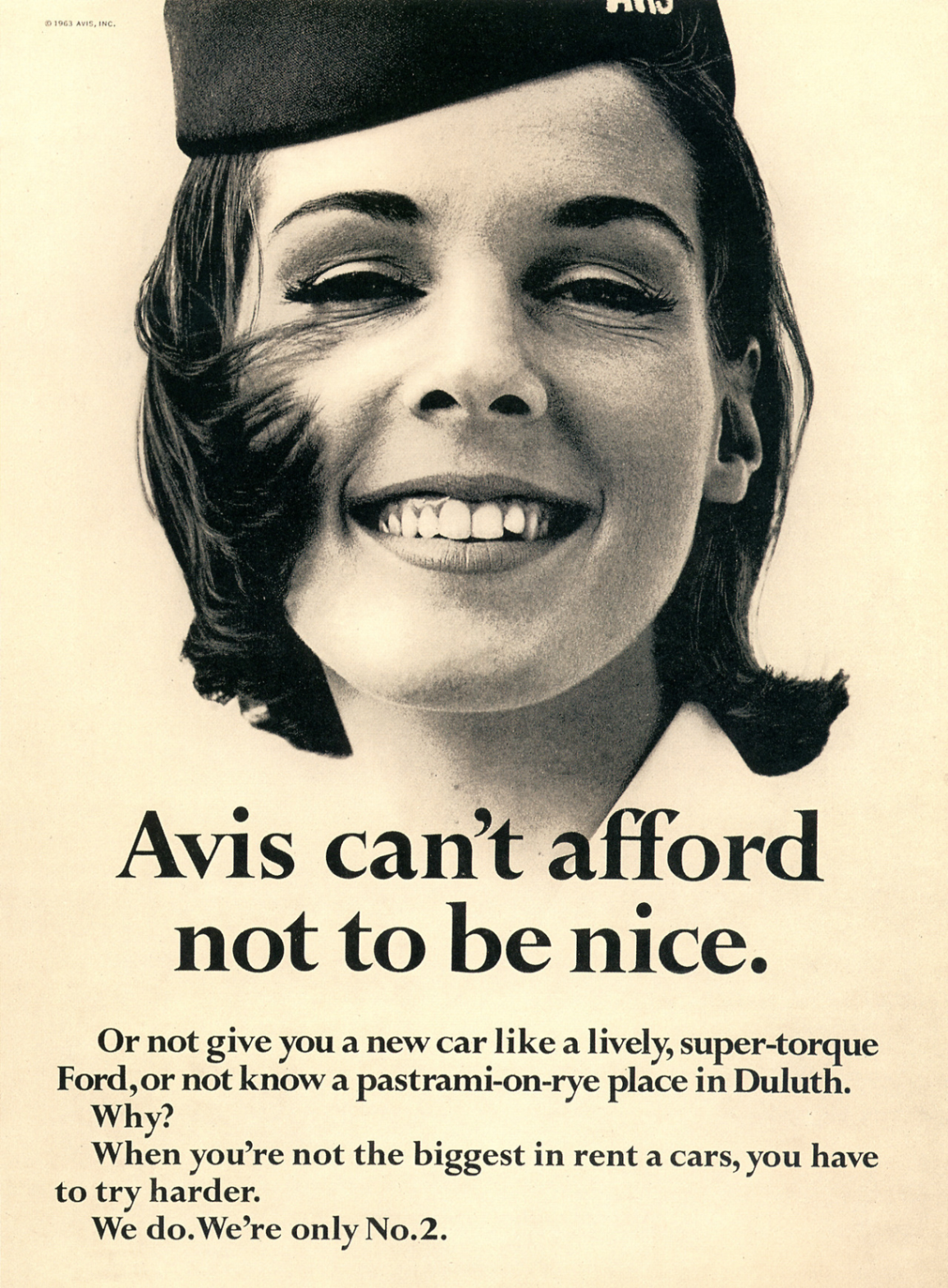
DDB appears twice on this list because they earned it twice. “We Try Harder” was born from a brief that would have scared off almost any other agency.
In 1962, Avis had only an 11% market share and had not turned a profit in 13 years, according to Campaign magazine’s historical account of the campaign. New CEO Robert Townsend called in DDB’s Bill Bernbach, who demanded 90 days to learn the company before writing a word. During that deep-dive, when DDB asked whether Avis had newer cars, more locations, or lower rates than Hertz, the answer to every question was no. “Well,” said Townsend, “we do try harder.” That honest admission became the brief.
Copywriter Paula Green, whom Campaign described as having gone “completely against the prevailing Madison Avenue philosophy that ads must never acknowledge a brand weakness,” turned it into “When you’re only No. 2, you try harder. Or else.” David Ogilvy later praised the campaign as “diabolical positioning,” as recorded in Slate’s 2013 investigation of the Hertz-Avis rivalry. Fred Danzig, then an Ad Age reporter, captured the industry reaction when the campaign launched:
“The audacity, the originality, the freshness, the life, the sassy spirit… it forever changed the way Madison Avenue communicated to the world.”
The results were immediate. Within a year, Avis turned a $3.2 million loss into a $1.2 million profit, its first in over a decade, as confirmed by both Campaign and Slate. Hertz executives, Slate reported, projected that by 1968, Avis might need a new campaign because it would no longer be No. 2.
Why it’s timeless: Honesty about your weaknesses, delivered with confidence, builds more trust than hollow claims of superiority. In a world of inflated promises, admitting what you’re not is a surprisingly powerful differentiator.
7. Apple, “1984” (1984)
Agency: Chiat/Day · Ad Age ranking: #12
It aired once, during Super Bowl XVIII on January 22, 1984. It never ran on national television again. And it remains the most discussed commercial in advertising history.
Directed by Ridley Scott, the ad depicted a grey, dystopian world of conformity being shattered by a lone woman hurling a sledgehammer through a screen showing “Big Brother.” According to Ad Age’s archive of the creatives behind the spot, it was written by Steve Hayden, art directed by Brent Thomas, and creative directed by Lee Clow, with Ridley Scott brought in while he was in London on “Blade Runner.” As Clow told Ad Age:
“Steve Jobs’ simple challenge was, ‘I think Macintosh is the greatest product in the history of the world. Make an ad that tells them that.'”
Apple used the commercial to position the Mac as the antidote to IBM’s domination of the information age, two days before the computer’s launch.
What makes the story richer is how close it came to never airing. Apple’s board of directors hated the spot and tried to kill it. Chiat/Day executive Jay Chiat held onto the Super Bowl airtime regardless. The ad ran once and generated massive earned media far beyond anything a single TV buy could have produced. Ad Age named “1984” the Commercial of the Decade for the 1980s. As Ad Age’s profile of Ridley Scott noted, the spot “effectively turned the Super Bowl into a platform for mini-blockbuster entertainment”, a legacy that defines Super Bowl advertising strategy to this day.
Why it’s timeless: The ad barely showed the product. It told a story about who Apple customers were — rebels, individuals, people who think differently. Forty years later, Apple still builds campaigns around that same identity.
What All 7 Have in Common
Looking across these campaigns, the patterns are impossible to miss.
None of them led with features. Not one. They led with feelings, identities, moments, and ideas. They treated their audiences as intelligent people capable of being moved, not consumers to be pushed.
They were also all built on a single, clear idea, one thought, executed with total conviction. And most importantly, they were honest. Sometimes uncomfortably so. Avis admitted they were second. De Beers built an entire campaign on a stone’s one real attribute: it doesn’t break. That kind of radical honesty in advertising is still rare, and still extraordinarily effective when you have the nerve to try it.
In 2026, with AI creative tools, performance dashboards, and algorithmic targeting dominating how we think about advertising, it’s easy to forget that the fundamentals haven’t changed. The best campaigns still earn attention rather than buy it. They still build something people want to belong to. They still tell one true thing in a way that makes people feel seen.
That’s what made these campaigns timeless. And that’s what will make the next great campaign timeless, too.