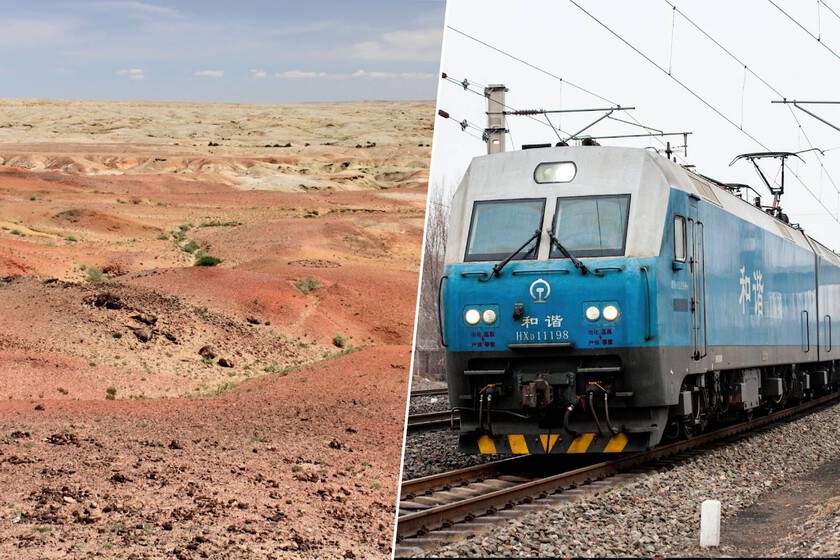
China and Mongolia have been trying for more than a decade to solve one of Asia’s most costly logistics problems: getting coal and metals from Mongolian mines to Chinese steel plants without using endless caravans of trucks. The solution: a railway corridor between the Tavan Tolgoi mines and the Chinese network capable of transporting up to 50 million tons of cargo, as the Mongolian president declared.
The project has been on the table since 2012 and, after delays and stoppages, the first part was completed. In 2025, the second phase began: a cross-border link of just 19.5 kilometers in length at the Gashuunsukhait-Gantsmod pass, the completion of which is scheduled for 2027. The fact that China is capable of remodeling a train station in one night but takes 22 months to build only eight kilometers anticipates the technical and orographic challenges it faces.
Context. Mongolia has some of the largest reserves of coal and copper in the world. Tavan Tolgoi deserves special mention, one of the largest unexploited coking coal deposits on the planet, with an estimated 6.4 billion tons of this resource. Copper and gold are also well served in Oyu Tolgoi. In fact, it has a projected production for 2030 of 500,000 tons of copper per year. But Mongolia is landlocked. China is historically the largest importer of Mongolian coal. As? With lines of trucks crossing the desert.
From an environmental and economic point of view, the change towards railways is the most sensible but it has fine print: the Mongolian railway network has 1,815 kilometers of Soviet gauge track, of which the majority are part of the TransMongolia line that links Russia with China. The network is practically single track, with limited capacity and vulnerable to snowfall in winter and Gobi sand in the southern section.
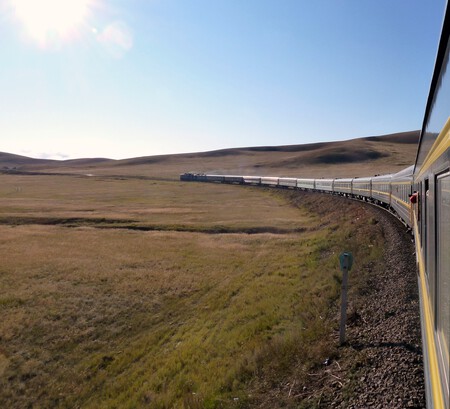
Trans-Mongolian crossing the Gobi Desert. PIERRE ANDRE LECLERCQ
Why is it important. Because this fully completed corridor will close a strategic logistics chain for China at a time when there is tension in the supply of critical raw materials. Without going any further, it already faced a veto of Australian coal a few years ago, having to look for supplies in Russia and Mongolia.
Mongolia also gains by improving its coal and metals export infrastructure. As stated by the Mongolian government, the average export volume will increase from 83 million tons to 165 million per year, which is an increase of 1.5 billion dollars. Of course, it reinforces its dependence on China: it already exports 90% of its raw materials.

First phase. The history of the Tavan Tolgoi–Gashuun Sukhait railway is checkered to say the least: it began in 2012, when Mongolian Mining Corporation announced a railway from Ukhaa Khudag to the Gashuun Sukhait border crossing, with completion scheduled for 2015.
With the earthworks very advanced, the work became entrenched due to both economic and political problems such as choosing what the track width should be. Work resumed in 2018 under new management. Finally, the line was inaugurated in 2022 with 233.6 kilometers in length crossing the Gobi Desert (258 km with auxiliary infrastructure), with 16 bridges and designed for loads of 25 tons per axle. According to Tavantolgoi Railway LLC and reported by AFP, the Price of a ton of coal fell from 32 dollars to 8.
The pending critical phase: the border. The Mongolian railway reaches the border from 2022, but the critical thing remained: coal could not cross to China by train. The main reason for being is pure engineering: Mongolia uses the Soviet width of 1,520 mm and China uses 1,435 mm, the international standard width. At the Gashuun Sukhait pass there was a physical gap that required the transshipment of goods, with the delays, costs and inconveniences that it entails.
They are going to solve it with a double track gauge, which extends both the Mongolian and Chinese lines, thus allowing trains from both systems to enter the area without transfers. This cross-border link will have a main road of 19.5 kilometers and includes bridge structures between 8 and 31 meters high, necessary to bridge the topographic difference between the two sides of the border. The Chinese side is being built by the state-owned company China Energy Investment Corporation and on the Mongolian side, Tavantolgoi Railway LLC.
A corridor full of challenges. The delay of the railway corridor project due to financial and political issues is just the tip of the iceberg of other challenges it has faced, ranging from the engineering problem of the track gauge to the extreme climate of the Gobi: the Mongolian section passes through one of the most inhospitable places on the planet, with temperature ranges ranging from -40 °C in winter to more than 40 °C in summer. It is no longer that it is uninhabitable, it is that it affects the structure of the road itself.
In WorldOfSoftware | 125 kilometers of water separate 140 million inhabitants. China is going to solve it with a mega railway tunnel
In WorldOfSoftware | China has built the highest bridge in the world and has done what it must: turn it into a show
Cover | Marcin Konsek and KUA YUE