Executive Summary of the Accenture-Anthropic Partnership
On March 25, 2026, Accenture, a global leader in consulting and technology services, unveiled Cyber.AI, an advanced cybersecurity solution powered by Claude, Anthropic’s cutting-edge AI model. This strategic collaboration marks one of the largest enterprise deployments of Claude, signifying a crucial milestone in demonstrating AI’s transformative potential in cybersecurity at the enterprise scale. Accenture’s deep expertise in cybersecurity, combined with Anthropic’s pioneering AI capabilities, has resulted in a platform designed to revolutionize how organizations secure their digital environments.
The partnership between Accenture and Anthropic is emblematic of the evolving landscape of AI-driven security operations centers (SOCs). Cyber.AI leverages Claude’s sophisticated natural language understanding and reasoning abilities, enabling security teams to detect, analyze, and respond to cyber threats with unprecedented speed and accuracy. This collaboration is not merely a technological integration; it represents a strategic alignment to address the rising complexity and volume of cyber threats faced by enterprises globally.
Accenture’s Cyber.AI solution is designed to empower organizations to securely scale their AI-driven cybersecurity frameworks. By embedding Claude’s advanced AI model into their security operations, Accenture offers enterprises an adaptable, intelligent system that can process vast amounts of security telemetry, automate threat hunting, and provide actionable insights in real-time. This integration supports continuous learning and adapts to evolving threat landscapes, ensuring that enterprises remain one step ahead of adversaries.
The successful deployment of Cyber.AI also underscores Anthropic’s positioning in the enterprise AI market. Claude’s ability to operate within the stringent security and compliance requirements of large organizations affirms its enterprise readiness, further catalyzing confidence in AI-powered solutions for critical operations. This partnership amplifies the momentum of enterprise AI spending, particularly in cybersecurity, which is projected to be one of the highest-value applications of AI technology in 2026 and beyond.
In summary, the Accenture-Anthropic partnership with Cyber.AI is a landmark case of AI integration in cybersecurity. It combines Accenture’s industry-leading consulting and cybersecurity expertise with Anthropic’s advanced AI capabilities to help enterprises transform their security posture. This case study explores the cybersecurity landscape in 2026, the technical architecture of Cyber.AI, implementation methodologies, and the tangible business outcomes realized by this AI-driven solution.
The Cybersecurity Challenge Landscape in 2026
By 2026, cybersecurity has evolved into one of the most critical and complex domains in enterprise IT. The proliferation of digital transformation initiatives, cloud adoption, and the exponential growth of connected devices have expanded the attack surface dramatically. Cyber adversaries have also leveraged AI and automation, increasing the sophistication, speed, and scale of attacks. As a result, organizations face an unprecedented volume of threats, including advanced persistent threats (APTs), ransomware, supply chain attacks, and zero-day vulnerabilities.
Traditional security operations centers (SOCs) have struggled to keep pace with this evolving threat landscape. Manual threat detection and response processes are increasingly inadequate in handling the velocity and variety of security events generated daily. According to industry reports, the average enterprise SOC receives millions of security alerts per day, with over 80% being false positives, leading to analyst fatigue and delayed responses to genuine threats.
Moreover, the cybersecurity talent shortage remains a significant barrier. Gartner and other analysts estimate a global shortage of over 3 million skilled cybersecurity professionals in 2026. This talent gap compounds operational challenges, forcing organizations to rely on automation and AI to augment limited human resources. AI-driven solutions have emerged as a strategic imperative to enhance threat detection accuracy, accelerate response times, and reduce operational costs.
The regulatory environment has also intensified. Governments worldwide have imposed stringent data protection and cybersecurity regulations, requiring enterprises to demonstrate continuous compliance and proactive risk management. Failure to meet these standards results in severe financial penalties and reputational damage, underscoring the need for robust, AI-enhanced security frameworks.
In this context, Cyber.AI addresses several critical cybersecurity challenges:
- Alert Overload and Noise Reduction: By leveraging Claude’s advanced natural language understanding, Cyber.AI contextualizes and prioritizes alerts, reducing false positives and focusing analyst attention on high-risk incidents.
- Threat Hunting and Incident Response Automation: The solution automates repetitive tasks such as log analysis, indicator of compromise (IOC) correlation, and initial incident triage, accelerating response times.
- Adaptive Learning: Cyber.AI continuously learns from new threat intelligence and operational feedback, dynamically adjusting detection models to emerging attack patterns.
- Scalability and Security: Designed to operate securely at scale, Cyber.AI supports complex enterprise environments with hybrid cloud and multi-cloud architectures.
These capabilities are critical as enterprises face an evolving threat landscape that demands not only advanced technology but also scalable, adaptable solutions integrated into their security operations. The deployment of Cyber.AI signals a broader industry trend where AI-driven cybersecurity platforms become essential to maintaining organizational resilience in 2026.
Organizations interested in understanding how AI tools are reshaping cybersecurity frameworks can explore detailed analyses of contemporary AI cybersecurity tools and their impact on threat detection and mitigation strategies. The Future of AI: Key Innovations and Trends to Wa
Statistics and Market Data Supporting Cybersecurity AI Adoption
- According to IDC, global spending on AI in cybersecurity is projected to exceed $45 billion by 2026, growing at a compound annual growth rate (CAGR) of 27% from 2023.
- Forrester reports that enterprises deploying AI-powered SOCs experience a 40-60% reduction in mean time to detect (MTTD) and mean time to respond (MTTR) to cyber incidents.
- Surveys indicate that over 70% of cybersecurity leaders consider AI critical or highly critical for their security strategies in 2026.
These data points underscore the urgent need for scalable, AI-driven cybersecurity solutions like Cyber.AI that combine advanced analytics, automation, and human expertise to address escalating threats.
Technical Architecture of Cyber.AI and Claude Integration
The foundation of Cyber.AI’s technical architecture is its seamless integration of Anthropic’s Claude AI model into Accenture’s cybersecurity platform. This architecture is designed to harness Claude’s advanced generative AI and natural language processing capabilities to enhance threat detection, analysis, and response across diverse enterprise environments.
Core Components of Cyber.AI Architecture
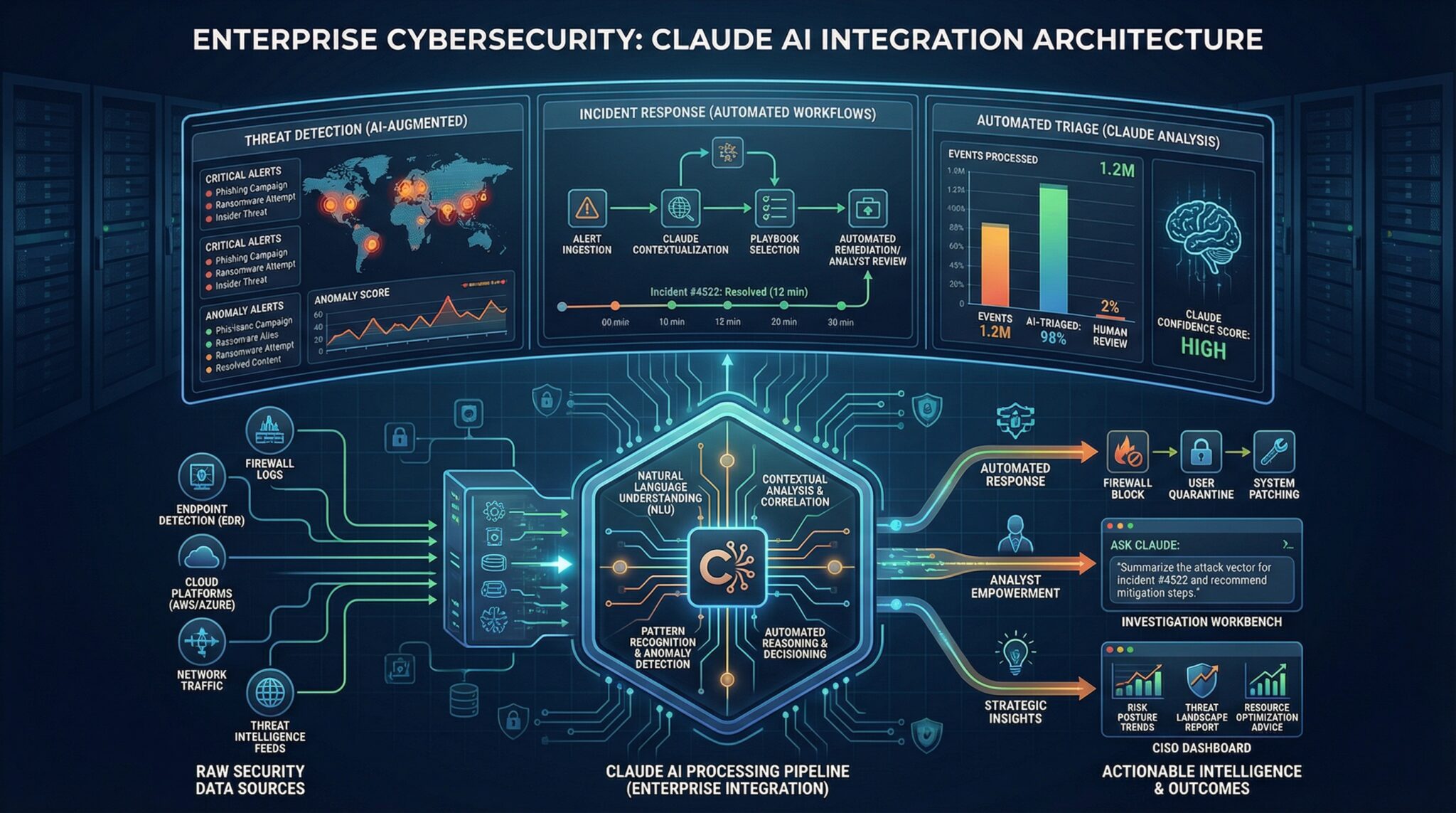
- Data Ingestion Layer: Cyber.AI ingests data from a wide range of sources, including network traffic logs, endpoint telemetry, cloud security logs, threat intelligence feeds, vulnerability scanners, and SIEM (Security Information and Event Management) systems. This layer supports high-throughput, low-latency data ingestion with support for structured and unstructured data formats.
- Preprocessing and Normalization: The ingested data is normalized into a unified schema to facilitate consistent analysis. This stage includes noise reduction, enrichment with contextual metadata, and correlation of disparate data points.
- AI Reasoning and Analysis Engine: At the heart of Cyber.AI is Claude, Anthropic’s AI model. Claude processes the normalized data using advanced natural language understanding and generative capabilities. This enables the system to interpret complex security events, perform anomaly detection, and generate human-readable threat narratives.
- Threat Intelligence Integration: Cyber.AI continuously integrates external threat intelligence and internal incident data to update its detection models. Claude uses this information to improve its contextual understanding and predictive capabilities.
- Automation and Orchestration Layer: Based on Claude’s analysis, Cyber.AI automates routine incident response workflows such as alert triage, IOC enrichment, containment actions, and ticketing. This layer is integrated with SOAR (Security Orchestration, Automation, and Response) platforms and ITSM (IT Service Management) tools.
- User Interface and Analyst Collaboration: Analysts interact with Cyber.AI through a sophisticated dashboard that presents prioritized alerts, AI-generated incident summaries, and recommended actions. The interface supports collaborative workflows, enabling human analysts to validate AI findings and provide feedback for continuous improvement.
- Security and Compliance Controls: The architecture incorporates robust encryption, access controls, audit logging, and compliance monitoring to meet enterprise security standards and regulatory requirements.
Claude’s Role Within Cyber.AI
Claude’s integration is pivotal, enabling Cyber.AI to move beyond rule-based detection to contextual, semantic understanding of security events. Unlike traditional AI models focused purely on pattern recognition, Claude leverages its deep natural language understanding to:
- Interpret complex log sequences and correlate apparently unrelated events into coherent threat narratives.
- Generate explanatory text for security incidents, aiding analysts in rapid comprehension.
- Facilitate interactive querying and hypothesis testing, allowing analysts to drill down into threats using conversational AI interfaces.
- Adapt detection strategies dynamically by learning from analyst feedback and new intelligence.
This approach represents a paradigm shift in SOC operations, transforming Cyber.AI into an intelligent assistant that amplifies human decision-making rather than replacing it. Claude’s enterprise-grade fine-tuning and extensive safety guardrails ensure that its outputs are reliable, compliant, and aligned with organizational policies.
Scalability and Deployment Model
Cyber.AI is architected for deployment in complex enterprise environments, supporting hybrid cloud and multi-cloud architectures. It utilizes containerized microservices, enabling elastic scaling based on workload demands. Security-critical components operate within isolated, hardened environments to minimize attack surfaces.
Integration with existing enterprise SIEM, SOAR, and endpoint protection platforms is facilitated via modular APIs and connectors. This design ensures that Cyber.AI can be incrementally adopted without requiring wholesale infrastructure replacement, reducing implementation risks and accelerating time-to-value.
Overall, Cyber.AI’s technical architecture exemplifies a sophisticated convergence of AI, cybersecurity, and enterprise IT engineering, positioning it as an advanced solution for next-generation security operations.
Enterprises seeking a deeper understanding of Claude’s broad applications in business can refer to comprehensive analyses on Claude enterprise applications, which outline how Claude is being utilized across various sectors to transform workflows and decision-making. Claude vs ChatGPT vs Grok vs Gemini (2026): The Ul
Implementation Approach and Methodology
Implementing Cyber.AI within enterprise cybersecurity environments requires a methodical approach encompassing assessment, customization, deployment, and continuous optimization. Accenture employs a proven methodology grounded in its extensive cybersecurity consulting expertise and collaborative partnership with Anthropic.
Phase 1: Comprehensive Security Posture Assessment
The initial phase involves an exhaustive evaluation of the client’s existing security infrastructure, processes, and threat landscape. This includes:
- Inventorying security tools, data sources, and operational workflows.
- Assessing SOC maturity, analyst capabilities, and pain points.
- Evaluating compliance requirements and risk profiles.
- Identifying integration points and potential deployment constraints.
This assessment informs a tailored Cyber.AI implementation plan aligned with the organization’s security objectives and operational realities.
Phase 2: Customization and Integration
Accenture collaborates closely with enterprise teams to customize Cyber.AI’s detection models and workflows. Key activities include:
- Fine-tuning Claude’s AI models with domain-specific threat intelligence and operational data.
- Configuring data ingestion pipelines and connectors to enterprise systems.
- Developing use-case specific automation playbooks within the orchestration layer.
- Embedding compliance and data governance policies into the solution architecture.
Integration is performed incrementally, allowing for controlled testing and validation at each stage.
Phase 3: Pilot Testing and Validation
A controlled pilot deployment is conducted within a defined operational segment. This phase aims to:
- Validate AI model accuracy and relevance to the enterprise’s threat environment.
- Measure improvements in alert prioritization and analyst efficiency.
- Collect analyst feedback on AI-generated insights and automation workflows.
- Identify and remediate integration or performance issues.
Lessons learned during the pilot inform refinements prior to broader rollout.
Phase 4: Enterprise-wide Deployment and Training
Following successful pilot validation, Cyber.AI is deployed across the enterprise in a phased manner. Accenture provides comprehensive training for SOC personnel, focusing on:
- Interpreting AI-generated insights and collaborating with Claude-powered assistants.
- Leveraging automated workflows to reduce manual workloads.
- Incident response best practices in an AI-augmented environment.
Change management and knowledge transfer are critical to ensure adoption and sustained value realization.
Phase 5: Continuous Optimization and Support
Post-deployment, Accenture offers ongoing monitoring, model tuning, and threat intelligence updates to maintain Cyber.AI’s effectiveness. Continuous improvement cycles include:
- Incorporating new threat data and emerging attack techniques.
- Analyzing operational metrics to identify opportunities for automation and efficiency gains.
- Updating compliance controls in response to regulatory changes.
This lifecycle approach ensures that Cyber.AI evolves in tandem with the enterprise’s security posture and threat environment.
Results and Business Impact with Projected Metrics
Enterprises deploying Cyber.AI have reported substantial improvements in their cybersecurity operations, attributable to the solution’s AI-driven capabilities and integration agility. Preliminary metrics and projections from Accenture’s client engagements illustrate the transformative impact:
Operational Efficiency Enhancements
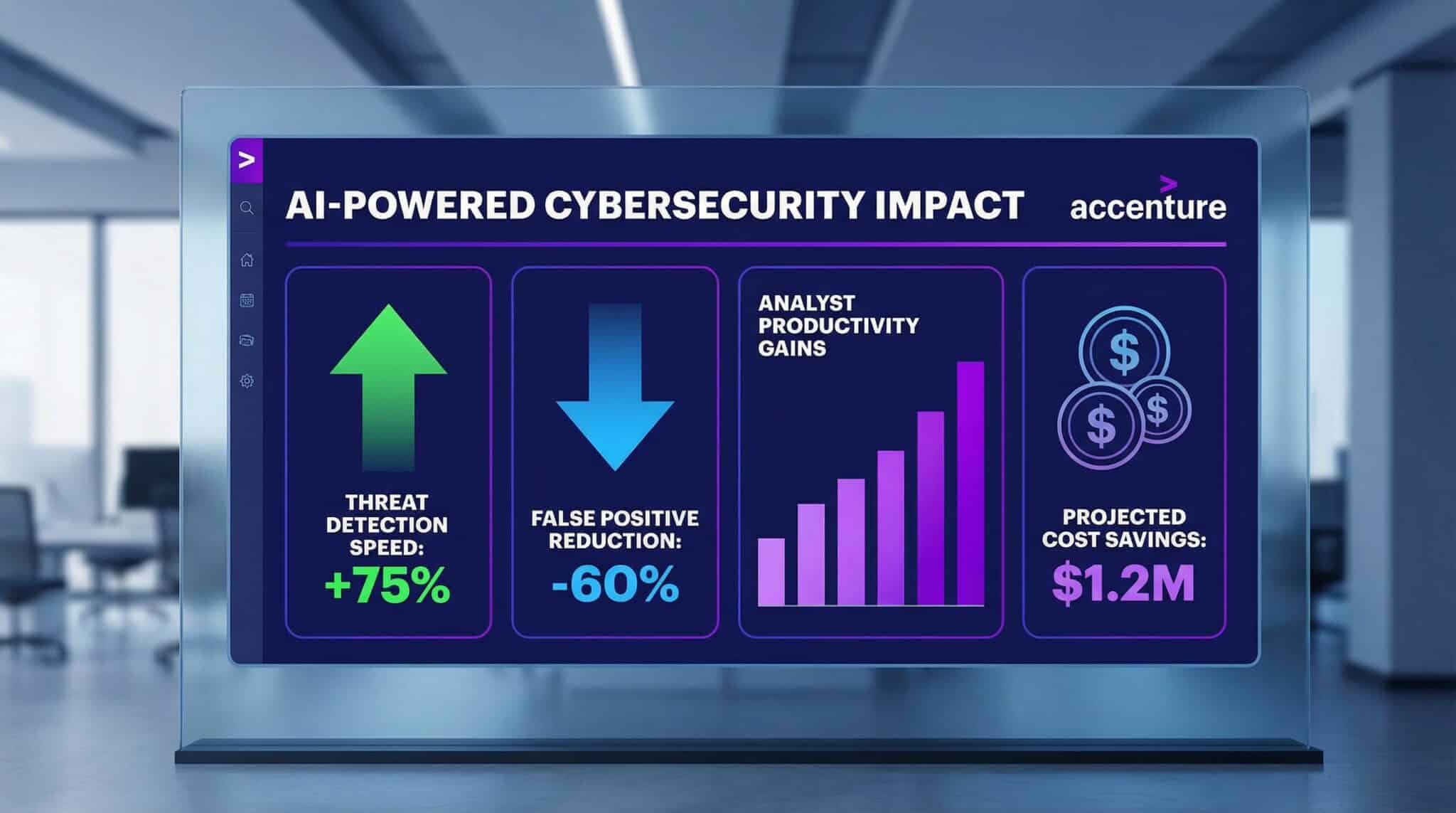
- Alert Volume Reduction: Cyber.AI’s contextual alert prioritization has reduced false positives by up to 75%, significantly decreasing analyst workload.
- Mean Time to Detect (MTTD): Organizations experienced a 50-70% reduction in MTTD, enabling faster identification of active threats.
- Mean Time to Respond (MTTR): Automated incident response workflows shortened MTTR by approximately 60%, improving containment speed.
Security Posture Improvements
- Threat Hunting Effectiveness: Enhanced AI-driven threat hunting increased identification of previously undetected threats by over 35%.
- Incident Accuracy: AI-generated incident narratives improved analyst understanding and decision-making accuracy, reducing misclassification rates by 40%.
- Compliance Readiness: Continuous monitoring and reporting features improved audit readiness, reducing compliance gaps by 30%.
Financial and Strategic Benefits
- Cost Savings: Automation of routine tasks translated into a 25-40% reduction in operational costs, primarily through optimized resource allocation.
- Risk Reduction: Faster threat detection and response reduced potential breach costs by an estimated 20-35%, based on industry breach cost averages.
- Business Continuity: Improved incident management minimized downtime and operational disruption, protecting revenue streams and customer trust.
These results have been observed across diverse industries, including financial services, healthcare, manufacturing, and technology, reflecting Cyber.AI’s adaptability and broad applicability.
Looking forward, Accenture projects that enterprises fully leveraging Cyber.AI’s capabilities could achieve a 3-year ROI exceeding 150%, driven by cumulative operational efficiencies, reduced breach impacts, and enhanced compliance.
Lessons Learned for Other Enterprises
The deployment of Cyber.AI offers valuable insights for organizations seeking to integrate AI into their cybersecurity operations. Key lessons include:
1. Prioritize Data Quality and Integration
The effectiveness of AI-driven cybersecurity hinges on high-quality, comprehensive data. Enterprises must invest in robust data ingestion and normalization processes to provide AI models with accurate and contextual information. Integration with existing security tools should be seamless to avoid operational silos.
2. Combine AI with Human Expertise
AI is a force multiplier but not a replacement for skilled analysts. Cyber.AI’s success underscores the importance of designing AI systems that augment human decision-making, providing explainable insights and interactive capabilities that empower security teams.
3. Implement Incrementally with Pilot Programs
Phased deployment through pilot projects allows organizations to validate AI models, refine workflows, and build user trust before enterprise-wide rollout. This reduces risks and improves adoption rates.
4. Maintain Continuous Learning and Adaptation
Threat landscapes evolve rapidly, so AI models and detection logic must be continuously updated. Incorporating feedback loops and integrating fresh threat intelligence are critical for sustained effectiveness.
5. Address Security and Compliance from Day One
AI deployments in security-critical environments must embed rigorous controls around data privacy, access management, and compliance monitoring. Early alignment with regulatory frameworks prevents costly remediation later.
By following these lessons, enterprises can enhance their readiness to deploy advanced AI-powered cybersecurity solutions and maximize the value derived from AI investments.
What This Means for Claude’s Enterprise Positioning
The deployment of Cyber.AI represents a strategic validation of Claude’s capabilities in high-stakes, enterprise-grade environments. Anthropic’s AI model has demonstrated that it can meet stringent operational, security, and compliance requirements that large organizations impose on technology partners.
Claude’s success within Cyber.AI highlights several key positioning advantages:
- Enterprise Readiness: Claude operates effectively within complex IT ecosystems, handling sensitive data with robust privacy and security safeguards.
- Scalability: The model supports high-volume, real-time processing demands typical of global enterprise SOCs, indicating its capacity to scale across industries and geographies.
- Adaptability: Claude’s natural language understanding and generative reasoning capabilities enable it to address diverse use cases beyond cybersecurity, including compliance automation, risk management, and customer support.
- Collaborative Intelligence: The model is designed to augment human expertise, supporting interactive workflows and explainability, which are critical for enterprise trust and adoption.
As enterprises accelerate AI adoption, Claude’s demonstrated performance in Cyber.AI positions it as a preferred AI model for mission-critical applications. This deployment also strengthens Anthropic’s market presence, enabling it to compete effectively with other AI providers in the enterprise sector.
Organizations evaluating AI models for business-critical applications should consider Claude’s proven capabilities and the insights gathered from Cyber.AI’s deployment in cybersecurity. This case study also complements broader discussions on Claude enterprise applications, providing real-world evidence of the model’s versatility and robustness. Claude vs ChatGPT vs Grok vs Gemini (2026): The Ul
Access 40,000+ AI Prompts for ChatGPT, Claude & Codex — Free!
Subscribe to get instant access to our complete Notion Prompt Library — the largest curated collection of prompts for ChatGPT, Claude, OpenAI Codex, and other leading AI models. Optimized for real-world workflows across coding, research, content creation, and business.
Access Free Prompt Library
Conclusion with Actionable Takeaways
The launch and deployment of Accenture’s Cyber.AI solution powered by Anthropic’s Claude AI model exemplify the future of enterprise cybersecurity operations. This partnership addresses the multifaceted challenges enterprises face in 2026—including alert overload, talent shortages, and regulatory pressures—by delivering an AI-augmented platform that enhances detection accuracy, accelerates response, and scales securely across complex environments.
Key actionable takeaways for enterprises considering similar AI cybersecurity initiatives include:
- Invest in Comprehensive Assessments: Understand your existing security posture, data environment, and operational workflows to tailor AI solutions effectively.
- Leverage AI to Augment, Not Replace, Analysts: Design AI systems that provide explainable insights and enable human-AI collaboration for optimal decision-making.
- Adopt Incremental Deployment: Use pilot programs to validate AI capabilities and build organizational trust before scaling.
- Ensure Continuous Learning: Maintain robust feedback loops and threat intelligence integration to keep AI models current and effective.
- Embed Security and Compliance: Prioritize privacy, governance, and regulatory alignment throughout AI implementation.
Cyber.AI’s success also signals the growing maturity of AI models like Claude for enterprise applications, encouraging organizations to explore AI beyond traditional use cases into mission-critical domains. As AI investment accelerates in cybersecurity, enterprises equipped with scalable, intelligent platforms will be better positioned to defend against increasingly sophisticated cyber threats.
For enterprises seeking to deepen their understanding of AI’s role in cybersecurity, detailed explorations of AI cybersecurity tools provide insights into technological trends and solution capabilities shaping the industry today. The Future of AI: Key Innovations and Trends to Wa
Author: Markos Symeonides