
For much of fintech’s evolution, regulation was treated as a hurdle to overcome rather than a foundation for long-term scale.
That narrative no longer reflects reality.
In the UK fintech ecosystem, regulatory maturity is increasingly a differentiator rather than a constraint.
The firms investing in strong governance, robust control frameworks and institutional-grade compliance are not being slowed down. They are better positioned for sustainable growth.
Anything that brings clarity and certainty is welcomed by business. In recent years, we have seen a marked increase in the FCA’s expectations around compliance, safeguarding, operational resilience and financial crime controls. That shift should not be viewed as friction; it is a foundation for sustainable scale.
Evolving landscape
For OpenPayd and other market players, we move and manage people’s money. Building trust, security and resilience is not optional; it is fundamental.
Clear standards create confidence across the ecosystem – for regulators, partners and clients – enabling businesses to innovate and scale within a trusted framework.
The global financial system is being rebuilt in real time. Digital assets, embedded finance, and new cross-border models are reshaping how money moves. In a moment of structural change, trust and credibility become defining factors for businesses looking to succeed in this evolving financial landscape.
Regulation, done well, does not suppress innovation. It channels it.
“The global financial system is being rebuilt in real time”
Finding harmonisation
As jurisdictions begin to introduce clearer regulatory frameworks for digital assets, and particularly stablecoins, the conversation around which region has the “best” approach has resurfaced.
Europe has implemented MiCA, the US is advancing stablecoin legislation through the GENIUS Act, financial centres across Asia are developing their own regulatory models, and the UK continues to define its own approach.
But for global businesses, the question is not which framework is best. What matters is how a degree of harmonisation can enable interoperability across regions.
For businesses to scale, they need certainty. They need to move and manage money globally within a compliant framework, without rebuilding infrastructure in every market.
Fragmentation creates friction, and every payment rail, currency and regulatory regime introduces complexity. Greater regulatory harmonisation across jurisdictions will help support global financial integration, but infrastructure providers must still absorb that complexity and unify it behind a single, reliable layer.
This is where regulatory maturity becomes a competitive advantage. Firms that have invested early in enhanced due diligence and strong governance can operate across borders with confidence.
They turn regulatory divergence into a manageable layer rather than a growth constraint.
Stablecoins and institutional adoption
Stablecoin adoption illustrates the power of this shift.
Five years ago, digital assets were largely associated with speculation. Today, digitally native businesses are leveraging blockchain and regulated stablecoins to optimise cost and speed in cross-border transactions.
Increasing regulatory clarity and institutional engagement are accelerating demand for integrated fiat-digital asset infrastructure.
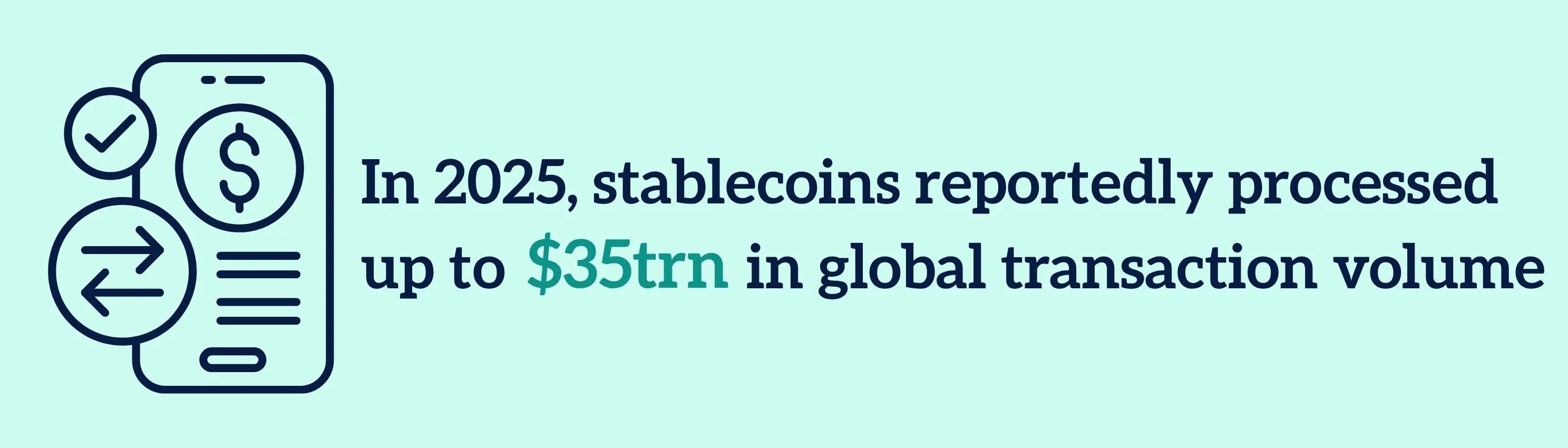
Stablecoin infrastructure is already operating at scale. In 2025, stablecoins reportedly processed up to $35trn in global transaction volume according to Artemis Analytics and McKinsey, demonstrating the resilience and efficiency of blockchain-based settlement networks.
The challenge now is less about technical capability and more about distribution, establishing the networks, connectivity and regulatory certainty required to extend stablecoin utility beyond crypto-native businesses and into the broader financial ecosystem.
As clarity increases, so does institutional participation. And as participation increases, the demand for secure, interoperable infrastructure grows in parallel.
In practice, regulation supports the trust required for institutional participation.
Strengthening defensibility
A more mature regulatory environment inevitably raises the bar. Expectations around governance, operational resilience and financial crime controls are higher than they were even three years ago.
But higher standards also create defensibility.
There is no single provider solving the dual challenge of global access and high-quality service in many parts of the world. Addressing that responsibly requires infrastructure built for resilience from day one.
Financial infrastructure is often the single most important factor in the success or failure of scaling a digital business. Yet building that capability in-house, without deep regulatory expertise across jurisdictions, is rarely advisable. Complexity does not disappear simply because it is internalised.
The firms that treat compliance as a strategic capability, not a box-ticking exercise, are the ones able to scale sustainably.
In that sense, regulation becomes a barrier to entry for weaker models, differentiating those businesses built on robust foundations.
The UK’s opportunity to lead in regulated fintech innovation
The UK fintech ecosystem is at an inflection point. Recent investment data from KPMG’s Pulse of Fintech report reinforces the UK’s continued competitiveness in fintech.
Total fintech investment across the EMEA region increased in 2025, with the UK attracting more than a third of that total funding – reaffirming our position as the European leader for fintech investment.
Even in a more cautious investment environment, this level of concentration reflects sustained confidence in the UK ecosystem’s strength, credibility and regulatory maturity.
Our competitive advantage will come from being the most credible and the most interoperable – a jurisdiction where innovation and regulation reinforce one another.
If we continue to prioritise clarity, proportionality and collaboration between regulators and industry, the UK can strengthen its position as a global hub for modern financial infrastructure.
Regulation is no longer a constraint. It is a signal of maturity. It signals the seriousness of intent and demonstrates to global partners that UK fintechs are building infrastructure designed to last.
The businesses that embrace this shift will be better positioned for the future of finance, playing a central role in shaping it.
Our mission at OpenPayd has always been to bridge digital asset markets with traditional, regulated financial services.
We focus on powering the growth of the digital economy by helping businesses move and manage money globally.
That means connecting traditional and digital finance into one compliant, frictionless experience.
Click here to find out more.