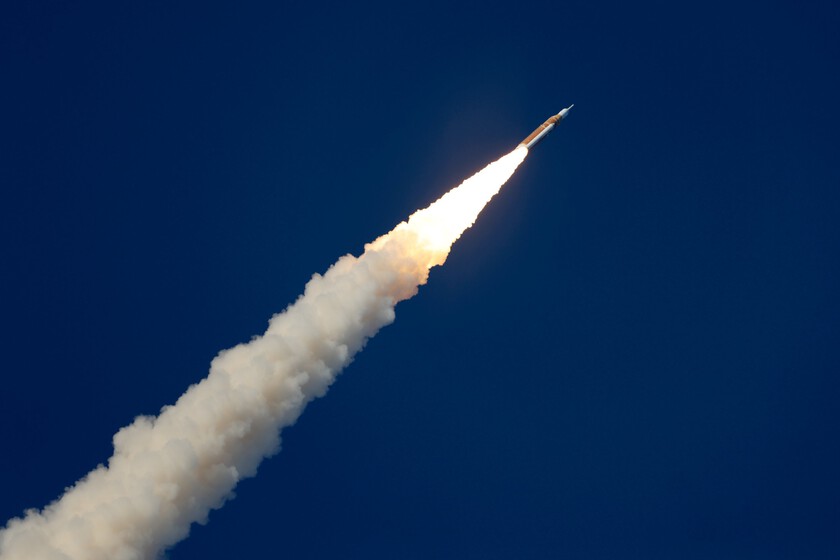
Artemis II has taken off successfully and we are not facing just any launch. What we have seen marks the return of beings humans heading to the Moon more than half a century after the last missions of the Apollo program, a milestone that for decades seemed reserved for the history books. This time, moreover, it is not just about returning, but about taking a crew further from Earth than any human being has gone in half a century.
To understand the dimension of this takeoff, it is worth stopping for a moment at what exactly Artemis II is. The mission represents the first crewed flight of NASA’s new exploration system, which combines the Orion spacecraft, the SLS rocket and the Kennedy Space Center’s ground systems. For approximately ten days, the astronauts will evaluate the behavior of the ship in real conditions, something that until now had only been tested without people on board. NASA itself proposes it as an essential step to pave the way for future missions designed to return to the lunar surface.
The flight that reopens the path to the Moon for humanity
Before reaching this moment, what we have had has been a countdown with some tension. In the hours before, the teams had to review an anomaly in a temperature sensor of a battery of the abort system, which NASA attributed to an instrumentation problem and which, according to the agency, would not affect the launch. Added to this was another incident in the flight termination system, the safety mechanism that allows the rocket to be destroyed if it deviates from its trajectory and poses a threat, a problem that placed the mission in “no go.” Both setbacks were left behind before takeoff and are now part of the background of a day that finally went ahead.
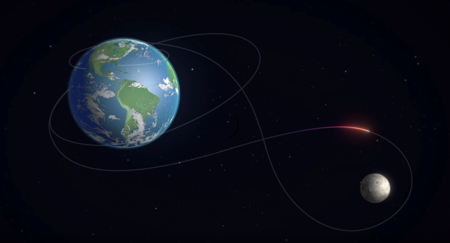
The planned flight path of Artemis II
Over the next few days, what we will see will be a relatively short, but very demanding mission. After launch, the spacecraft will first enter a high orbit around the Earth for about 24 hours to check that all systems are working correctly, before beginning the journey to the Moon. From there, the crew will perform various maneuvers, including a manual control test and approach to the upper stage of the SLS, to validate Orion’s behavior in real situations. The plan is to circle the Moon and return without setting foot on our satellite, on a journey of about ten days designed to rehearse each key phase of the trip.
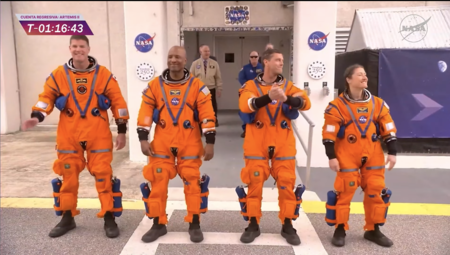
The crew of Artemis II
If we look at the crew, what we find is a very measured mix of experience and symbolism. Reid Wiseman is the mission commander, accompanied by Victor Glover as pilot and Christina Koch and Jeremy Hansen as mission specialists, four profiles who have already experienced space first-hand. Together they have accumulated 660 days in orbit and 12 spacewalks, which fits with a mission in which every decision counts. Added to that is something that also weighs: Koch will be the first woman to travel to the Moon and Hansen the first non-American to do so, opening a new stage in who is part of these trips.
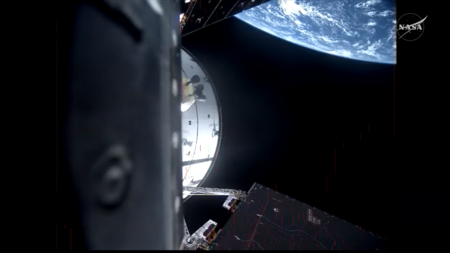
View from the Orion spacecraft of Artemis II
There is a detail that touches us a little more closely and that we should not lose sight of. Part of this mission also passes through Spain, specifically through Tres Cantos, in Madrid, where Airbus Crisa has designed, manufactured and validated the Thermal Control Unit of the European Service Moduleintegrated into Orion. This system is responsible for supplying air and water to the crew and maintaining the temperature within appropriate levels for both the astronauts and the equipment. It is a discreet piece within the whole, but without it it would not be possible to sustain a mission like this in safe conditions.

If Artemis II confirms that everything works as it should, the next step will be to take another step without touching the surface yet. Artemis III is planned as a test mission in low Earth orbit to validate the necessary systems and maneuvers before the big jump. Then Artemis IV will arrive, which according to current plans will mark the return of astronauts to the lunar surface. From there, the goal will no longer be just to return once, but to move towards a lasting human presence on the Moon with increasingly frequent missions.
Images | POT
In WorldOfSoftware | The Artemis II astronauts will carry out experiments in what will be their own study models