
Federal lawmakers might be looking to levy an additional tax on their EV-driving constituents, as House Republicans have proposed adding an annual federal registration fee to the next surface transportation law, with the current iteration set to expire in September 2026. U.S. representative Sam Graves, a GOP lawmaker from Missouri who chairs the House Transportation and Infrastructure Committee, first floated the idea of adding a new tax on electric cars. According to Reuters, the bill would charge EV owners a $250 annual registration fee, while hybrid vehicles would be subject to a $100 federal tax.
At first glance, the logic behind the proposal is straightforward. As Representative Graves told USA Today, the fee is intended to offset federal taxes paid by owners of gas-powered vehicles, a comment the congressman made in reference to federal gasoline and diesel taxes that contribute to the Highway Trust Fund (HTF). The HTF is one means Congress uses to pay for America’s expansive highway network. Traditionally, the fund’s revenue has partially depended on federal gas taxes. EVs, meanwhile, don’t contribute to federal highway funds via the electricity they use, causing lawmakers like Graves to question whether EV owners are paying their fair share.
Pro-EV advocates, however, argue that this financial burden is just another in a long line of myths plaguing the EV industry. In fact, many denigrate such fees as ineffective and punitive, disproportionately shifting the financial burden onto EV owners. The urgency of such debates is dire. According to the Congressional Budget Office, the gap between HTF revenue and spending will reach $40 billion annually in 2027, compiling a total deficit of $240 billion by 2033.
EV taxes miss the mark
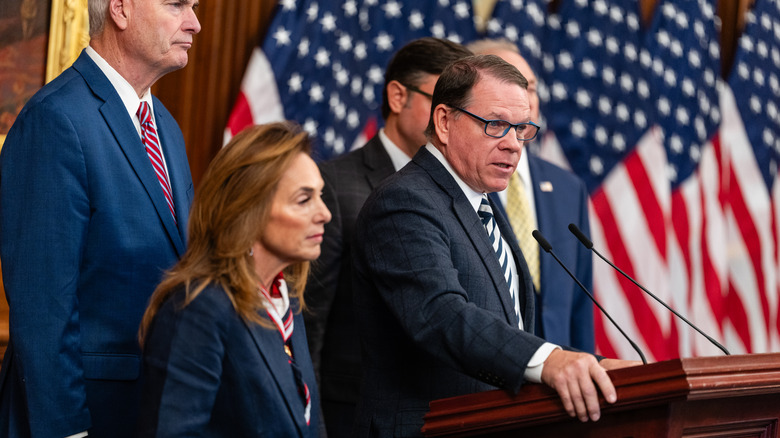
Congressman Graves’ tax proposal is indicative of an environment in which EV owners are disproportionately held responsible for America’s highways. As of January 2026, 41 states levy additional registration fees on EVs, while 34 do so on hybrids. In Illinois, for instance, a proposed state bill will raise EV registration fees to almost $500. Texas, meanwhile, charges EV owners both a $400 registration tax and a yearly $200 fee. New Jersey, Georgia, and Pennsylvania are three of at least 14 states charging EV owners a minimum of an extra $200 per annum (via Transportation Investment Organization).
This is not to say that EV owners shouldn’t pay into transportation funds. However, advocates argue that such fees are beyond those paid by their gas counterparts. Because federal gas taxes aren’t tied to inflation, drivers haven’t paid more than 18.4 cents per gallon since 1993. According to a 2019 Department of Energy statement, the average American driver traversed 11,484 miles in vehicles averaging 22.3 miles per gallon. This means that the average American driver paid $94.75 in annual federal gas taxes — a fraction of Graves’ proposed $250 fee and less than half of what would have been paid had the federal gas tax been indexed to inflation. This discrepancy is compounded by improved fuel efficiency rates, which means constituents are paying less taxes per mile driven. Furthermore, over half of state gas taxes are similarly not indexed to inflation.
As a Consumer Reports white paper states, EV taxes cannot make “a significant contribution to reversing” transportation infrastructure revenue deficits. With only 1 in every 20 new cars sold today being electric, EV ownership isn’t widespread enough to make a meaningful dent. As it stands, EVs are only responsible for roughly 2% of the HTF’s funding pitfalls (via Consumer Reports).
Searching for a cure

These discussions come as the Trump administration strips back tax advantages for EV owners. For instance, the administration’s Big Beautiful Bill repealed the Biden-era $7,500 EV tax rebate. California’s zero-emissions vehicle mandate, clean energy credits, and ITC solar and energy storage credits have also been in the administration’s crosshairs. Congressman Graves, meanwhile, has been a proponent of taxing EV owners, proposing a previous $200 tax in 2025. By comparison, Graves’ proposal only charged gasoline-powered car owners $20. Interestingly, shortly after proposing this bill, Graves announced that he would not be seeking reelection in 2026, instead opting to retire from Congress after 13 terms. According to the Wall Street Journal, Graves nonetheless plans to bring the bill before his committee in April 2026.
Advocates suggest lawmakers incorporate EV drivers into the road funding system more equitably. One solution is to charge EV drivers per mile driven. Hawaii, Oregon, Utah, and Virginia have instituted such systems, charging as much as $0.02 per mile. Taxes on EV charging is another solution which mirrors gas taxes for ICEVs. However, because most EVs charge at home, a per-kWh tax is much more difficult to implement.
Ultimately, no EV-centric schema is likely to solve the government’s tax problems. As Chris Harto, Consumer Reports’ head of sustainability advocacy, states in a March 2026 press release, “taxes on EV drivers alone — no matter how excessive — won’t solve the larger problem of transportation funding shortfalls.” Meanwhile, the federal government’s purchasing power from its current gas tax system continues to plummet, falling 81% since its latest update (via Consumer Reports). The result is a tax scheme that leaves American roads degraded, costing U.S. motorists $167 billion annually, roughly $725 per driver (via National Transportation Research). With the HTF’s total nearing catastrophic highs, lawmakers must find a solution that adequately and fairly addresses the oncoming crisis head-on.