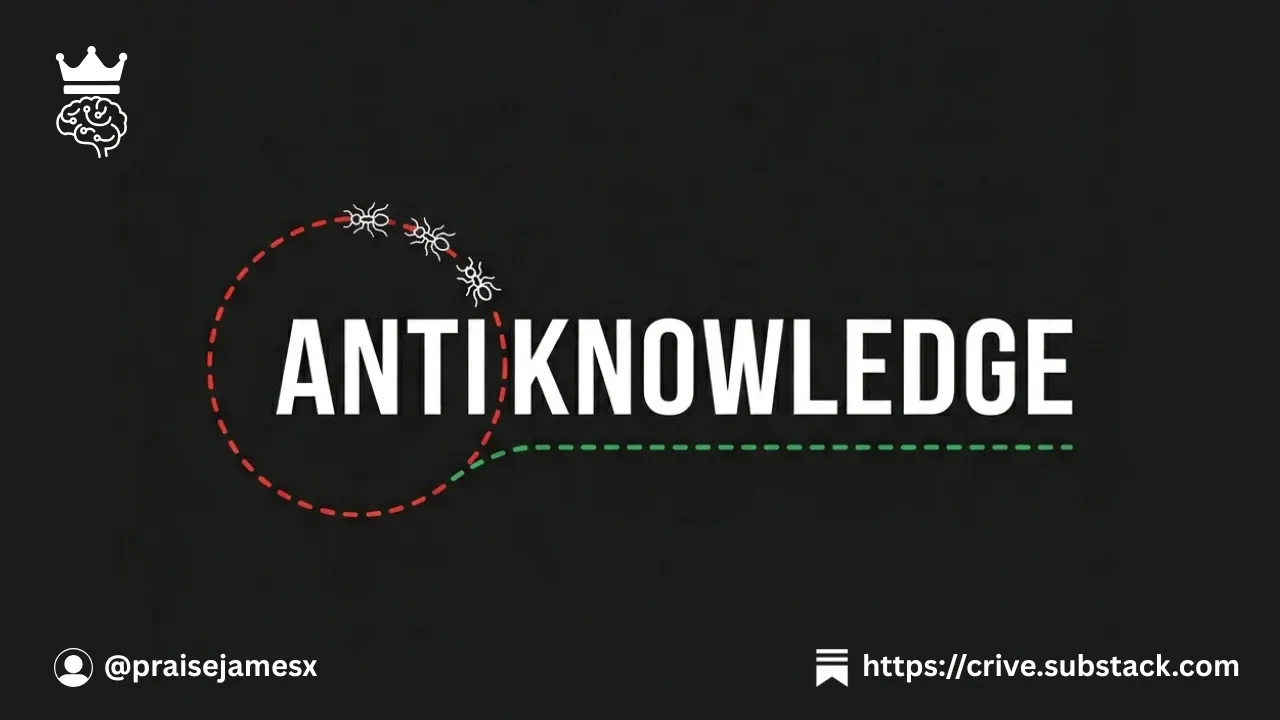
The opposite of knowledge is not ignorance.
I type fast. Years of specific hand positions, now firing without thought. I learned, recently, that if I want to type significantly faster, I cannot simply practice more. My lack of speed comes from sub-optimal finger movements that have become reflexive. I have to get slower first. I have to rewire the motor patterns before I can reach something mathematically more optimal.
This is how skill works when your scheme is wrong.
Call it anti-knowledge. Ignorance is the absence of knowledge. Anti-knowledge is the skill you’ve built that actively blocks the skill you need next.
A scheme is what the concert pianist has when he knows the sound of the note before his finger touches the key. Not remembering it. Not calculating it. Not reciting G#-F# in his head. The knowledge has dissolved into the nervous system. It runs on its own. It is no longer retrievable as a conscious thought — and that is exactly what makes it powerful, and exactly what makes it dangerous.
When the scheme is wrong, it’s difficult to find and fix. The anti-knowledge runs below conscious access. You don’t know you don’t know. You just keep performing, confidently, at a ceiling you can’t see.
Anti-knowledge compounds. Every day you perform the suboptimal pattern, you’re trading future capacity for current output.
Optimizing Everything is Suboptimal
The cost of optimizing everything is higher than the cost of running some things suboptimally. Obsessing over every inefficiency is inefficient and creates its own paralysis.
And yet — some compounding debts are quietly catastrophic. Sleep is worth optimizing. How you read might be worth optimizing. The question is never “am I suboptimal?” Everything is suboptimal. The question is which suboptimalities sit at the intersection of three conditions:
- You’ve built knowledge that works.
- A better version of performance exists, and you want it.
- Your current skill is the thing blocking you from reaching it.
Only the intersection of all three is anti-knowledge.
Some people find the optimal path early. A teacher shows them the right way on day one. Lucky them. This only happens in closed systems where there is a cap on maximum performance.
Some people are suboptimal, and it genuinely doesn’t matter. They type sixty words per minute. They’re a novelist. The suboptimal pattern is load-bearing for a life that has no use for ninety-five WPM. The cost is a tax on a destination they’re not travelling to.
Some skills have no fixed optimum. The jazz musician whose idiosyncratic technique emerged from years of playing wrong notes produces sounds that a technically correct player cannot reach. Remove the wrongness, and you remove the music.
The Thing That Separates World-Class From Average
The question isn’t just what to fix. It’s how you fix it at all.
The pianist who has played average for twenty years doesn’t fix his technique by practising harder. He fixes it by going meta — stepping outside the performance, locating the pattern running below it, and deliberately installing a new one, even while it makes him slower and worse in the short term. This is painful. Most people can’t do it. They prefer the ceiling.
The athlete who rebuilds their serve from scratch mid-career. The coder who stops and relearns the fundamentals. The writer who throws out their tics. They’re all doing the same thing: locating anti-knowledge, then willingly dismantling a skill that works — because they can see what it’s costing them.
What allows this? Not intelligence. Not discipline, exactly.
Something more structural: the ability to see your own patterns from the outside.
And here is where biology becomes relevant. Because the reason this is so difficult — the reason most people never do it — is not laziness. It’s the way the system works.
No ant has the blueprint.
When an ant finds food, it doesn’t return to the nest and file a report. It drags its abdomen along the ground, releasing a chemical trail — a pheromone line that says something good is this way. The next ant that crosses that line follows it. If it finds food, it lays more signal. The trail doubles. Then quadruples. Within hours, hundreds of ants are walking a highway no single ant designed, toward a destination most of them have never seen.
Trails that lead nowhere get walked once. Maybe twice. No return signal. The pheromone evaporates.
The entire architecture of the colony — ventilated chambers that regulate temperature to within half a degree, nurseries that protect the brood, food storage organised by type and age, highways that solve shortest-path problems faster than most human algorithms — emerges from this. No architect. No blueprint. No commander. Just signal, response, deposit, repeat.
This is called stigmergy: coordination through the environment rather than through command.
But here is the tragedy. The food moves.
The colony finds a source. The highway forms. The ants walk it, reinforce it, optimize it. Then the food disappears. For a brief window, the highway remains the strongest signal in the environment, and ants are following it to nothing. The trail is perfectly efficient. The destination no longer exists.
Stigmergy is not only in ants. It’s in you.
Open source software. Wikipedia. Markets. Your immune system. Your roads. All of these systems share one property: they’re smarter than any individual participant, and dumber than anyone who can see the whole board from outside.
The ant cannot see that the food has moved. It can only follow the strongest trail.
This is the condition you are in, inside your own mind, about your own habits, almost all of the time.
Billions of neurons. Trillions of synapses. No central architect. Thoughts are trails. Each time a similar input arrives, it follows the stronger path. Do this ten thousand times, and you have a highway. A hundred thousand times, and you have a scheme — knowledge running below thought, automatic, confident, potentially catastrophically wrong.
Before a thought reaches consciousness — before it gets allocated to working memory — your brain runs a signal-strength evaluation. Weak signal gets no RAM allocation. The thought dies. You never know you had it. This is why you ignore an artist the first three times you see their name on Spotify. The signal is too faint. But when you encounter them in three different places — a playlist, a conversation, a review — the signal compounds. You “decide” to check them out.
The solution to a problem can be obvious, available, right in front of you — but if the search your brain ran evaluated the path as low-signal and energetically expensive, it discarded it. Because the hardware is ancient. The brain optimizes for the most reward at the least energy cost, a heuristic calibrated for an environment where calories were scarce, and unknown trails were frequently lethal. That environment no longer exists.
The pause you feel when thinking through something novel — where you hold a sentence in your head, repeating it while the next word won’t come — is the colony protecting its computation. Evolution optimised for survival. Not for finding the best move.
Where agency actually lives
This does not eliminate agency. It locates it.
Agency is not the absence of stigmergy. Agency is the conscious act of depositing a signal on trails the algorithm would otherwise ignore — repeatedly, long enough, until the colony eventually walks there. You cannot override the system. You can game it.
This is the difference between the world-class and everyone else. Not talent. Not even work ethic. The capacity to reconstruct their own patterns. To find the broken scheme, go below the level of performance, and rebuild from the substrate — even when it makes them slower, even when the old highway is still there and far more comfortable to walk.
They don’t just practise. They practise on themselves.
You can read and subscribe for more of my essays here.