Price: Pixel Undercuts Samsung—But Read the Fine Print
Left to right: Galaxy S26 Ultra, S26+, and Galaxy S26 (Credit: Eric Zeman)
Find Top Deals on a Galaxy S26


There are a total of six phones between these two lineups, not counting the Pixel 10a. The S26 starts at $899.99, the S26+ starts at $1,099.99, and the S26 Ultra starts at $1,299.99. All three come with at least 256GB of storage; higher capacities cost more.
Meanwhile, the Pixel 10 starts at $799, the Pixel 10 Pro starts at $999, and the Pixel 10 Pro XL starts at $1,119. Note that the Pixel 10 and 10 Pro base models come with just 128GB of storage. Their 256GB variants cost $100 more, putting their prices more in line with the Galaxy S26 and S26+.

Left to right: Pixel 10 Pro XL, Pixel 10 Pro, Pixel 10 (Credit: Eric Zeman)
Score Savings on a Pixel 10


The S26 Ultra with 1TB of storage is priced at an eye-watering $1,799.99. A 1TB Google Pixel 10 Pro XL is $1,549. The Pixel 10 series costs less than the Galaxy S26 lineup and notches its first win.
Winner: Pixel 10
Design: Two Distinct Looks, One Familiar Formula
Samsung and Google make it easy to identify their phones from the back because, from the front, they all look like rounded rectangular slabs.

Left to right: Galaxy S26 Ultra, S26+, Galaxy S26 (Credit: Eric Zeman)
The Galaxy S26 measures 5.89 by 2.82 by 0.28 inches (HWD), and weighs 5.89 ounces; the 6.7-inch Galaxy S26+ is 6.24 by 2.98 by 0.29 inches, and weighs 6.70 ounces; and the Galaxy S26 Ultra is 6.44 by 3.07 by 0.31 inches, and weighs 7.55 ounces.
The Pixel 10 is 6.02 by 2.83 by 0.34 inches and 7.20 ounces. The 10 Pro shares the same dimensions as the 10, but weighs 7.30 ounces. The 10 Pro XL is a big phone at 6.41 by 3.02 by 0.33 inches and 8.18 ounces. When it comes to thin and light, the Samsung series is thinner, and its phones weigh less than their Pixel counterparts.

Left to right: Pixel 10 Pro XL, Pixel 10 Pro, Pixel 10 (Credit: Eric Zeman)
All of these phones are rated IP68 for dust and water resistance and feature aluminum frames. Samsung covers its S26 and S26+ screens in Corning Gorilla Glass Armor, while the S26 Ultra gets Gorilla Armor 2. Google uses Corning Gorilla Glass Victus 2 across all Pixel 10s.
The back of every Samsung S26 features three cameras in a vertical pill-shaped riser, while the S26 Ultra adds two rounded sensors to the right. The Pixel series features Google’s Camera Bar, an oblong camera bump that runs horizontally across the back panel.
As for colors, the Galaxy S26 comes in Black, Cobalt Violet, Sky Blue, or White with Silver Shadow and Pink Gold options available online only. The Pixel 10 comes in Frost (light blue), Indigo (deep blue), Lemongrass (light green), or Obsidian (black). The Pro models come in Jade (light green), Moonstone (grayish), Obsidian (black), or Porcelain (white).
Style is subjective, so decide which pleases your eyes.
Winner: Tie
Displays: Bright Panels—and One Genuinely New Trick

Left to right: Galaxy S26 Ultra, S26+, Galaxy S26 (Credit: Eric Zeman)
See the chart for all the details, but note that the Pixel 10 series has a higher maximum brightness (3,300 nits), while the S26 Ultra has the largest screen (6.9 inches). No matter which device you choose, you will get crisp details and smooth animations. The Pixel 10 is the only device here that does not support a 1-120Hz refresh rate.

Left to right: Pixel 10 Pro XL, Pixel 10 Pro, Pixel 10 (Credit: Eric Zeman)
Samsung’s Galaxy S26 Ultra has a novel feature called the Privacy Display, which can narrow the viewing angle to prevent people from reading over your shoulder or even from right next to you. Privacy Display technology can also obscure the screen on an app-by-app basis and/or on portions of the screen, such as notifications. This is real innovation, which gives the S26 Ultra the win, even if it sometimes gets in the way of everyday life.
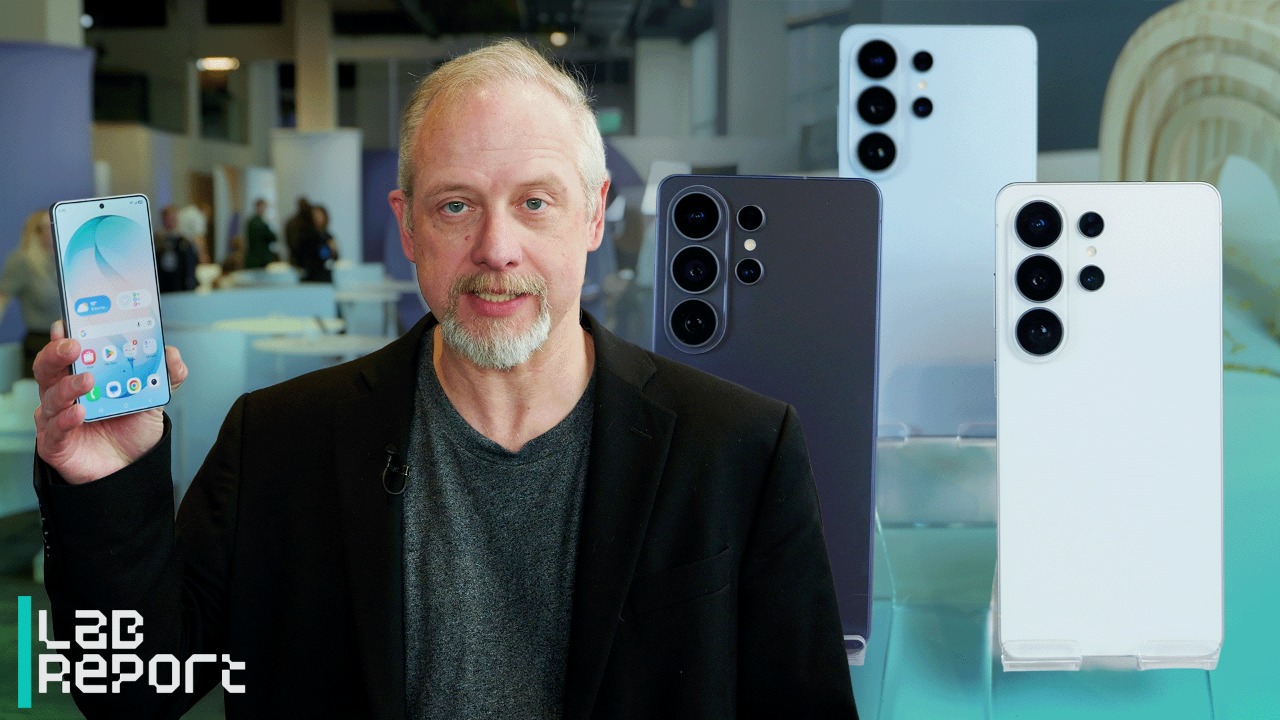

Samsung Galaxy S26 Ultra First Look: The AI Powerhouse Plus a New Display
Winner: Galaxy S26
Performance: Fast Is Just Table Stakes
Every Galaxy S26 model is powered by a Qualcomm Snapdragon 8 Elite Gen 5 for Galaxy, a customized chip not found in the competition. All models offer at least 12GB of RAM, but the 1TB S26 Ultra comes with 16GB.
The Pixel 10 series uses Google’s homegrown Tensor G5 processor, custom-built for AI applications. I found the Pixel 10’s performance vastly superior to the Pixel 9 series. Additionally, the Pixel 10 comes with 12GB of RAM, while the two Pro models have 16GB.
In testing, the Snapdragon 8 Elite Gen 5 simply dominates the Tensor 5G. It’s not even close. You can see the results in the table below:

Get Our Best Stories!
A Smart, Bold Take on the Wireless World

By clicking Sign Me Up, you confirm you are 16+ and agree to our Terms of Use and Privacy
Policy.
Thanks for signing up!
Your subscription has been confirmed. Keep an eye on your inbox!
Winner: Galaxy S26
Cameras: Top-Tier Photography and Video

Galaxy S26 camera modules (Credit: Eric Zeman)
The Galaxy S26 and S26+ use the same hardware found on their predecessors. That is a 50MP main shooter, a 12MP ultra-wide camera, and a 10MP telephoto camera with 3x optical zoom. The S26 Ultra features a 200MP main camera, a 50MP ultra-wide lens, a 50MP telephoto camera with 5x optical zoom, and a 10MP telephoto camera with 3x optical zoom. All Galaxy S26 devices use the same 12MP front-facing camera.

Pixel 10 series camera modules (Credit: Eric Zeman)
The Pixel 10 has a 48MP main camera, a 13MP ultra-wide sensor, and a 10.8MP telephoto camera with 5x optical zoom. For front-facing cameras, the Pixel 10 has a 10.5MP selfie cam, while the Pros have a 42MP part.
For video recording, all Galaxy S26 phones shoot at up to 8K resolution at 30 frames per second (fps), while the Pixel 10 series shoots at up to 4K at 60fps. Pixel 10 Pro models can produce 8K video at 30fps by processing uploaded footage.
The Galaxy S and Pixel phones are among the best in the world at taking photos and recording video, and that’s true of the S26 and Pixel 10 devices. If you want slightly higher saturation and more pixel-rich results, the Galaxy S series wins. On the other hand, the Pixel 10 phones deliver more accurate color (especially darker skin tones), better processing, and offer more after-the-fact editing tools.
Winner: Tie
Battery and Charging: Faster Speeds Cost More

Pixel 10 Pro XL on a Pixelsnap charger (Credit: Joseph Maldonado)
Every phone here charges at a minimum of 25W wired and 15W wirelessly. Wired and wireless charging rates increase as phone prices rise. Take a look at the chart below for battery specifics. Every Pixel 10 supports Google’s PixelSnap magnetic charging technology, while none of the S26 phones have magnets built in.
Recommended by Our Editors
In our battery tests, the Galaxy S26 phones win across the board with an average battery life of 15 hours and 10 minutes. Meanwhile, the Pixel 10 lasted 12 hours and 40 minutes, the 10 Pro lasted 12 hours and 40 minutes, and the 10 Pro XL ran for 12 hours and 35 minutes.
Winner: Galaxy S26
Software: With AI Everywhere, Philosophy Matters
Both sets of phones run Android 16, while Samsung adds its One UI layer atop it. Both offer a wealth of AI tools, including prompt-based image editing, voice transcription, and summarization. Samsung and Google are software partners, and the S26 features an advanced version of Circle to Search that identifies multiple items from one picture. Both companies support their phones with seven years of OS updates and seven years of privacy updates.

Google prompt-based image editing (Credit: Google/PCMag)
This is a matter of personal preference. If you value productivity, you may prefer Samsung’s advanced multitasking, or you may think Magic Cue, Google’s proactive assistant that gives you information before you need it, is better for your needs. If you want the fastest updates, the Pixel series gets every new Android feature before any other Android phone.

Magic Cue (Credit: Iyaz Akhtar)
On the non-AI front, the Galaxy S26 supports DeX, which lets you attach the phone to a monitor and keyboard for a desktop-like experience. Desktop mode is coming to Android as a whole, but it is not an official feature of the Pixel 10.
Winner: Tie
Extras: Stylus, SIM Strategy, and 5G Nuances
There are a few other things that don’t fit easily into one section, but are worth considering.

Galaxy S26 Ultra with S Pen (Credit: Eric Zeman)
The Galaxy S26 Ultra is the only device here that supports a stylus—its embedded S Pen. The S26 phones still support physical SIM cards and eSIM, but the Pixel 10 is eSIM-only (in North America). For 5G, all three Pixels, as well as the S26+ and S26 Ultra, support sub-6GHz and mmWave. The S26 supports only sub-6GHz 5G. The S26 is also the only one of these phones that doesn’t support ultra-wideband and Wi-Fi 7.
Winner: Tie
The Verdict: It Comes Down to Power Users vs. Purists
There’s a lot to consider here. Each family of devices has its pros and cons. Even more confusing, the individual selections within the Pixel 10 lineup and Galaxy S26 family compete with one another.
-
If you love multitasking or want your phone to double as a full computer, the Galaxy S26 is the way to go.
-
If you want every new Android feature—including AI—as soon as possible, pick a Pixel.
-
If you love magnetic charging, the Pixel 10 series has it. You’d need a case for the S26 series for the same function.
-
If you love funky new tech, the Galaxy S26 Ultra is the only phone with a built-in Privacy Display.
Which one do you like? Be sure to let us know in the comments.