For decades, product development has operated under a structural constraint: teams are expected to validate ideas early — to assess desirability, feasibility, and viability — yet the tools and approaches available make this difficult to do with sufficient speed, depth, and consistency.
At the same time, development cycles have continued to compress under pressure from market dynamics and rising user expectations. Prototypes have played a central role in adapting to this shift. They allow teams to explore whether a concept holds together — whether the value proposition is clear, key scenarios are coherent, and the experience is usable in principle. However, the signal they provide is inherently limited. Prototypes can approximate interaction, but they only partially reflect how a product will perform under real conditions — where attention is fragmented, trade-offs are real, and motivation is variable.
To compensate for this, teams rely on research. Interviews, surveys, and focus groups provide additional input, but introduce their own constraints. They are slow, resource-intensive, and dependent on self-reported behavior, which often diverges from actual decisions. In large organizations, access to research is uneven and budget-constrained. In smaller organizations or startups, it is often limited or entirely absent.
The result is a persistent imbalance. Product teams are expected to validate before building, but meaningful validation often happens after substantial investment. Decisions about value, adoption, and behavior are routinely made with incomplete evidence, and incorrect assumptions are only surfaced once they become expensive to correct.
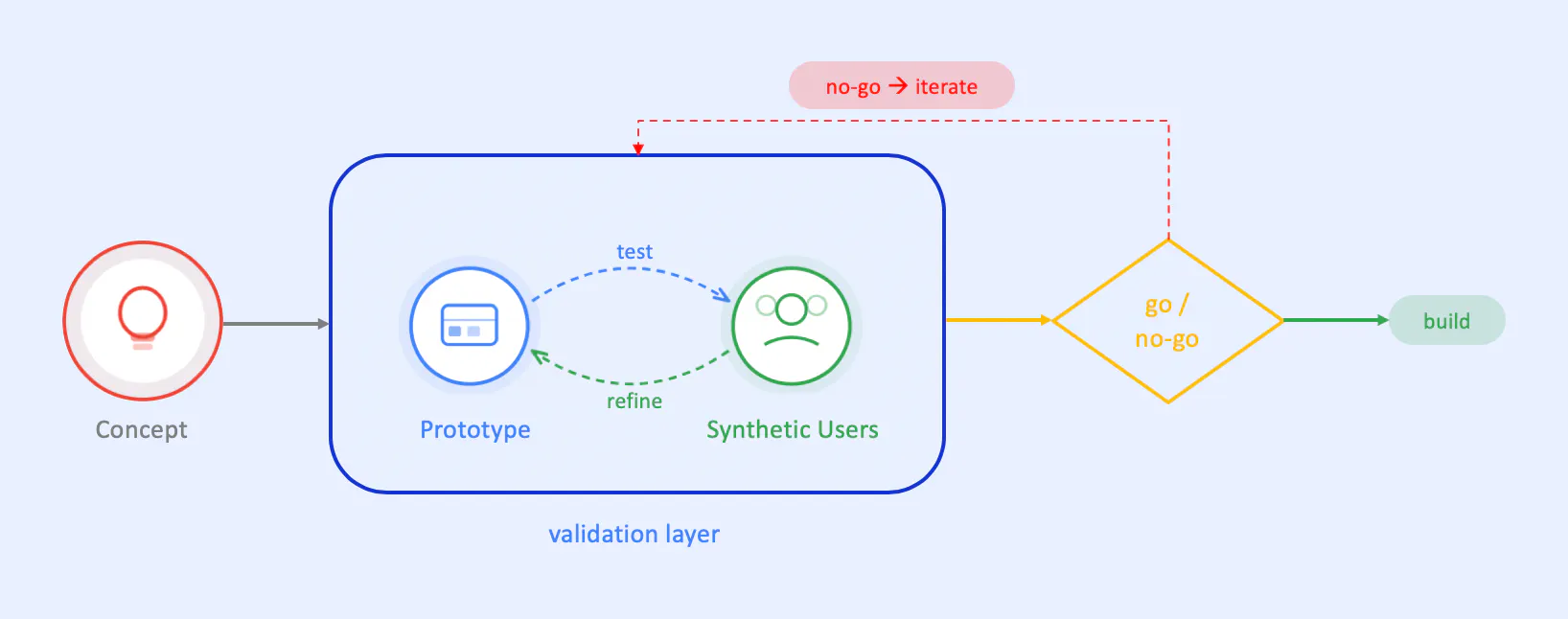
What has been missing is a validation layer — one that allows teams to test hypotheses earlier, more frequently, and at a lower cost, progressively narrow a wide space of possibilities into clear go/no-go decisions.
That layer is now beginning to emerge.
Recent advances in AI are reshaping how product concepts are created and evaluated. Rather than replacing existing practices, they are extending them — introducing new capabilities between early idea formation and real-world validation.
Two developments are driving this shift.
The first is a new generation of AI-assisted prototyping tools. Systems such as Figma Make, Lovable, Replit, and others significantly reduce the cost of generating and iterating on product concepts. Interfaces, flows, and variations can be produced and refined in rapid succession, lowering the friction of early exploration and reducing dependence on designers and developers, as these tools are increasingly accessible to a broader range of users without specialized skills. Increasingly, they also incorporate evaluative capabilities — identifying structural weaknesses, inconsistencies, and likely friction points before user testing takes place.
The second is an emerging category that can be broadly described as synthetic users. While still evolving, these systems share a common premise: product concepts can be tested against simulated respondents that approximate how different types of users may behave. Drawing on qualitative inputs, behavioral patterns, and contextual signals, they allow teams to examine how a proposition is likely to be interpreted, where engagement may degrade, and which assumptions are most fragile.
Individually, each of these developments improves part of the product workflow. In combination, they introduce something more consequential: a continuous validation loop.
Concepts can be generated quickly, tested against simulated behavior, refined, and tested again — all before significant resources are committed. This does not eliminate uncertainty, nor does it replace validation with real users. But it changes when and how uncertainty is addressed.
The implications are both operational and economic. Faster iteration cycles reduce the time required to converge on a viable concept. Lower-cost validation reduces the likelihood of investing in products built on incorrect assumptions. Perhaps most importantly, access to validation expands. Capabilities that were previously constrained by research budgets and organizational structure become available to a broader set of teams.
This is not yet a mature system. AI-assisted prototyping tools are still evolving, with limitations in control over outputs, consistency of results, and the ability to represent more complex, multi-step product scenarios. At the same time, synthetic user models remain limited in their ability to capture real-world complexity, including how behavior evolves over time or adapts to changing context. The space is still forming, and methodologies are far from standardized.
Even so, the direction is clear. The most important shift is not in how products are designed, but in how decisions about them are made — earlier, with better signals, and at significantly lower cost.