What is the Facebook algorithm?
The Facebook algorithm is a ranking system on Facebook’s servers that decides which posts appear in a user’s Facebook feed and in what order. Instead of showing content chronologically, you’ll see the content Facebook’s algorithm thinks you’ll like most and interact with first.
At a basic level, the algorithm looks at three things:
- What content is available (posts from friends, groups, pages or personal Facebook profiles, and ads)
- Signals about that content (who posted it, how recent it is, and how other users interact with it)
- Predictions about user behavior (whether someone will like, comment, share, or spend time on it)
This is where AI and machine learning come in. Facebook evaluates thousands of input signals, including past behavior, to assign a relevance score to every piece of content. The higher the score, the more likely that post is to appear higher in people’s feeds.
When Facebook talks about “personalization,” it means no two users see the same feed. The algorithm creates a unique mix of connected content (from friends, pages, and Facebook groups you follow) and recommended content (based on similar posts you’ve interacted with before). Even if you created a new account and followed all the same people, there would be differences.
For marketers, this matters because the Facebook algorithm rewards high-quality content that drives meaningful interactions, and there’s always a lot of content being posted on the platform.
In fact, an analysis of 9,332,840 posts across 10 social media platforms shows that brands are most active on Facebook. In 2025, 44.5% of all social media content was published there, making it the top platform by posting volume. It’s also currently the top platform by monthly active users, with over 3.07 billion.
If your posts don’t spark engagement or match your specific audience’s interests, they’re unlikely to reach many individual Facebook users, no matter how often you post.
How the Facebook algorithm works in 2026
The Facebook algorithm works as a prediction engine. It evaluates everything that could appear in a user’s Facebook feed (formerly known as the news feed algorithm) and ranks content based on how likely someone is to engage with it.
When someone opens the app, the Facebook feed algorithm builds a personalized feed using two main types of content:
- Connected content: Posts from friends, Facebook groups, and pages the user already follows
- Recommended content: Posts from new creators or pages, selected based on past behavior and similar posts the user has interacted with
There’s also a third category, ads, but those are handled separately through targeting rather than the core ranking system.
At the center of this process is a four-step model: inventory → signals → predictions → relevance score. This is how Facebook evaluates and ranks every post.
1. Inventory: what Facebook can show you
First, Facebook gathers all available content a user could see at that moment.
This includes:
- Posts from friends and other users you interact with
- Content from your Facebook page likes and followed accounts
- Posts from relevant Facebook groups
- Suggested posts based on your interests
For example, if you follow five pages, interact with two groups daily, and have 300 friends, your inventory can easily include thousands of potential posts every time you open Facebook.
Before anything gets ranked, Facebook filters out spammy links, false news, or anything that violates community standards. Only eligible content moves forward.
2. Signals: how Facebook evaluates each post
Next, Facebook analyzes ranking signals. These are the data points that help the algorithm understand what a post is about and how relevant it might be.
Some signals are stronger than others.
Strong signals include:
- Your past behavior (what you like, comment on, or share)
- Whether you’ve interacted with this creator before
- How often you engage with similar content
Weaker signals include:
- How recent the post is
- The format (video content, links, or images)
- Your device or internet connection
For example, if you consistently watch Facebook videos from a specific creator to completion, that sends a strong signal. If you scroll past their posts quickly, that sends the opposite signal.
This step is where Facebook starts to understand your content preferences at a very granular level.
3. Predictions: what Facebook thinks you’ll do next
Using those signals, Facebook makes predictions about how likely you are to interact with a post.
It’s estimating specific actions, such as:
- Will you stop scrolling and read the post?
- Will you watch the video content to the end?
- Will you like, comment, or share it?
- Will this post spark meaningful interactions or conversations?
For example, if you tend to comment on posts that ask questions or share opinions, Facebook prioritizes posts that are similar in your feed.
This is where AI and machine learning do most of the heavy lifting. The system continuously learns from your behavior and updates its predictions in real time. Over 20% of what users see in their Facebook feed now comes from AI-driven recommendations, including posts from people, groups, and accounts they don’t follow.
4. Relevance score: how Facebook ranks content
Finally, Facebook assigns each post a relevance score (also called a relevancy score).
This score is the result of everything that came before:
- The available content (inventory)
- The ranking factors
- The predicted likelihood of engagement
Posts with a higher relevance score are ranked higher in users’ feeds. Lower-scoring posts may never appear at all.
This is why two people can follow the same Facebook brand page but see completely different content. The algorithm creates a personalized ranking for each particular user.
At this stage, the algorithm also makes sure to take measure like space out content from the same creator, so the feed doesn’t become monotonous.
How does the Facebook Reels algorithm work in 2026?
The Facebook Reels algorithm focuses on distributing short-form video content to users who are most likely to watch and engage with it. Unlike the main feed, where relationships matter more, Reels are driven by discovery and personalized recommendations based on past behavior. This feed was introduced to help Facebook compete with video-first platforms like the social media network faTikTok.
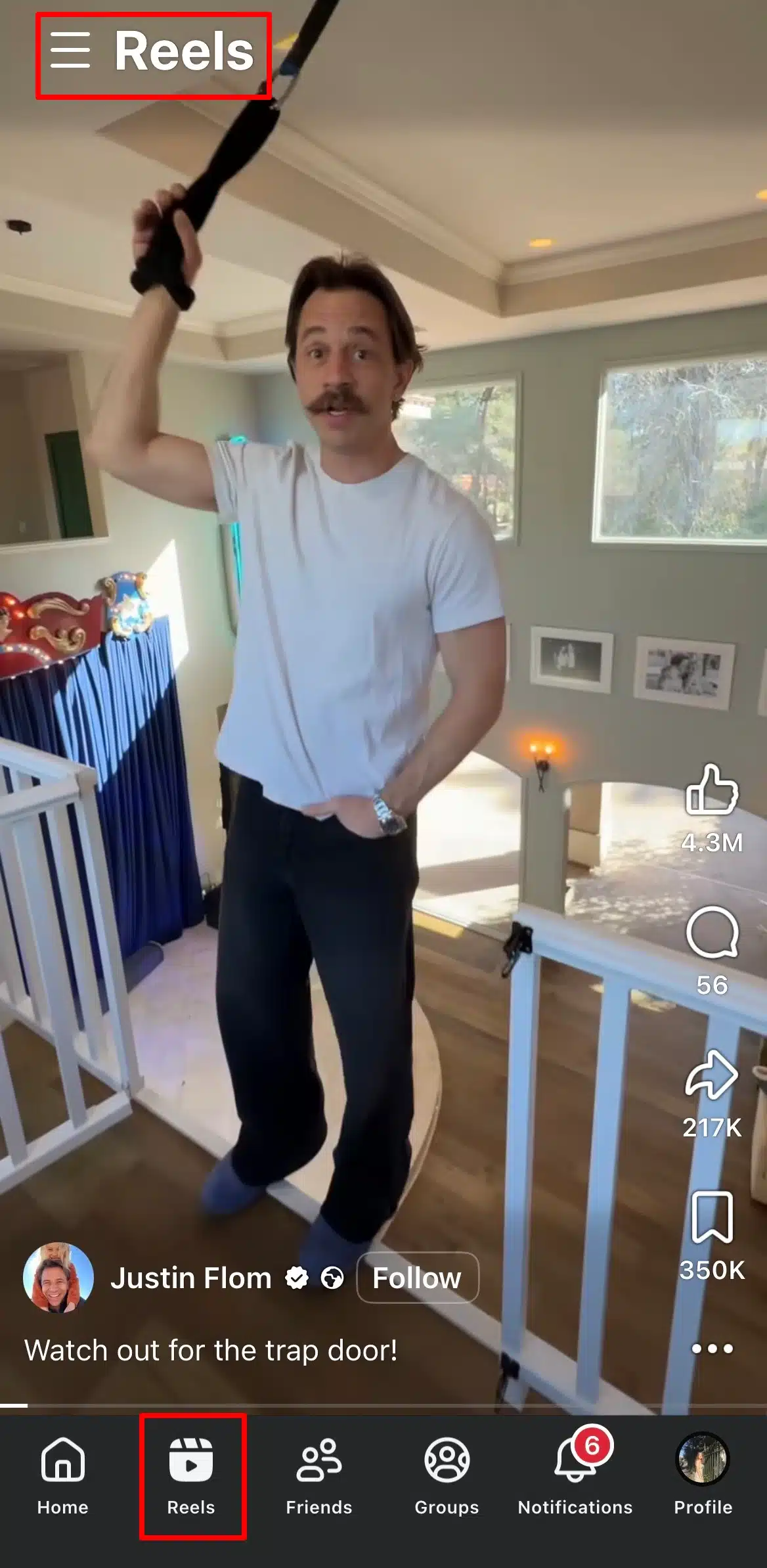
Here are the key factors the Facebook algorithm considers for Reels:
- User engagement priority: Watch time is the strongest signal. Videos watched from start to finish, rewatched, or interacted with (likes, comments, shares) are more likely to be pushed further. This is why the first few seconds matter. If users don’t stop scrolling, the Reel won’t spread.
- Content originality and quality: Facebook limits the reach of recycled or low-quality content, especially videos with watermarks or minimal edits. Original, clear, and well-structured video content performs better.
- Use of trends: Trending audio, formats, and topics can increase visibility, but only when they fit the content. Generic trend-chasing without context tends to underperform.
- Community guidelines compliance: Content that violates Facebook’s community standards or is flagged as spammy content will see reduced reach or be removed entirely.
- Personalized recommendations: The algorithm analyzes users’ past behavior and similar posts they’ve interacted with to decide which Reels to show. This is why consistent themes help Facebook understand your target audience.
Powered by AI and machine learning, the system constantly adapts, so there is almost always a new Facebook algorithm change to catalog. The types of Facebook videos that perform well can shift based on the audience’s preferences and platform trends.
In practice, Reels are tested quickly. If people watch, engage, and don’t scroll past, the algorithm expands distribution. If not, the content disappears from people’s feeds just as fast.

How does Facebook recommend content?
Facebook recommendations are your best chance to reach people who don’t already follow your Facebook page. But your content will only be shown to new users if it meets a higher quality threshold than what’s simply allowed on the social network.
Unlike the main feed, recommended content is selected to help Facebook users discover new pages, creators, and topics based on their past behavior and the types of posts they engage with most.
To be eligible, your content must follow both Facebook’s Community Standards and its stricter Recommendations Guidelines. That means content can be allowed on the platform but still not be recommended.
If you want your content to appear in people’s feeds beyond your current audience, avoid:
- Content that raises safety concerns, such as self-harm, explicit material, or promotion of regulated products
- Misleading content or false claims, including fake news content, debunked information, clickbait links, or misleading health information
- Spammy content or inauthentic behavior
- Low quality content, including weak sources or low-quality webpage links
- Engagement bait designed to force interactions instead of earning them
From what I’ve seen in the past few years, the biggest issue is content that technically follows the rules but doesn’t offer real value. Facebook evaluates whether content is useful, trustworthy, and worth showing to other users.
If you want to increase your chances of being recommended, focus on creating content that people actively choose to engage with. That means clear ideas, original perspectives, and posts that feel relevant to a specific audience.
Update: Facebook keeps expanding AI, creator tools, and discovery features (April 2026)
Meta has introduced a series of updates in 2026 that focus on AI integration, creator collaboration, and content discovery across Facebook.
Facebook announced a major shift in the growing role of AI-powered features. Meta is rolling out tools like AI-generated voiceovers, translation for video content, and new integrations with its Manus AI system across Meta platforms like Ads Manager and Creator Marketplace. These updates point toward a stronger focus on helping content reach broader audiences through automation and localization, including when Facebook runs advertisements, not just for organic posts.
There are also updates aimed at improving content discovery and creator visibility. Features like the “Target audience” filter in the Creator Marketplace and Reels trending ads tied to major events (such as Black Friday or the NFL) make it easier for companies to align their branded posts with specific audiences and moments.
On the collaboration side, Meta Business Suite now supports inviting collaborators for Instagram Reels, giving teams and creators more ways to work together on content directly within the platform.
Other changes focus on how content is presented and managed. Facebook is testing ways to prioritize more relevant notifications, expanding features like Community Notes globally, and introducing updates that affect how paid ads and sponsored content are labeled and tracked.
These updates show a clear direction: more AI support, more tools for creators, and more ways to connect content with the right audience. The Meta CEO, Mark Zuckerberg, has hinted since 2025 that he intends to do big things with AI in 2026:
“In 2025, we rebuilt the foundations of our AI program…Over the coming months, we’re going to start shipping our new models and products… and I expect us to steadily push the frontier over the course of the new year.”
As for what this means for brands: “This also has implications for commerce…New agentic shopping tools will allow people to find just the right set of products from the businesses in our catalog.”
If you want to stay up to date with the latest Facebook changes, check out our full guide, which is regularly updated with new features and algorithm updates.
Tips for working with Facebook’s algorithm
The algorithm ranks content based on signals like engagement, watch time, and past behavior. That means every post you publish is tested quickly. If people interact with it, it spreads. If they ignore it, it disappears from users’ feeds just as fast.
In a SocialBee analysis, Facebook accounted for 31% of all growing social profiles, making it the platform where users most frequently saw measurable growth, and that’s thanks to the algorithm’s help.
What I’ve seen across different Facebook pages is that small changes in how you post can make a big difference in reach. The tips below focus on actions that consistently improve visibility.
1. Start conversations in your posts
The Facebook algorithm ranks content higher when it leads to meaningful interactions, especially comments and replies between users.
A post with 10 thoughtful comments will often outperform one with 100 passive likes. That’s because comments signal that people are actively engaging, not just scrolling past.
To get more of these interactions, you need to design posts that invite responses naturally:
- Ask open-ended questions people actually want to answer
Example: “What’s one thing you stopped doing in your business that actually improved results?” - Share a clear opinion and let people react
Example: “Posting every day hurts more pages than it helps. Here’s why…” - Turn everyday situations into relatable prompts
Example: “What’s the most frustrating part of managing a Facebook page right now?”
You can also increase engagement by how you respond:
- Reply quickly to early comments to keep the thread active
- Ask follow-up questions to extend the conversation
- Use the @followers tag in comments when it makes sense to bring people back into the discussion
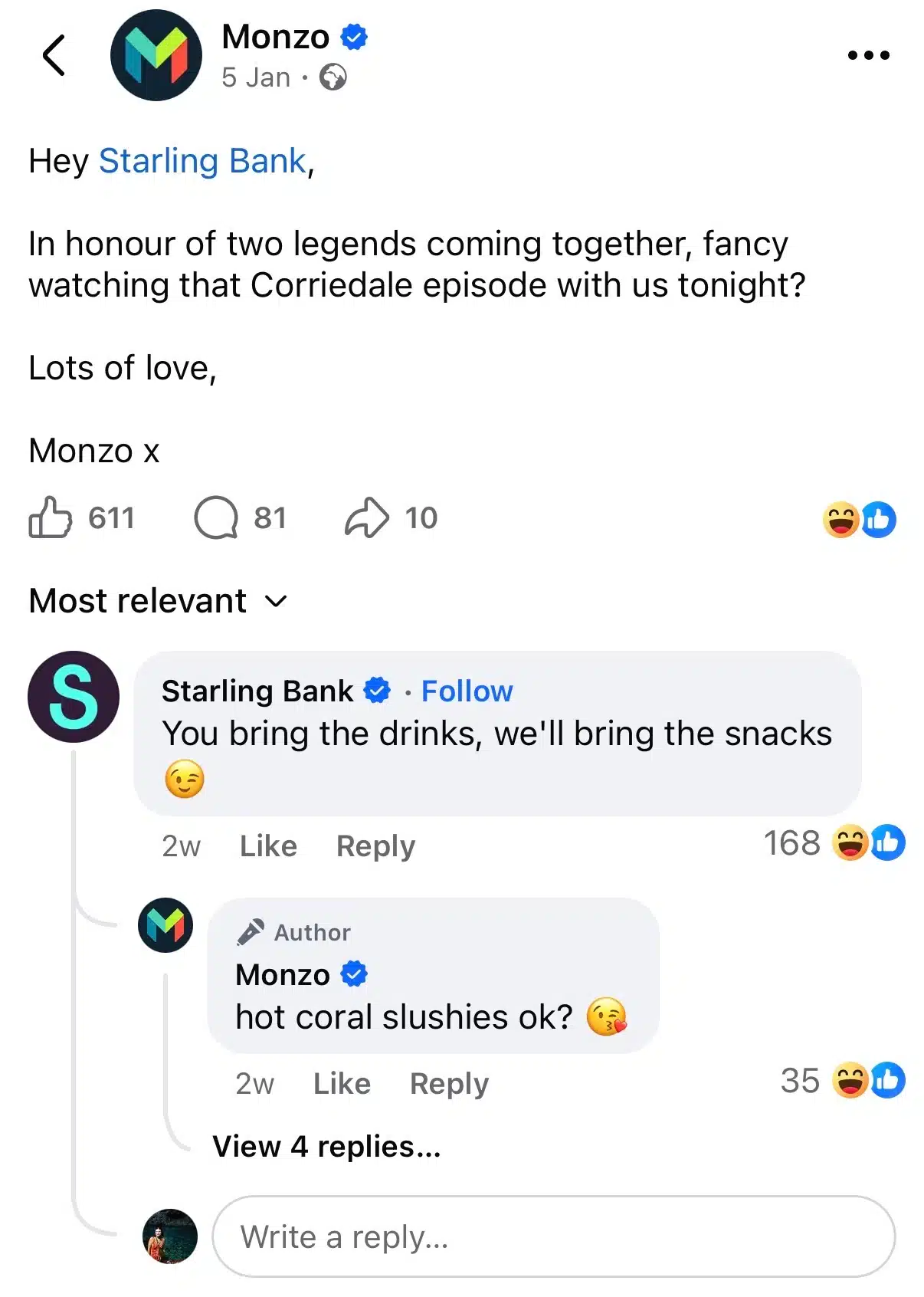
Another great idea, exemplified below, is to tag other brands and start conversations with them. This, on top of generating engagement, also opens you up to the audience of another company, which means higher reach.
Another tactic that works well is using simple interactive formats like polls, quick “this or that” questions, or short Q&As. These give people an easy way to participate without overthinking it.
2. Use additional Facebook features that are built for engagement
Facebook tends to give more visibility to content that uses its native platform features. These are formats designed to keep people on Facebook, which aligns with how the algorithm ranks content.
In practice, this means certain formats get more distribution than others:
- Facebook Reels and short-form video content for discovery
- Native video uploads instead of external links
- Polls, lives, and interactive posts that encourage users to participate

For example, posting a YouTube link often gets less reach than uploading the same video directly as a Facebook video. Same thing goes for sharing a blog post or any other external link. The platform favors content that keeps users inside the app, so it’s time to discover additional Facebook features that help you present what you would have otherwise only linked to.
The same applies to how you structure your posts. A quick tip shared as a native post will usually outperform a link that sends users to a blog immediately.
A better approach looks like this:
- Share the core idea directly in your Facebook content
- Add value upfront so users can engage without leaving
- Place links to external sites in the comments if needed
3. Stay consistent with your posting schedule
The Facebook algorithm favors business pages that show up regularly. When your posting pattern is predictable, it’s easier for the system to evaluate your content and distribute it to the right audience.
Irregular posting makes this harder. If you post heavily for a few days and then go quiet, your reach will usually drop because there’s no steady stream of signals coming from your page.
A more effective approach is to choose a schedule you can stick to over time.
For example:
- Posting 3–4 times per week on a steady rhythm tends to perform better than short bursts of daily posts followed by gaps
- Publishing at similar times helps build consistent engagement patterns
- Keeping a regular cadence makes your content more likely to appear in people’s feeds
Timing still matters, but your own data matters more than general benchmarks.
To refine your schedule:
- Look at when your past posts performed best
- Test a few consistent time slots during the week
- Adjust based on how your audience actually responds
Frequency also depends on what you’re posting:
- Pages focused on short form video can post more often
- Pages sharing more detailed posts may see better results with fewer, stronger updates