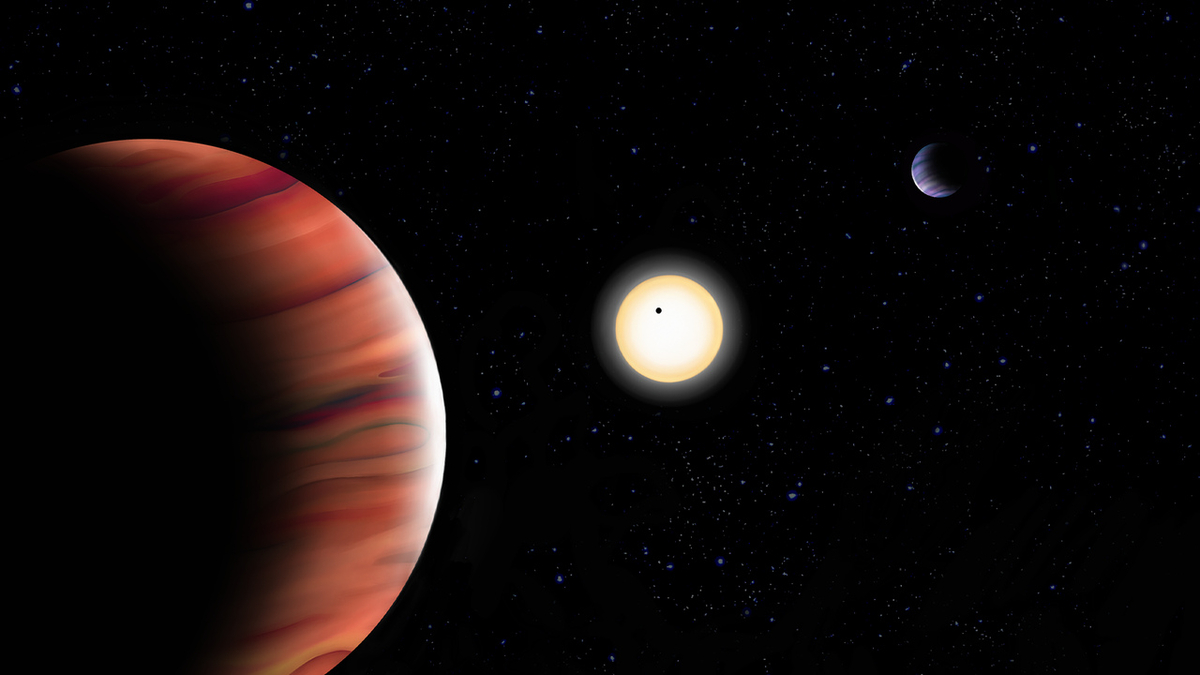
A team of astronomers from the University of New Mexico, led by doctoral student Ismael Mireles, published a study in Science Advances on the exoplanetary system TOI-201. Their research confirms the presence of three celestial bodies: a super-Earth (TOI-201 d), a hot Jupiter (TOI-201 b) and a brown dwarf (TOI-201 c), whose gravitational interactions modify orbits in real time.
What are the components of this atypical system?
The first body, TOI-201 d, is a rocky super-Earth, about 1.4 times larger than our planet, but six times more massive. It completes its orbit in just 5.85 days, probably making it too hot to harbor liquid water.
Further away is TOI-201 b, a hot Jupiter that is a gas giant half the mass of our Jupiter and orbits in 53 days. The main actor, however, is TOI-201 c, a woman brune massive in a very elliptical orbit of almost 8 years, responsible for most of the system’s disturbances.
Why is this system so special?
The particularity of TOI-201 lies in its observable evolution. Ismael Mireles explains: “ It is one of the few systems where planetary orbits can be observed actively changing on a human scale. “The gravitational influence of the brown dwarf causes rapid and measurable changes.
This dynamic is so pronounced that within 200 years, super-Earth will stop transiting in front of its star from our point of view. According to the researchers, these objects follow cycles where they become visible then invisible over thousands of years, depending on the inclination of their orbits.
How were the orbits confirmed?
To characterize this complex system, scientists combined several observation techniques.
Spectroscopy made it possible to measure the oscillation of the star to determine the masses, while transit photometry, using data from NASA’s TESS telescope, detected drops in brightness as the planets passed.
They also used variations in the timing of the transit to detect mutual gravitational influences and astrometry to track the star’s position. The next transit of the brown dwarf is expected on March 26, 2031.