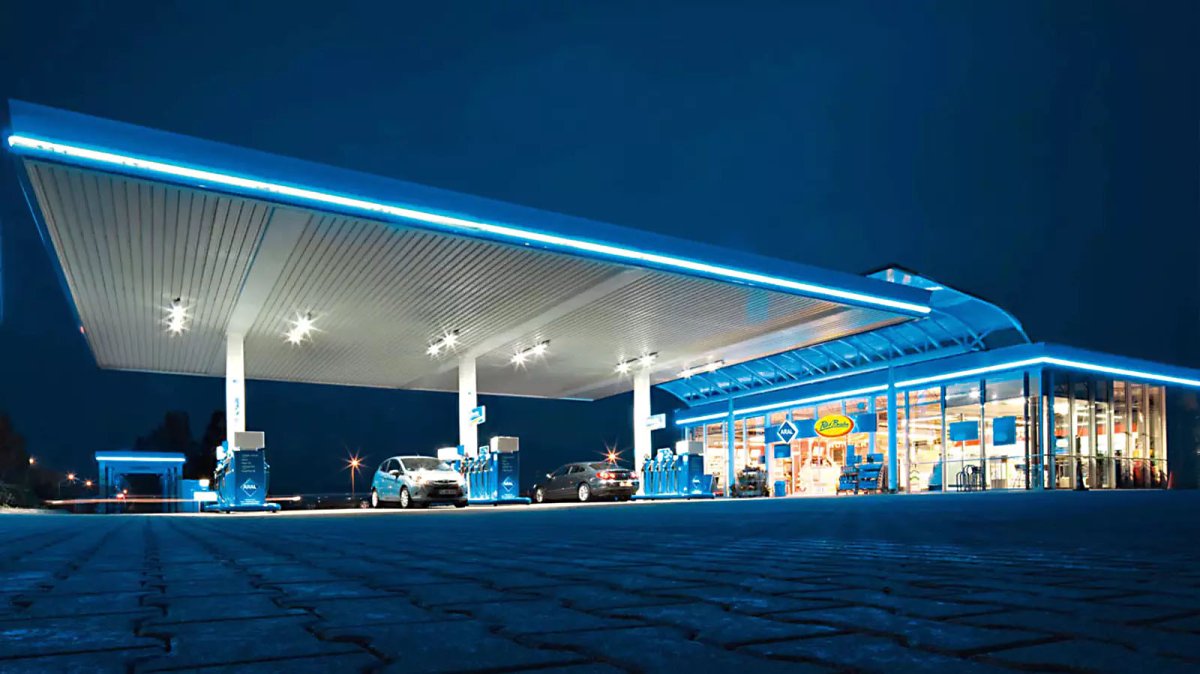
As far as fuel prices are concerned, April is expected to be the most expensive month of all time, as can be estimated from data from the ADAC. At its peak, diesel was more expensive than ever, and gasoline just missed its record from 2022. But adjusted for inflation, the prices are no longer so extraordinary, even if most drivers won’t find that particularly comforting.
Read more after the ad
If you look at the number, April will be a record month. There are average prices calculated by the ADAC for the first 29 days. Your average is around 2.11 euros per liter for E10 petrol and around 2.27 euros for diesel. Both would be clear records. The previous highs are 2.07 euros for E10 in March 2022 and 2.16 euros for diesel last March. This means that the price would have to crash extremely on the last day of April in order to prevent new records.
Adjusted for inflation in the meantime, things look different: Not only fuels have become significantly more expensive, but also other goods and services. The general price level in April was a good 25 percent higher than the average for 2020, as can be calculated from preliminary figures from the Federal Statistical Office. If you convert the fuel prices in April to the general price level of 2020, it is only 1.68 euros per liter for E10 and 1.81 euros for diesel.
Adjusted for inflation, 2011 and 2012 were sometimes more expensive
If you compare that with the price-adjusted monthly prices since the beginning of 2011, the diesel price is still high, but is well below the high of the equivalent of 1.98 euros in March 2022. And E10 falls even further behind compared to previous prices: adjusted for inflation, the fuel was not only more expensive in the initial phase of the Ukraine war than it is now, but also over long periods in 2011 and 2012.
This will hardly be of any consolation to drivers who now spend more than 100 euros on a tank of fuel. However, you can hope for the fuel discount from May 1st and look at the price development over the course of April. Most recently, prices were well below the highs around Easter. Even these highs no longer look so drastic when converted to 2020 levels: for diesel, the 2.447 euros on April 7th becomes 1.95 euros, for E10 the 2.192 euros on April 6th becomes 1.75 euros.
Measured against the general price development, fuel “continuously became cheaper” in the 2010s, says Friedrich Heinemann from the Leibniz Center for European Economic Research (ZEW). “Then came the two price surges, in the energy crisis after Russia’s attack and now. But at the turn of the year, price-adjusted fuel costs were more than ten percent below the level at the beginning of the 2010s.” If you now take into account that “purchasing power has increased and fuel consumption per horsepower has declined, the actual burden on drivers is put into perspective.” This raises the question of why politicians are “so quick to pull out the checkbook”.
Read more after the ad
(fpi)