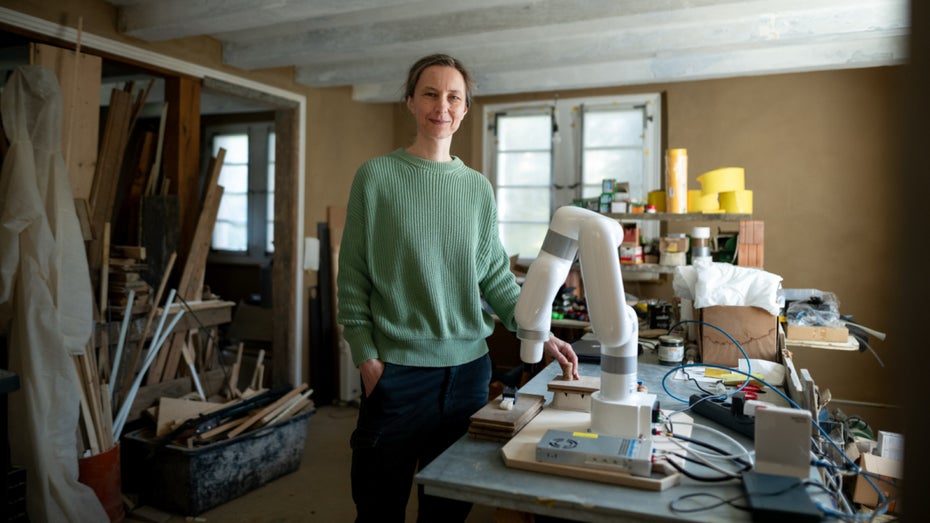
The Solingen slate house, typical of the region, is around 225 years old, is a listed building and is currently being completely renovated. Half-timbering and clay plaster testify to ancient craftsmanship. But anyone who takes a look at the construction site can hardly believe their eyes: inside, robots are being trained to become construction helpers with the help of artificial intelligence.
Homeowner Aleksandra Konopek made a virtue out of necessity: When the former university teacher couldn’t find a craftsman to plaster the ceiling with clay, she came up with an idea. The former professor quickly converted her slate house in the Bergisches Land into an AI and robotics laboratory.
After all, overhead plastering is one of the most health-damaging jobs in construction, she reports. The heavy clay has to be pressed with a lot of pressure so that it holds. The hard work has consequences for the construction workers, their shoulders and necks: “After 3,600 hours of work, the first damage to health occurs.” These are now a recognized occupational disease.
One day work, two days sick
“A craftsman told me: If I do that for one day, I’ll be sick for two days afterwards. By the mid-40s at the latest, the hard work becomes a health problem for the construction workers.”
The first question – can the robot hold a trowel – was quickly answered: “It can.” Now Konopek wants to teach the robot to master this work in the crooked and crooked old building. The robot is already swinging the trowel, but: “It will take about two years until we have trained it,” says the qualified industrial designer.
But can he also press heavy clay onto the ceiling in such a way that it holds? The first attempt fails, the clay hits the floor, but Konopek defends her robot: “It was because of the clay, it was too dry. The ceiling also needs to be moistened more.”
Editorial recommendations
${content}
${custom_anzeige-badge}
${custom_tr-badge}
${section}
${title}
Second attempt: The clay sticks
The second attempt works: the clay sticks to the ceiling and is smoothed out by the robot with a trowel. “Great! I’m totally satisfied,” says the scientist.
She sees enormous demand for its development: there are almost 20 million residential buildings with more than 40 million apartments in Germany, says Konopek. 60 percent were built before 1980. A lot would have to be done to get the renovation backlog under control – if it weren’t for the shortage of skilled workers.
However, the problem is still the robot, especially its weight, especially since it needs a mobile base. Heaving equipment weighing 300 or 400 kilograms up narrow stairs to the first floor is not practical. “Our goal is a device weighing 60 to 70 kilos.”

The robot arm in use. (Photo: picture alliance/dpa | Fabian Strauch)
Potential for further areas of application
In the end, the robot should detect all the unevenness of the ceiling itself and plaster them. The former professor has found a dozen partners for this purpose and is now hoping for research funding. “The camera, the weight sensors – they already exist.” A laser is supposed to measure the subsurface.
The industrial designer already has other areas of application in construction in mind: “Working with paints or removing asbestos. A robot does not breathe in dangerous dust or vapor.” Its operator could stand outside and – if not AI trained – control the robot using VR glasses. A third area of application is the facade: a robot on a lifting platform does not require scaffolding.
But his colleague robot also has sensitivities, which is why he is wrapped in plastic film in Solingen. If plaster falls on his joints, it’s not so good: “They won’t forgive that.” The work is not entirely without danger, because the robot is powerful. “It has already torn itself from its anchorage,” reports the developer.
DIN standard for clay
“We work with the Visual Language Action Model,” says Konopek. It’s about linking movement data with image data and voice commands. A digital twin could take over the learning and also simulate the nature of the clay. “Fortunately, there is a DIN standard for clay.”
In the old building, however, nothing is standardized. The robot must be light, agile and modular. “Quality control has to be done by a person.”
Arnim Spengler, expert for digitalization in construction, believes that the time for robots in construction has gradually come. Eight years ago, the scientist at the Ruhr West University of Applied Sciences in Mülheim developed a robot that can build sand-lime brick walls. He was also involved in the first 3D printed building in North Rhine-Westphalia.
Nobody wants to become a bricklayer anymore
“Because of the hard work, no one wants to become a bricklayer anymore. That’s why the use of robots makes sense,” says the engineer. The bricklayer would thus become a machine operator, but not superfluous. “A human-machine symbiosis will emerge.”
Smaller repair jobs that are incredibly difficult for the robot are very easy for the trained bricklayer. But why don’t we still see robots in construction? “The construction industry is conservative. The craft has developed its standards over centuries,” says Spengler. “New construction methods and techniques have a hard time.”
Robot systems are also a cost factor. “Humans are still cheaper than a robot,” says digitalization expert Spengler. But robotics is becoming increasingly cheaper – and the shortage of skilled workers is becoming ever greater.
Top Article
${content}
${custom_anzeige-badge}
${custom_tr-badge}
${section}
${title}