In Spain more and more people live alone. And more and more people are living in overcrowded conditions as well. I know: it sounds contradictory, but that is the curious reality drawn by the studies that are in charge of ‘x-raying’ the country’s homes. As paradoxical, counterintuitive and even ironic as it may be, statistical observatories such as the INE or Eurostat confirm that while a part of Spain is forced to live in overcrowded conditions, sharing a house or even a room, the number of single-person households is growing at such a speed that in a few years they will probably be the most common in Spain.
That tells us a lot about how the country, its society, the economy and (also) the residential market are changing.
Overcrowded Spain. Among its many functions, Eurostat is responsible for reviewing every year how overcrowding data evolves in the different countries in Europe.
Said this way, the concept ‘overcrowded’ may sound subjective, but its technicians have a clear guideline to distinguish what is (and what is not) an ‘overcrowded’ home. In general terms, a home is considered saturated when it does not have a room for each couple, for each adult or for each two young people of the same sex. In Spain that is a reality that more and more people are dealing with. Especially if we talk about people who live in rented houses.
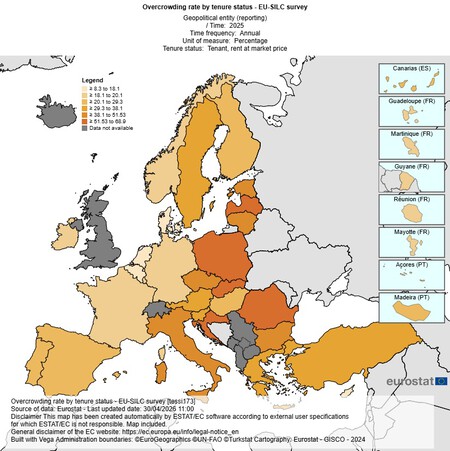
A percentage: 9.5%. The data from Spain leave two clear readings. The first, positive one, is that in our country the overcrowding rate is much lower than that of other European nations. At a general level (if we take into account all types of housing, owned and rented, both in the free and regulated markets) Eurostat estimates that 9.5% of the Spanish population resides in ‘overcrowded’ houses. Although in practice this is equivalent to millions of people, it is far from the 16.8% average of the 27 EU countries or the ratio of states such as France (10.8%), Italy (24.3%), Portugal (12.7%) or Germany (11.7%). That’s the positive part. The negative part is how the indicator has evolved.
In Spain the overcrowding rate has not stopped growing in the last five years until it is at its highest level in the last decade. As a reference, in 2018 it was 4.7% and in 2016 it was 5.4%. The EU average has advanced at a much slower pace. In fact, it has been practically stagnant for years at around 16.8%, a value somewhat lower than that registered in 2016, when it was around 18%.
A tenant problem. Eurostat data reveal something else: although there is no market that escapes overcrowding, not everyone suffers from it equally. Its incidence is especially high when we talk about people who reside in homes rented at market prices. That is, without taking into account protected housing. In that case the overoccupancy rate shoots up to 20.5%. What does that mean? That a fifth of Spanish tenants who have rented houses on the free market live in what Eurostat considers overcrowded conditions.
Once again, the figure is below the EU average (23.8%) or the rate of nations such as Italy, but it exceeds the indicators for France (18.6%), Germany (18.3%) or the Netherlands (8.3%). And again it also stands out for its evolution. Beyond the comparison with the rest of the EU, the reality is that this 20.5% is considerably above the 12.5% in 2016 and represents the highest value since at least 2014.
|
Spain |
General overcrowding rate |
Overcrowding rate among tenants in the free market |
|---|---|---|
|
2016 |
5,4 |
12,5 |
|
2017 |
5,1 |
12,4 |
|
2018 |
4,7 |
12,8 |
|
2019 |
5,9 |
16,3 |
|
2020 |
7,6 |
18,8 |
|
2021 |
6,4 |
15,4 |
|
2022 |
6,6 |
14,9 |
|
2023 |
7,6 |
17,5 |
|
2024 |
9,1 |
20 |
|
2025 |
9,5 |
20,5 |
What is the reason for this increase? A sum of factors, as stated this week The Country in an analysis of the increase in overcrowding in Spain. One of those (crucial) elements is how the housing market has performed in recent years. Idealista reveals that in general the price of rentals has almost doubled in the last decade, at least if we talk about nominal values (without taking into account the effect of inflation): from €7.7/m2 in April 2016 we have gone to €15/m2. In highly stressed markets, such as Palma, this increase has been even more pronounced.
The increase in housing prices (extended to both the rental and purchase markets) directly influences the behavior of families. Not only does it limit the options that those looking for housing can choose from, it also makes it difficult to become emancipated and assume the rental of an apartment without sharing expenses. Not to mention that the imbalance between supply and demand can lead some landlords to opt for renting single rooms and makes it difficult for families who, after growing up (due to reunification or the birth of children) aspire to a larger apartment.
A more populated country. There is another key factor. The increase in the overcrowding rate coincides with the general growth of the Spanish registry. According to the INE, at the beginning of 2026, 49.57 million people resided in the country. Not only are they 440,000 more than a year before, they also represent “the maximum value in the historical series,” in the words of the INE. This growth is also supported by immigration, which broke its own record. In January, the foreign-born population exceeded ten million people for the first time.
Why is it important? Although inflation may have led some families to rent part of their homes to make mortgage payments more bearable, it is not unreasonable to think that this increase in migration explains in some way the rate of overcrowding. The economist José García Montalvo remembers in The Country that the foreign population tends to group together in support networks and part of the migrants who arrive in Spain choose, at least at first, to settle in the homes of people they already know. “So where three live, five end up living,” he illustrates.
In any case, the phenomenon is more complex and cannot be explained only by migration flows. Another key factor is the age at which Spaniards become independent. Although it has been recovering little by little after the pandemic, the emancipation rate of young people is still far below that reached in 2007, before the great recession. In practice, this means that children spend more time living with their parents. There are also studies that suggest that in Spain it is increasingly common for family members belonging to several generations to live together in the same home.
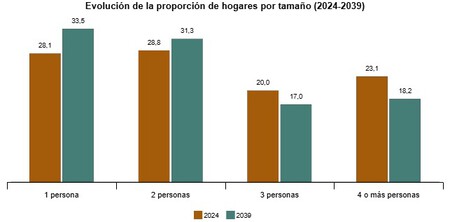
The great paradox. The evolution of the overcrowding rate is curious in itself, but it is even more so when another phenomenon that is also gaining ground in Spain is taken into account: people living alone. In an article published in December in The ConversationElisa Brey, an expert in migration and urban life at the Complutense University of Madrid, recalled that single-person households have gone from five million in 2021 to more than 5.5 in July 2025. The growth, of 10.8%, exceeds that of households formed by two people (9%), those in which three members reside (1.6%) and the largest, which fell by 0.3%.
If the INE’s projections are right, in 2039 there will be 7.7 million single-person households, an important figure for two reasons. To begin with, because it is the format that will grow the most in the next decade and a half: 41.9%, well above the 29.7% estimated for households with two members or the 1.1% of those with three members. The other reason why the figure stands out is that, if the INE forecast is met, single-person households would surpass those made up of two people and would become the most common type. In fact, they would represent around a third (33.5%) of the country’s households.
Images | Mathias Reding (Unsplash), INE and Eurostat
In | Madrid’s crazy price escalation threatens to leave families without their “plan B”: looking for housing in the periphery