Apple is preparing a visual patch for macOS, a year after launching a design that its own engineers admit they did not have time to finalize. Safari gains automatic tab classification.
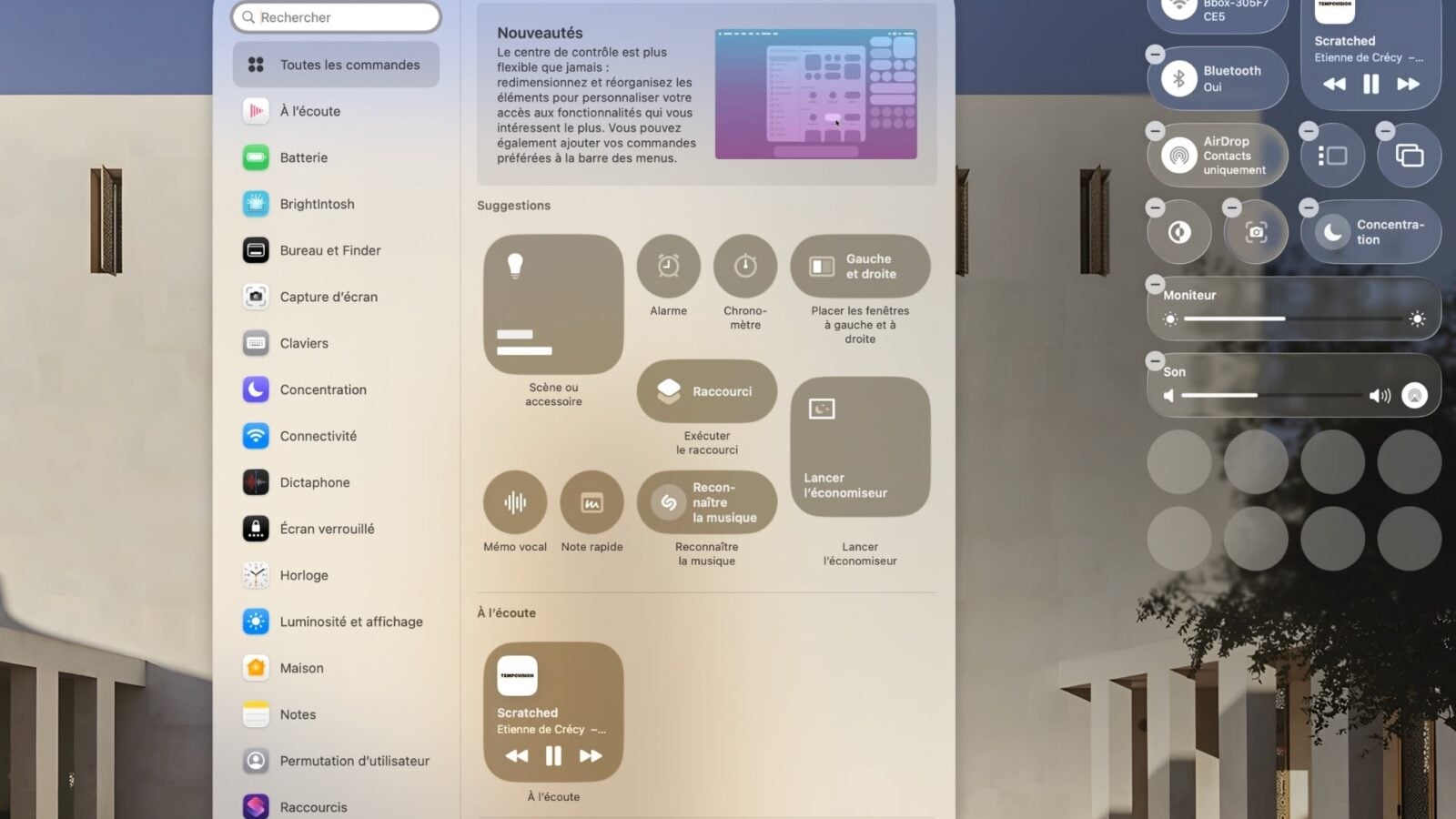
Liquid Glass, you remember. Announced with great fanfare at WWDC 2025, this visual language full of transparency and dynamic reflections was to modernize the entire Apple ecosystem. On iPhone, the result is passable. On Mac, the graft took significantly less well. According to leaker Mark Gurman, macOS 27 will include a “slight redesign” to correct the readability problems that Tahoe has had since its release. Apple is not backtracking on Liquid Glass. The firm simply admits (internally) that the execution was shoddy.
What Apple will change on macOS 27
The adjustments will focus on shadows, opacity and transparency layers. These are precisely the elements that have been problematic for a year. On Macs equipped with LCD screens (the vast majority of the fleet, MacBook Air and Neo in the lead), the result is painful on a daily basis. The texts in the Control Center, Finder and sidebars become difficult to read as soon as the wallpaper is light. The refraction effects, designed for the OLED panels of the future touchscreen MacBook, simply do not work on classic LCD panels.
Gurman is pretty blunt about the diagnosis. The problem is not the Liquid Glass as such, but an implementation delivered before being completed. The most telling precedent dates back to 2013. When Jony Ive imposed flat design with iOS 7, the criticism was just as virulent. Apple then adjusted the approach in small steps on iOS 8, 9, 10, until it found the balance. Same strategy here, except that macOS Tahoe started from further afield (Mac users are less tolerant than iPhone users when it comes to productivity).
Safari learns to organize your tabs on its own
Second new feature confirmed by Gurman for macOS 27: Safari integrates a function AI automatic tab grouping. In iOS 27 test builds, a new “Organize Tabs” button appears at the top of the interface. The user can choose between automatic classification (Apple Intelligence analyzes the content of pages and creates thematic groups) or manual sorting on demand. The feature will be available on macOS 27, iOS 27 and iPadOS 27.
Apple is not the first to try this. Chrome has offered a Tab Organizer since January 2024, and Firefox followed in July 2025 with its AI version in Firefox 141. The difference is the plumbing. Chrome worked for two years by sending your tab titles and URLs to Google’s servers for classification. It wasn’t until March 2026, with Chrome 146, that Google switched to local inference. Firefox took the opposite path: local inference from day one, ONNX models downloaded to the machine, no data transmitted to Mozilla. The approach had its failures (Firefox 141 caused more than one user’s fans to spin), but the principle was established.
Apple should logically take the same route as Mozilla. Apple Intelligence already runs on the Neural Engine of the M and A-series chips. The company made it a commercial argument: “your data does not leave your device”. Classifying tabs by theme does not require the power of a frontier model. This is exactly the type of task for which local inference makes sense. Apple’s advantage over Firefox remains iCloud synchronization: a group created on Mac can be found on iPhone and iPad. For others, it’s one less reason to leave Chrome.
All these new features will be officially revealed during the keynote WWDC from June 8, 2026. The betas for developers will follow immediately, the public version in July, and the final deployment in September. Mac users with LCD screens therefore still have a few months of approximate Liquid Glass ahead of them.
👉🏻 Follow tech news in real time: add 01net to your sources on Google, and subscribe to our WhatsApp channel.
By: Opera
Source :
Bloomberg/Mark Gurman