Mike Sawh
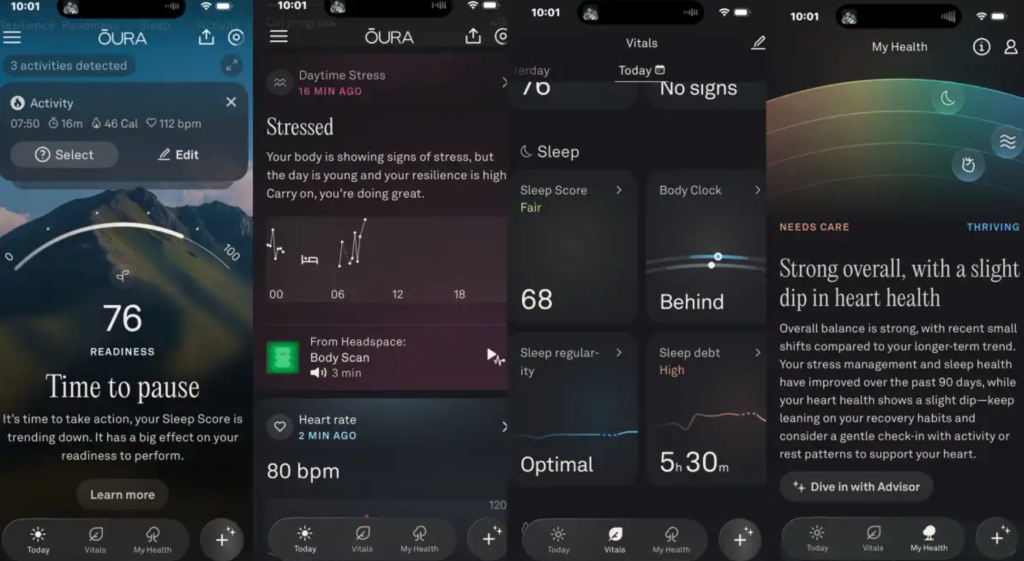
The data is stored in the Oura companion app, which is still considered the market leader among smart rings. Especially when it comes to presenting a growing amount of data and insights in an engaging way.
You can access some features for free, but to make owning the device worthwhile, you’ll still need to pay the monthly or annual subscription.
The app also offers useful integrations, including Strava, Headspace and Clue. These help fill the gaps in features that the Oura can’t offer – which isn’t a particular strength of the Oura ecosystem.
The main Today screen gives you updates on your daily readiness levels or a reminder of when you should get ready for bed. Click on the drop down menu and there is much more to discover. For example, logging meals or using the symptom radar.
Mike Sawh
New software features such as “Health Radar” will initially be rolled out to users in the US. This feature builds on Oura’s “Symptom Radar” to detect early signs of illness. Blood pressure signals are also being introduced in certain regions. While you can’t measure blood pressure with your Oura ring, the device tracks trends in your cardiovascular patterns using the data its optical sensors collect throughout the night.
These software features are offered to both Oura Ring 5 and Oura Ring 4 users, so existing owners may not see a reason to upgrade in this regard.
The Oura does a solid job of recording daily steps. I wore it with two other trackers during the day, and the daily step counts were very close to each other most days.
As for the improved heart rate measurement, you should see a slight improvement in exercise heart rate as well as recovery-based tracking during sleep monitoring.
Looking at the heart rate, the values during sleep corresponded to the reliable sleep rate measurement of a Garmin device and another smart ring that I wore at the same time. The situation was similar with the daily average values.
As for heart rate measurement during exercise, this has always been a problem for smart rings in general and not just Oura. Simply because the ring tends to shift when you sweat and move. I would still say that heart rate monitoring during exercise is not Oura’s strong point.
However, a solution has been developed to improve the situation. Now you can share the live heart rate data from another wearable. Of course, this means you have to own another device, but if you already have one, this is a great way to get that better training data.
Mike Sawh
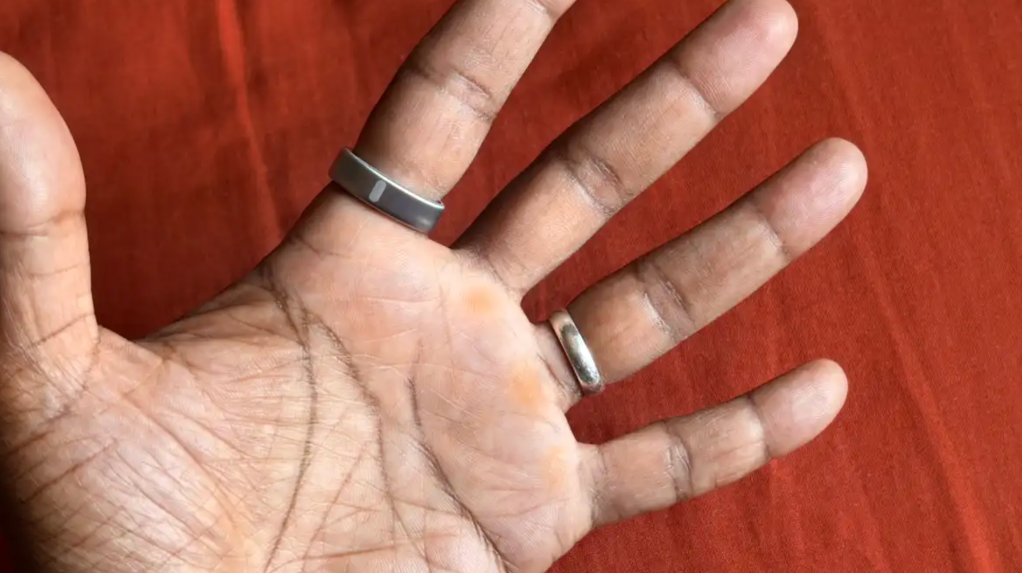
Then there’s sleep, which has always been one of Oura’s strengths. That’s not just because it’s a very comfortable ring to take with you to bed – which is even more the case with the Ring 5.
In addition to sleep metrics, you get sleep summaries, a more detailed sleep breakdown, and core metrics like sleep stages and sleep duration.
These insights were very meaningful, especially in terms of tracking the time I fell asleep as well as the displayed times I spent in REM and deep sleep. Oura also shows you how well you are making up for your lack of sleep and to what extent you are in tune with your natural internal clock.
Many of these metrics form the basis of Oura’s key insights on preparedness and resilience. The former has been adopted by other wearable device manufacturers under similar or different names.
The “Readiness” function is designed to simply show you whether you have enough energy to cope with a busy day. I compared the Readiness scores with similar evaluations from Garmin and Ultrahuman, and they were only a few points off the Oura scores.
Resilience insights relate to understanding your ability to recover from physically demanding or stressful periods of your week. Your recovery during the night and day as well as your stress levels throughout the day are taken into account.
You will then find out whether you have a high level of resilience to these factors or whether you have difficulty recovering.
You’ll receive additional guidance and advice to help you manage this stressful period of your week. I find that the insights on preparedness are easier to put into practice than those on resilience. If you’re more focused on stress, this feature is more tailored to you.
Battery life & charging
- Up to 9 days of battery life
- Full charge in 80 minutes
- Optional charging case available
Despite the smaller size, Oura says the Ring 5’s battery life isn’t compromised. Accordingly, the Ring 5 lasts between 6 and 9 days. This is in contrast to the 5 to 8 days stated for the Oura Ring 4 – so it has been slightly improved.
Mike Sawh
Oura says it has revised the design and optimized battery performance using software. Similar to previous models, this ring lasts for a week as long as you don’t use the more energy-intensive blood oxygen measurement.
As for the question of whether this is the best battery life among the smart rings currently available, it’s still not quite up to par. Both the RingConn Gen 2 and Ultrahuman’s newest rings last longer, but the Ring 5 should last long enough for most users.
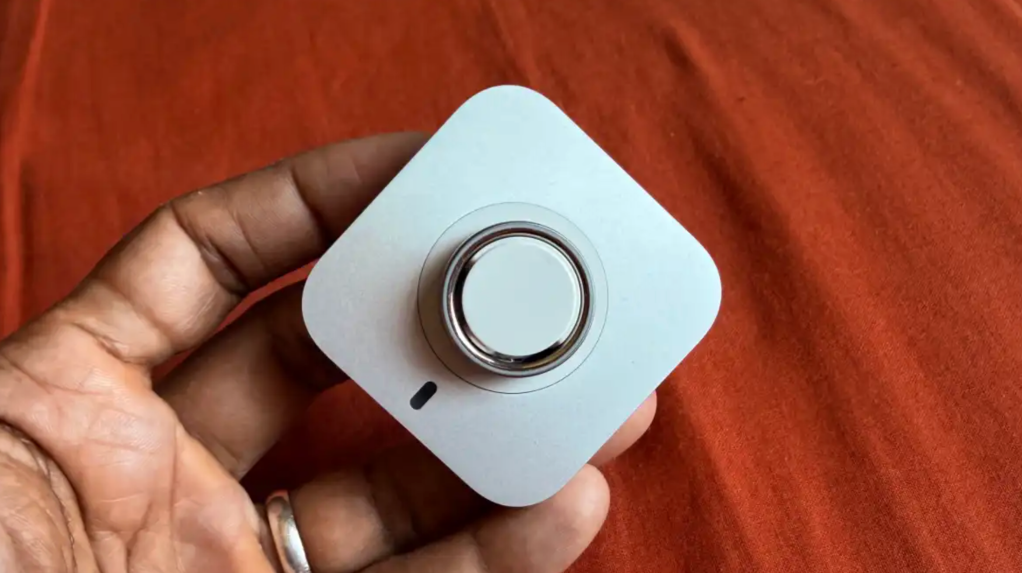
Charging the ring is still done in the same way. It’s the same type of charging station that can take over an hour to charge the battery from 0 to 100 percent. If you want a more convenient and travel-friendly way to charge the Ring 5, you’ll have to spend more on the charging case, which – like the Ring – isn’t exactly cheap at $109.
Price & Availability
The price for the Oura Ring 5 starts at 429 euros and can go up to 529 euros, depending on the version. That’s a price increase of 20 euros over the Oura Ring 4, without the additional subscription of 5.99 euros per month or 69.99 euros per year.
This makes it one of the most expensive smart rings on the market, so the purchase decision is not that easy. Especially when there are now models without a display, like the Fitbit Air for 100 euros, if you don’t necessarily want to opt for a ring.
However, it is not as expensive as the Ultrahuman Ring Pro and RingConn Gen 2. However, these rings do not require a subscription to access all available features. This also applies to the Samsung Galaxy Ring for 449 euros.
You can purchase the Oura Ring 5 in the official shop as well as from providers such as Amazon. Check out our list of the best smart rings for our full recommendations.
Should you buy the Oura Ring 5?
If you already own an Oura Ring 4 and are happy with the size, appearance and performance – whether ceramic or standard – then you probably don’t need the Oura Ring 5. Especially since the new software functions will also be available for the Ring 4.
If you’ve been waiting for a smaller, more stealthy Oura, then the Ring 5 is for you. In addition, you get access to the same features and potentially longer battery life (as long as you’re okay with the subscription cost).
The hardware and software package continues to make the Oura Ring the benchmark to beat. Providers like Ultrahuman and newcomers like the Leep Ring 1 have shown that there is also excellent software outside of Oura. But it just doesn’t look as stylish, which is important for a smart ring.
I enjoyed using the Oura Ring 5 and think the new, smaller design will likely encourage more people to buy a smart ring despite the subscription. But I would also be happy to go back to my ceramic Oura Ring 4. This just goes to show that Oura now has two strong Ring options on offer that don’t make you feel like you’re missing out on important software updates by spending less.
Technical data
- up to 9 days battery life
- compatible with Android and iOS
- 2,28 mm dick
- from 2 g weight
- waterproof up to 100 meters
- tracks blood oxygen levels, heart rate, body temperature, sleep and daily activity
- requires a monthly or annual subscription
(PC-Welt)