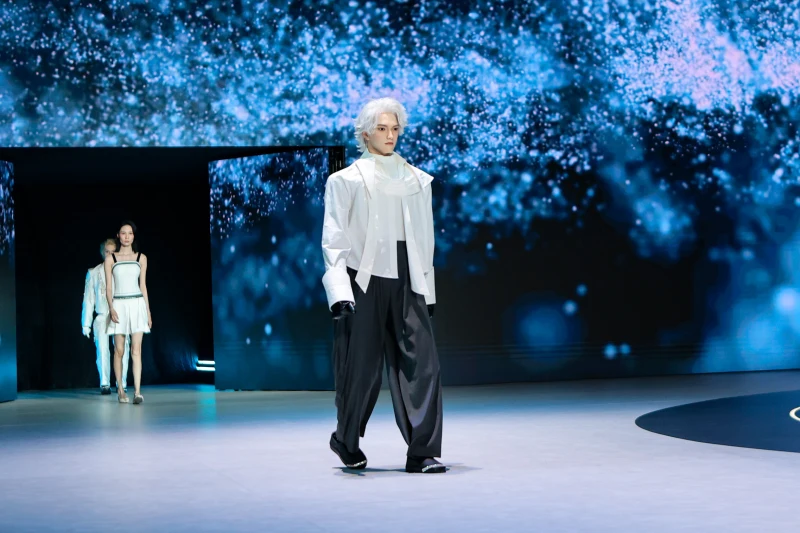
The robotics company Ubtech from Shenzhen, China, is launching the Uworld U1 series, new humanoid robots that are specifically designed for use in private environments. As New Atlas reports, the manufacturer is positioning the models as the world’s first mass-produced “ultrabionic” companions for humans. The People’s Republic of China has been considered a global leader in humanoid robotics for some time, but its development has so far focused almost exclusively on machines for tough industrial use. With the new product line, Ubtech now wants to open up a new market and bring robots directly into consumers’ living rooms.
The machines have human facial features and skin made of silicone, which, according to the manufacturer, even has pores and wrinkles and should feel very realistic. To reinforce the illusion of a real counterpart, the robots blink and, thanks to 88 integrated servo motors, can display up to 300 different micro-expressions on the face. This brings scenarios that were previously only known from films a significant step closer to technical feasibility. However, a closer look at the specifications shows that the machines are still a long way from having a truly human appearance.
Ubtech Uworld U1 focuses on emotional support
The manufacturer had originally made far-reaching promises about the range of functions and promised tasks such as caring for the elderly, walking dogs or general household tasks. These advertising messages, which according to the reports should be fully supported by artificial intelligence, promised an always loyal and versatile helper for everyday life. However, at the official market launch, the practical use cases were deleted without replacement, so that the focus of the Uworld series is now exclusively on emotional support and companionship for lonely people. The approach of satisfying basic human needs for interaction through machines raises profound ethical questions.
Interested buyers can choose between a male and a female model as well as different technical levels, which are marketed as U1 Lite, U1 Pro and U1 Ultra. The Lite version consists of only one upper body, while the Pro and Ultra models are designed as full-body systems with different capabilities. The male model measures 1.83 meters in height and weighs 42 kilograms. The female version is slightly more compact with a height of 1.63 meters and a weight of 35 kilograms.
Latency in AI and limitations in practice
So that the machines can react appropriately to human emotions, integrated AI systems record the eye contact, tone of voice and facial expressions of the human counterpart. Although the time delay in pure lip synchronization is said to be less than 20 milliseconds according to Ubtech, the artificial intelligence reveals significant weaknesses in processing speed when actually answering questions. Calculating an adequate answer simply takes too much time, making a natural flow of conversation almost impossible.
In an official demonstration, a woman told the robot that she was depressed, and the machine initially stared at her silently for several dozen seconds before making a verbal response. These massive delays lead to unpleasant pauses in the conversation, which significantly tarnish the advertised impression of a progressive companion. In addition, the movements of the machines seem rather slow and unnatural when walking, which is why observers compare the systems more with life-sized dolls than with agile robots.
Pre-orders for the humanoid robots from China
Despite these obvious technical limitations and a very short battery life of just two to four hours, the manufacturer claims to have received over 13,000 orders on the day of release. However, this number is quickly put into perspective upon closer inspection, as a large proportion of the early purchases apparently did not come from private individuals, but can be traced back to government procurement programs and commercial exhibition halls. The mass introduction of companion robots into private households is still a long time coming.
Top Article
${content}
${custom_anzeige-badge}
${custom_tr-badge}
${section}
${title}
The acquisition costs for the robots vary considerably depending on the desired equipment and severely limit the potential target group. Prices start at 119,800 renminbi, which corresponds to around 17,655 US dollars, and range up to 990,000 renminbi, i.e. almost 146,000 dollars for the absolute top model in the series. Investing the equivalent of a luxury car in a machine that has to be plugged in after a few hours and stalls during complex conversations is unlikely to be a rational decision for most people.
In addition to the financial hurdle, such systems also raise fundamental questions about the extent to which machines can actually be a healthy solution to the increasing social problem of loneliness. The attempt to replace human interactions with programmable, always-agreeing companions could, in the long term, change the way people form real relationships and manage conflict. It will undoubtedly take many years of technological research before humanoid robots are able to carry on a truly error-free and natural conversation.