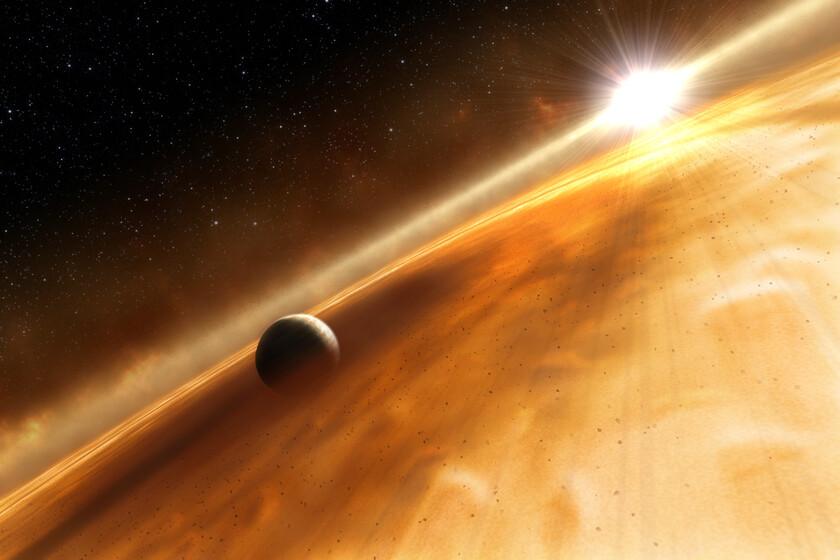
Investigating the universe beyond the Solar System we know sometimes brings up more questions than answers. The search for exoplanets has left findings so different from what we know as fascinating. Thus, more than a decade ago the Kepler space telescope identified Kepler-16b, a planet with “two suns” like Tatooine from Star Wars, and the James Webb telescope came across a world of boiling lava that is paradoxically colder than theory says.
In the process of investigating the universe you can witness the disappearance of a planet, as NASA’s Hubble has monitored, to discover that there was nothing like a planet: they were in front of a violent cosmic phenomenon.
First they detected a bright point of light and assumed that it was a planet covered in dust where the brightness of its star was reflected. Then the object disappeared and a different bright source appeared nearby. Finally, this international research team realized that they were not seeing planets at all: the light was coming from incandescent debris generated by violent collisions, as they later published in Science.
A planetesimal collision that changes everything
In their observations in time, they captured two different and very powerful impacts that generated large amounts of dust in the same planetary system, which constitutes a magnificent opportunity to understand how planets are formed and what type of materials they are made of. Their main hypothesis: they have glimpsed not one, but two extremely rare events: one (two) planetesimal collisionthat is, a collision between small rocky objects similar to asteroids.
Northwestern University astrophysicist Jason Wang explains that it is the first time they have seen a planetesimal collision outside the solar system and that its study is “key to understanding how planets form and can also provide information about the structure of asteroids, something important for planetary defense programs such as the DART test.” Paul Kalas, an astronomer at the University of California at Berkeley and lead author, insists on the exceptionality of the event: “It is not present in any of our previous Hubble images, which means that we have just witnessed a violent collision between two massive objects and a huge cloud of debris, something that has no parallel in our current solar system.”
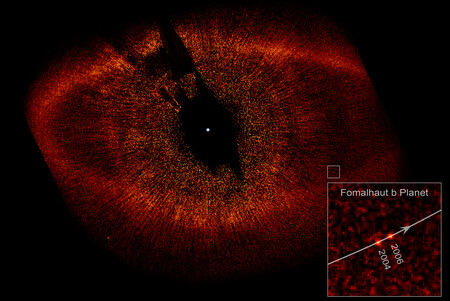
F. Kalas, J. Graham, E. Chiang, E. Kite (University of California, Berkeley), M. Clampin (Nasa Goddard Space Flight Center), M. Fitzgerald (Lawrence Livermore National Laboratory), and K. Stapelfeldt and J.
These collisions occurred in the planetary system surrounding the star Fomalhautwhich is larger than the Sun, is surrounded by an extensive and dense set of dusty debris belts and located about 25 light years from Earth, in the constellation Pisces Austrinus. That dust belt is so large that it is a real candy for research.
Planet it seems, cloud of dust it is
In 2008 they detected Fomalhaut b, a bright object of unknown nature that some researchers thought was a planet and others believed it was an expanding cloud of dust from a collision. Back in 2023, a new Hubble observation gave an unexpected twist to everything: the original light source was no longer there and another bright object had appeared in a slightly different area. As Wang explains, first They assumed it was Fomalhaut b, but they got a surprise:
“We assumed the bright light was Fomalhaut b because it was the known source of the system. But by carefully comparing the new images with the old ones, we realized that it couldn’t be the same source. It was exciting, but also perplexing”
So they had to change perspective and nomenclature: the original object was renamed Fomalhaut cs1 and its disappearance supports the idea that it was a cloud of dust that was slowly dispersing after a collision. They called the second bright source Fomalhaut cs2 and its behavior reinforces the conclusion that neither of the two objects was a planet: everything indicates that they are clouds of debris created when large planetesimals collide with each other.
Investigating Fomalhaut cs2 they concluded that it looked very similar to the beginnings of cs1 from two decades ago, both in brightness and location. So the team already estimates the frequency of collisions in this guy in the system: every 100,000 years or even less. After all, in 20 years they have already seen two.
Kalas explains that “if you took a movie of the last 3,000 years and sped it up so that each year lasted a fraction of a second, imagine how many flashes you would see. The Fomalhaut planetary system would be full of these crashes.”

Fomalhaut cs1 no longer exists, but the research team wants to continue monitoring the system and has its eyes on cs2, which could hide more valuable information about how collisions develop in young planetary systems. Of course, in addition to the old Hubble, they will use the near-infrared camera of the James Webb Space Telescope since the NIRCam can capture detailed information about color, so they can determine the size and composition of dust grainsfor example if they contain water or ice.
The confirmation of these collisions put a warning on the table for hunters of planets outside the Solar System: the gLarge clouds of dust can very well imitate the appearance of an exoplaneta by reflecting light from its star, which can lead to error using the reflected light detection system. Kalas sums it up: “What we learned from studying cs1 is that a large dust cloud can masquerade as a planet for many years.” As new observatories point to the sky to obtain direct images of Earth-like planets, differentiating between real planets and temporary dust clouds seems providential.
In WorldOfSoftware | Poland and Spain are the European countries that have increased their contribution to space the most. For very different reasons
In WorldOfSoftware | China reveals its cards for 2030: it will go in search of an “Earth 2.0” on its own
Cover | Javier Miranda
By ESA, NASA, and L. Calcada (ESO for STScI) – Hubble Directly Observes Planet Orbiting Fomalhaut