Adamya Sharma / Android Authority
I’ve been writing about technology for more than 12 years, and in that time, I’ve visited my fair share of smartphone assembly lines, design studios, and manufacturing hubs — places where the devices we use every day are built, tested, and refined long before they reach our hands. There’s something special about going behind the scenes, watching some of the brightest minds in the industry at work, and seeing just how much thought and precision go into a product that millions of people will someday rely on daily. During a recent trip to Taipei, Taiwan, I got to experience one such place firsthand: Google’s Pixel Hardware Labs, the company’s second-largest hardware R&D facility outside the US.
Which kind of testing do you care about the most in a smartphone?
66 votes
Google doesn’t usually open the doors to this space because it houses over 50 highly specialized and mostly secretive engineering labs under one roof. On this trip, organized by the company, I was part of a select group of journalists from around the world who were allowed inside five of the most fascinating Pixel hardware labs, and what I saw made it very clear why Pixels feel the way they do in daily use.
Editor’s Note: We’ll soon be publishing a full behind-the-scenes video tour of Google’s Pixel hardware labs on Android Authority’s YouTube channel, where you’ll be able to see these tests in action. Stay tuned.
The durability labs

Adamya Sharma / Android Authority
My first stop was the Pixel Reliability Lab. This is where Google gets really rough with its phones. One of the first stations I saw was the IPX4 water resistance test. The “X” indicates that the device is not specifically tested for solid particles, such as dust, while the “4” signifies protection against water splashes, simulating scenarios like heavy rain or sweat. This setup checks whether a Pixel can survive everyday water exposure. The phone being tested is mounted on a rotating turntable and is sprayed with water from all angles for about 10 minutes. The display is kept active during this time to monitor for any issues. It’s like the phone is taking a luxurious shower.
Of course, this isn’t the only test Google conducts to assess water resistance. Most Pixel flagships, including the Pixel 10 Pro Fold, are IP68-rated, and to achieve that, Google has to run separate full-immersion tests. Unfortunately, I didn’t get to see that during my visit to the lab.

Adamya Sharma / Android Authority
Once water resistance is cleared, things get more personal. There’s a test here that Google officially calls the sit test. The machine simulates what happens when you sit down with your phone in your back pocket, complete with a realistically simulated human butt. Google uses this test to assess the device’s design integrity and its ability to withstand this kind of force. It looks a bit funny, but it tests a very real-world scenario given how our phones perpetually live in our pockets.

Adamya Sharma / Android Authority
Then comes the ball drop test. Balls made of various materials, including steel and plastic, are dropped from different heights onto the phone’s display and back. It’s all about understanding how the glass and frame react to impact from different heights.

Adamya Sharma / Android Authority
Drop testing is another important part of Google’s reliability testing for its phones. Pixels are repeatedly dropped from different heights and at various angles to simulate real-world accidents, such as phones slipping out of hands onto various types of hard surfaces. By varying the impact points and surfaces, engineers here study how the frame, glass, and internal components of a phone can be impacted by sudden drops.

Adamya Sharma / Android Authority
One of the most mesmerizing tests to watch is the fold test. During my visit, the Pixel 10 Pro Fold was being opened and closed by a machine over and over again, stress-testing its hinge and folding display. Thanks to this process, Google confidently rates the device for 200,000 folds.

Adamya Sharma / Android Authority
And finally, there’s the tumble test. This one simulates the life of a phone inside a handbag, where it’s exposed to various physical stressors, such as coins, keys, hairbrushes, and other items. The goal is to ensure a Pixel can survive the chaos of everyday carry.
The robotic connectivity lab

Adamya Sharma / Android Authority
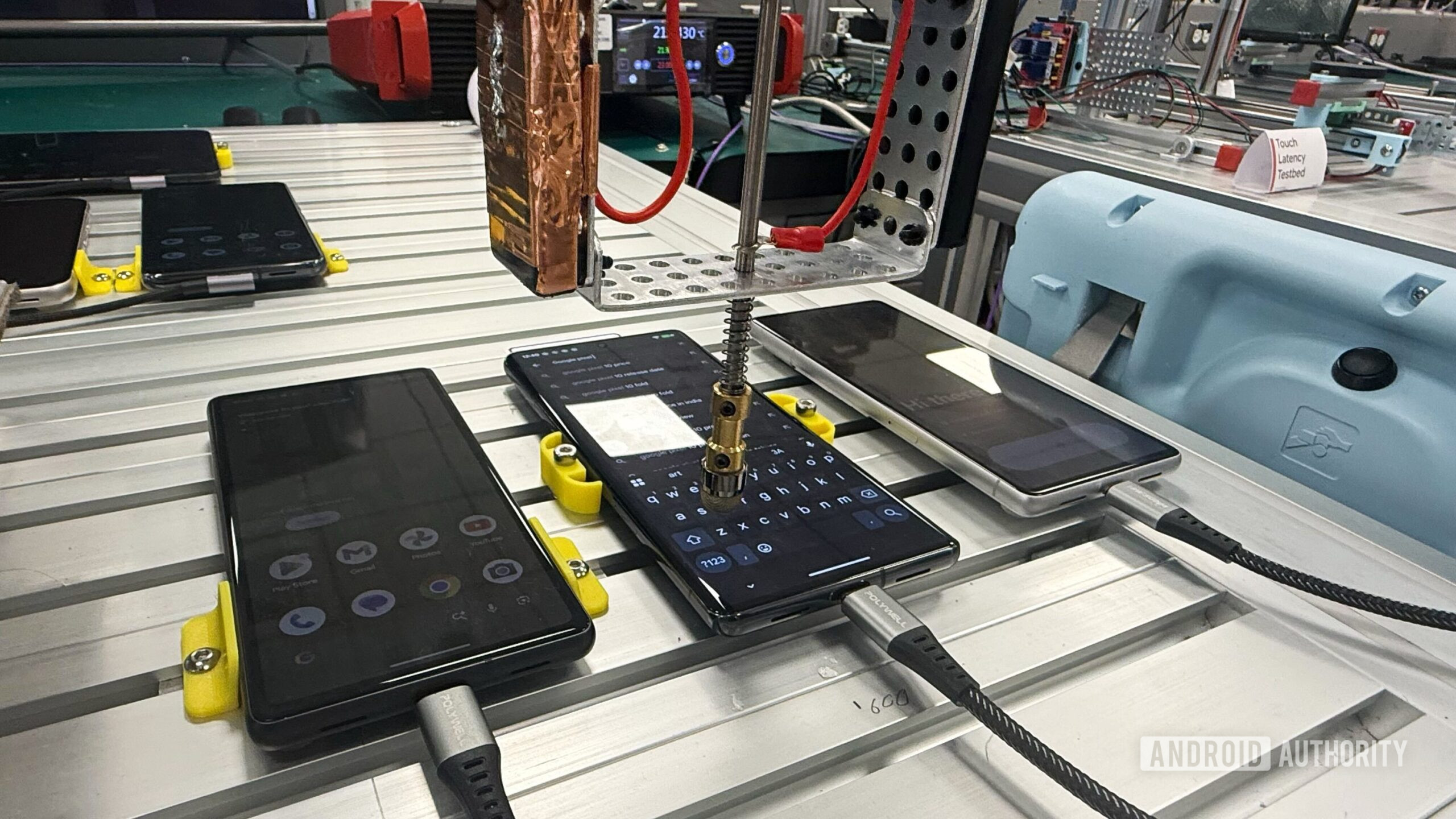
Because of my love for automation and machines, the robotic connectivity lab stood out the most during my visit to the Pixel Hardware Labs in Taipei.
Robotic arms are everywhere, picking up Pixel phones at random and testing nearly every sensor imaginable. Touch latency, temperature, light sensors, proximity sensors, it all happens here, and it happens fast.
What’s especially impressive is how customized everything is. Google fine-tunes these robotic systems specifically for Pixel testing, even 3D-printing custom rigs and tiny stands so phones sit at the exact right angle for each test.

Adamya Sharma / Android Authority
This is also where features most people take for granted are validated. Things like Watch Unlock, Adaptive Brightness, Flip to Shhh, and countless other systems are tested repeatedly until they work seamlessly. You would never see this lab in marketing promotions, but you can feel its work every single day you use your Pixel phone.
Don’t want to miss the best from Android Authority?


The audio lab

Adamya Sharma / Android Authority
In addition to testing attention-grabbing Pixel audio features, Google’s audio lab is equally focused on getting the fundamentals right. This is where headline features like real-time Voice Translate are evaluated, but also where core Pixel capabilities such as Audio Zoom are carefully refined. For those who don’t know, Audio Zoom is a feature that enhances sound from a zoomed-in subject while suppressing background noise during video recordings. The modest feature has been present on every Pixel since the Pixel 5 era, but the effort, engineering, and infrastructure required to perfect it are quite remarkable.
Call quality is another major focus area within the audio labs. Custom testing setups are used to evaluate how clearly a user’s voice comes through during calls, and how effectively that voice cuts through ambient noise when the phone is held at different angles and positions.
Google showed me two large anechoic chambers (pictured above) designed to test these features and their performance in the purest form. Stepping inside these rooms creates an almost unsettling sense of silence because they are designed to block all external noise, vibrations, and internal sound reflections entirely.
The design lab
My final stop was the design lab, where Pixel products from phones and earbuds to watches and more are conceived long before they are actually built. This is where product planning takes center stage, and where many of the decisions that define a Pixel are first made.
The design team plays a critical role in selecting materials and in shaping how complex components, such as foldable hinges and displays, should move, flex, and endure daily use. One example is the gearless hinge used in the Pixel 10 Pro Fold (see above), which was developed by teams in this lab. By eliminating traditional gears and instead relying on mechanical components called cams, Google was able to accommodate a larger folding display while keeping the device thin. The new design also made room for a larger battery on the phone.

Adamya Sharma / Android Authority
Beyond hinges and displays, the lab also houses precision machines that push materials to their limits. Materials that go into phone panels, watch straps, and other components are stretched until they resemble liquid cheese, allowing engineers to observe how they’ll behave after years of repeated stress.
Thermal solutions are another major focus area. Vapor chambers, graphite sheets, copper foils, thermal pastes, and other cooling technologies were displayed at the lab, many of which have appeared in recent Pixel devices, such as the Pixel 8, 9, and 10 series.
The takeaway

Adamya Sharma / Android Authority
While I only saw a small fraction of what goes into creating a Pixel device, spending time inside Google’s Pixel labs made me realize that the features we often take for granted are the result of relentless testing, iteration, and hundreds of hours of intentional engineering and design.
Of course, Google isn’t the only smartphone maker putting its devices through this kind of rigorous testing. Most major manufacturers run similar durability, sensor, audio, and design validation processes behind closed doors. However, what made this visit stand out was the opportunity to see how Google approaches these challenges in its own way. From the tools it builds in-house to the level of customization across its testing setups, seeing the processes up close added valuable context to the decisions Google makes and the trade-offs that shape Pixel devices long before they ever reach consumers.
Thank you for being part of our community. Read our Comment Policy before posting.