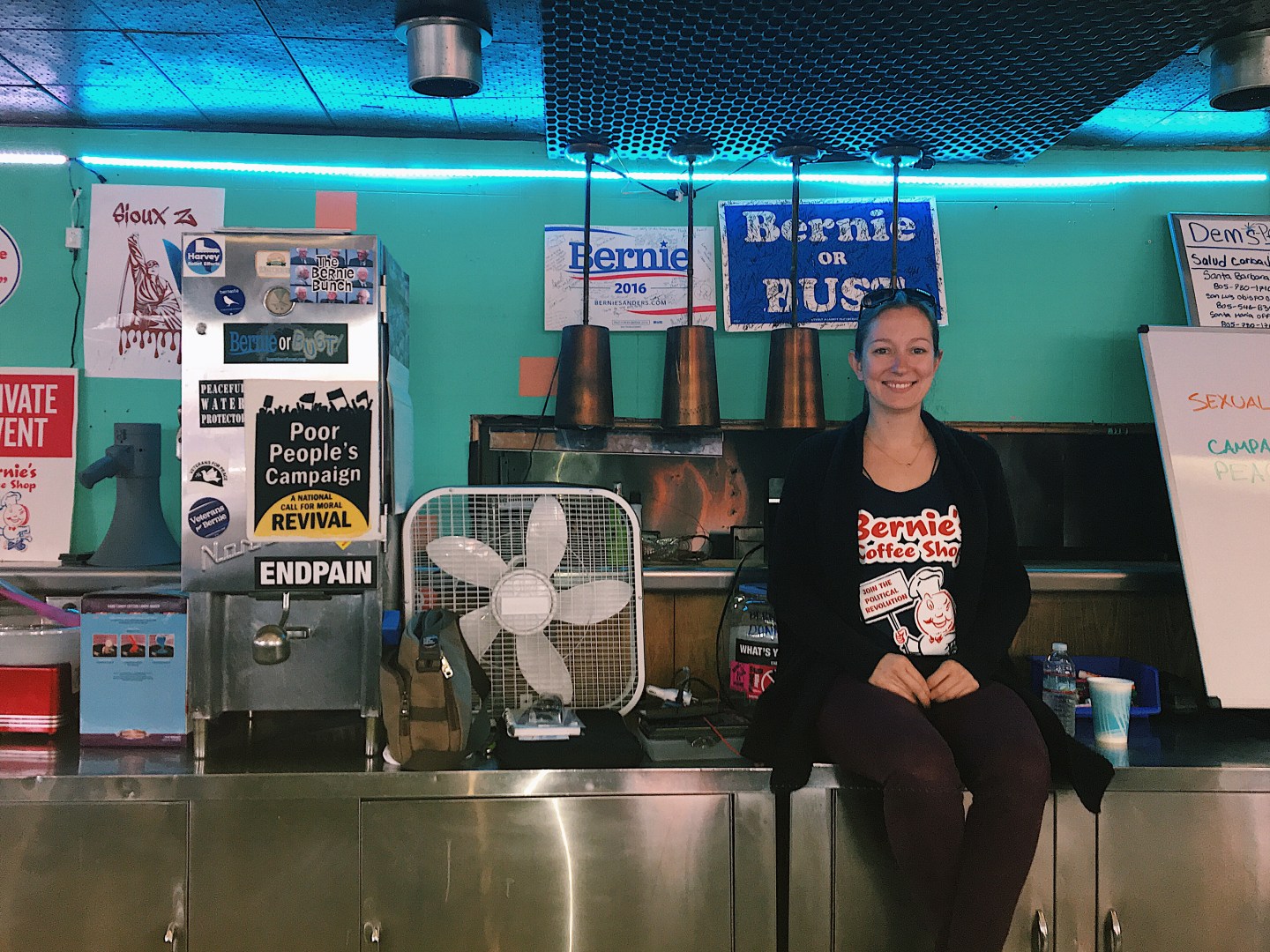
Anyone who has visited Museum Row in Los Angeles has encountered the landmark that is Johnie’s Coffee Shop. Its tall glass windows and twinkling neon signs draw the attention of tourists and residents alike. But, as one approaches, messages scrawled across the windows reading “Stop the billionaire takeover” and other social justice slogans offer a puzzling contrast to what is clearly a former diner. Upon further inspection, a visitor would find that this is much more than an old restaurant: now known as Bernie’s Coffee Shop, the space has served as a vibrant community center for a decade at the corner of Wilshire and Fairfax.
The building was constructed in 1956 and originally opened as Romeo’s Time Square. It officially became Johnie’s Coffee Shop in 1966 and remains a paragon of Googie-style architecture, a futuristic design type that flourished in the 1950’s and 1960’s. Googie architecture is characterized by neon accents, bold glass usage, and angular, unusually-shaped roofs. The trend exploded into US cities in a way that demonstrated a desire for modernity and the allure of space-age design. Johnie’s, with its neon sign, extreme use of glass, and sharply angled roof, is considered a textbook example.
The diner operated until 2000, then sat vacant for 16 years. That changed in 2016, when a group of activists reimagined the space during Bernie Sanders presidential campaign.
Bernie’s Coffee Shop was never meant to last. The transformation of Johnie’s was initially planned as a one-night art installation in support of Sanders’ run. Artist Kii Arens created custom graphics for the windows, keeping the diner theme present by putting Sanders’ head in a fried chicken bucket. Multidisciplinarian Dionisio Ceballos painted a mural of the senator on the side of the building facing east. All this artwork was only meant for one event. After the event, the expectation was that Johnie’s would return to silence. However Michelle Manos, an organizer and event producer involved in grassroots Sanders campaign efforts, intervened. She asked the property owners, the Gold family, if it was possible for Bernie’s Coffee Shop to exist longer than just a night and be used as an organizing center for the campaign. They agreed.
“This was the beginning of something great at Bernie’s,” Manos told Knock LA. “The booths were filled with phone bankers every day. The counters on the Fairfax side were filled with walking packets for canvassers, and the counters on the Wilshire side were where we made things like t-shirts, mugs, books, stickers, posters and more available for donation.”
The 2016 Sanders campaign came to an abrupt end the night before the California primary when the Associated Press called the race preemptively for Hillary Clinton. Manos and her other Bernie’s Coffee Shop co-founder Lauren Hammel realized that the Gold family was willing to let them have access to the space beyond Bernie’s presidential run. Thus, the current iteration of Johnie’s Coffee Shop was born and emerged onto the Los Angeles community organizing scene as Bernie’s Coffee Shop.
“This was an extraordinary blessing and responsibility,” Manos said. “We made the decision to use the space to organize around all the issues that had brought us together in support of Bernie Sanders. The healthcare groups, the climate groups, immigration groups, and many others with social justice missions came and put the space to good use.”
The task of being the building’s steward was a tall order. While structurally sound, the space’s inactivity had taken a toll. The former diner does not have a functional restroom, running water, or WiFi.
“It was a massive undertaking,” Hammel told Knock LA. “We have done the work of cleaning the windows, we’ve done the work of patching the roof, of painting over graffiti, of scraping the graffiti off, of calling exterminators, of multiple rounds of patchwork to the building’s exterior. If perfection is what we’re seeking, we’re not going to find it here. It is a lesson in accepting what is and being grateful for the gift that this space was.”
Despite the building’s limitations, it served a crucial role in the social justice ecosystem of LA by providing a third space for community groups to organize out of. Bernie’s Coffee Shop stayed committed to its core value of accessibility for its whole tenure and opened its doors to organizing efforts free of charge. Ground Game hosted one of their early fundraisers out of Bernie’s when they were raising money for rent. Most recently, West Los Rapid Response Network threw a fundraising party out of Bernie’s Coffee Shop to raise money for their organizing efforts and to support individuals impacted by ICE kidnappings.
Accessibility went further than making the space available for organizations to use. According to Hammel, the Bernie’s Coffee Shop open-door policy was as literal as one could possibly make it.
“It goes beyond just a friendly environment when it comes to somebody needing a spot to sit down and charge their phone, or somebody coming in and asking ‘Hey do you have a bottle of water?’ or ‘Do you have a jacket?’ or a sleeping bag or a tent,” Hammel said. “That means a coffee seeker, that means an unhoused person, that means a volunteer, that means a fellow organizer.”
For both Hammel and Manos, the experience of encountering a visitor in search of caffeine became a comically common occurrence.
“We’re not actually a coffee shop,” Hammel said with a chuckle. “We understand why you would get that impression, but we’re not.”

The energy of Bernie’s Coffee Shop was contagious throughout its ten years of existence. Over the years, a vast variety of organizing efforts made a home within the old diner. In 2016, a contingent of organizers collected donations and traveled with them to Standing Rock to support indigenous folks in their protest against the Dakota Access Pipeline. 2017 brought the eruption of the #MeToo movement, which utilized Bernie’s a hub and a command center for planning a 4,000 person march in Hollywood. The crackdowns on DREAMers enacted during Donald Trump’s first term sparked the creation of Humanity First, a coalition built to resist xenophobic policies through direct action. The building was also a place of refuge for organizers during the 2020 protests in Los Angeles following the murder of George Floyd.
Woven into the DNA of Bernie’s Coffee Shop was its ability to respond to crises at blinding speed. One example was Project Mask LA, an initiative to sew and distribute cloth facemasks at the onset of the COVID-19 pandemic in 2020. With consistent input from a fellow organizer who works as a nurse, community members sourced fabrics, created patterns in compliance with CDC guidelines, sewed the masks, then handed them off to volunteers who would distribute them around the city to other organizers and unhoused folks.
“Ultimately, we made and distributed over 14,000 CDC-regulation fabric masks to orgs, senior homes, churches and anyone else who needed them during the mask shortage,” said Manos. “We even had a sub-project called ‘mask exchange’ where we delivered masks to [homeless] encampments weekly, went back and collected used masks, washed them in an industrial strength washer, repaired them and redistributed them the following week.”
In 2021, Manos brought in a handful of other community organizers and pitched the idea of creating a nonprofit that would provide logistical support to the social justice movement in Los Angeles. She called it Community Solidarity Project. The organization was formalized in early 2021 and took on the task of operating Bernie’s Coffee Shop while using it as a home base.
Five years after the onset of COVID-19, a different crisis swept Los Angeles. On January 7, 2025, high-gusting winds and extremely dry conditions led to the Palisades and Eaton Canyon Fires, destroying 16,000 structures and displacing thousands of people. Bernie’s Coffee Shop rose to the occasion yet again, as it had done so many times in the past. According to internal data, over the course of 6 weeks Community Solidarity Project organizers and volunteers delivered personalized, essential supply packages to over 220 families in the LA area.
“Our fire response was one of my favorite things to see in that space,” Hammel told Knock LA. “It was insane a little bit and everything was everywhere, but it was genuinely such an outpouring and such a show of solidarity with each other.”
The city-wide response to the fires, driven almost entirely by grassroots mutual aid groups, brought in a new wave of people that wanted to get involved in community organizing. All over the city, people showed up ready and willing to roll up their sleeves and get to work. Some did not have to look far to join a broader community organizing effort.
“I had walked past Bernie dozens of times just walking my dog around the neighborhood, so it was easy to walk over and check out what was going on,” said Felisha Miles, who lives nearby. “It was truly amazing that I could walk next door and see how LA was pulling together to support people impacted by the fires and those in need in general.”
After a month, the fire response evolved into a free store in the neighboring, vacant 99 Cents Only building. Dubbed “The Really Really Free 99” by Community Solidarity Project organizers, it operated for thirteen months right in Felisha’s proverbial backyard.
“I’ve never seen anything like it before, and it opened up my imagination for what is possible,” said Miles. “If a free store could operate in the heart of Miracle Mile for over a year in the midst of some of the most atrocious social conditions, more fantastic things would be possible.”

Over a decade of political activity at Bernie’s Coffee Shop encompassed countless protests, art builds, coalition meetings, strike support preparations, and many other initiatives. For many organizers with the Community Solidarity Project, the space marked formative years, shaping both their political commitments and personal lives. The impact of not having Bernie’s Coffee Shop in their lives in the future could not be overstated.
“This is where I became a person that does this work,” Hammel said. “This is my home. We celebrate birthdays there. This is a place where we would host holiday dinners for folks who didn’t have family to do that with. We would be family for each other. That is a loss that I don’t even have a scope for yet.”
Beck Frei, an organizer with Community Solidarity Project and co-producer of their annual Queer Fair, said that the building holds deep significance in their heart as a place of safety and support. “Community Solidarity Project and Bernie’s have been here for me during my entire transition, and have been stabilizing forces during this period of great change in my life,” he said. “Nothing will ever be able to replace the magic of Bernie’s.”
As the era of Bernie’s Coffee Shop draws to a close, organizers are focused on securing a new space to continue their mutual aid and logistical support work across Southern California. They are currently fundraising to establish a new event space and distribution center, one that would carry forward Bernie’s legacy. The Community Solidarity Projects team has invited the public to one last celebration on April 18, the final day of Bernie’s Coffee Shop’s existence after 10 years of presence.
“This is the beginning of the rest of our work,” Hammel said. “I anticipate thinking of Bernie’s Coffee Shop all the time. And the only thing I know for sure is that we don’t stop. We are not going to go into the woodwork and stop. That’s not something we do.”
To make a tax-deductible donation to support Community Solidarity Projects in finding a new space, visit their website www.communitysolidarityproject.org.