On November 8, 1519, an extraordinary meeting took place: Hernán Cortés met with Emperor Moctezuma II. Of course, neither one nor the other understood anything of what their interlocutor was saying: Hernán Cortés spoke Spanish and Moctezuma spoke Nahuatl, but that problem was solved thanks to two chain translators: Malinche translated from Nahuatl to Mayan, and Jerónimo de Aguilar went from Mayan to Spanish, and vice versa.
History is full of legendary translations like that one, and in all of them, human beings depended on human translators to understand the other party. That has been changing with various technologies, but the one that is really about to change everything is AI.
With AI we have found (and translated)
In fact, translation technology has run parallel to technological evolution itself. From the rule-based translation of the second half of the 20th century we moved in the 90s to automatic statistical translations that, for example, ended up using Google Translate. These systems looked for the “most likely” translation, not the “most correct” one.
These statistical models improved with phrase-based translation, but the definitive leap was made by DeepL, which appeared in 2017 to change everything with the use of neural networks and neural machine translation. Google had also begun to adopt that system in 2016, and it was clear what the path was.
With the arrival of generative AI we have found ourselves with another potential leap in this field. There are, however, differences: these systems are based on large language models (LLM) that are then trained and tuned specifically for translationwhich a priori gives them an advantage when it comes to achieving more natural and versatile translations.
The application of AI models to the field of translation seems to be following in the footsteps of what we have seen with programming. Developers have embraced this revolution and many of us have realized thanks to vibe coding that it is possible to program without knowing how to program.
The same clearly occurs with these systems that enable us to know how to speak languages that we don’t actually know how to speak. Machines do it for us, and they do it better and more immediately.
The real-time translation is very fashionable and both Google and Meta – which has been warning for some time – are integrating it into their current or future augmented reality glasses. Apple, which does not usually release things that are not mature, has just integrated it into its AirPods. The user experience may not be perfect at the moment, but it is clear that this type of function is going to become more and more common, a commodity technological more.
The transition
And this transition that wants to turn access to quality translations into something “trivial” has been made evident these days with the launch of two platforms. The first, the ChatGPT Translator, which is surprising not because it is an obvious and simple use case of AI, but because it is a logical indiscriminate copy of the services that already work, Google Translate and DeepL. Being able to do the same with AI shows that that problem seems solved.
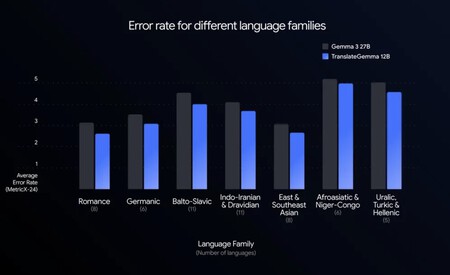
The translation of Gemma 3 27B was already good. TranslateGemma’s is even better, even with smaller models and challenging language pairs.
And if it didn’t seem like it enough, Google has just presented its new generative AI models specifically aimed at translation. This is TranslateGemma, a family with versions 4B, 12B and 27B (the latter, logically, the most capable) that allow these tasks to be carried out locally, privately and without connection to the cloud.
They support 55 language pairs and of course they are prepared for the most popular ones (English, Spanish, Chinese, French, Hindi), but their creators already indicate that they are training them with 500 additional language pairs for the future.
We are therefore facing a moment in which learning a language will probably end up becoming something more vocational or aspirational than something that we really need on a daily basis. Human translators, like human programmers, will still have valuebut once again what is clear is that AI is going to make this type of capability more accessible than ever.
In WorldOfSoftware | Some of the emails you read may not say exactly what was written. A forgotten Gmail setting is to blame