By using this site, you agree to the Privacy Policy and Terms of Use.
Accept
World of SoftwareWorld of SoftwareWorld of Software
  • News
  • Software
  • Mobile
  • Computing
  • Gaming
  • Videos
  • More
    • Gadget
    • Web Stories
    • Trending
    • Press Release
Search
  • Privacy
  • Terms
  • Advertise
  • Contact
Copyright © All Rights Reserved. World of Software.
Reading: AI Model Integration Streamlines Feedback in Multiscale Design Environments | HackerNoon
Share
Sign In
Notification Show More
Font ResizerAa
World of SoftwareWorld of Software
Font ResizerAa
  • Software
  • Mobile
  • Computing
  • Gadget
  • Gaming
  • Videos
Search
  • News
  • Software
  • Mobile
  • Computing
  • Gaming
  • Videos
  • More
    • Gadget
    • Web Stories
    • Trending
    • Press Release
Have an existing account? Sign In
Follow US
  • Privacy
  • Terms
  • Advertise
  • Contact
Copyright © All Rights Reserved. World of Software.
World of Software > Computing > AI Model Integration Streamlines Feedback in Multiscale Design Environments | HackerNoon
Computing

AI Model Integration Streamlines Feedback in Multiscale Design Environments | HackerNoon

News Room
Last updated: 2025/12/08 at 8:39 PM
News Room Published 8 December 2025
Share
AI Model Integration Streamlines Feedback in Multiscale Design Environments | HackerNoon
SHARE

Table of Links

Abstract and 1. Introduction

  1. Prior Work and 2.1 Educational Objectives of Learning Activities

    2.2 Multiscale Design

    2.3 Assessing Creative Visual Design

    2.4 Learning Analytics and Dashboards

  2. Research Artifact/Probe

    3.1 Multiscale Design Environment

    3.2 Integrating a Design Analytics Dashboard with the Multiscale Design Environment

  3. Methodology and Context

    4.1 Course Contexts

    4.2 Instructor interviews

  4. Findings

    5.1 Gaining Insights and Informing Pedagogical Action

    5.2 Support for Exploration, Understanding, and Validation of Analytics

    5.3 Using Analytics for Assessment and Feedback

    5.4 Analytics as a Potential Source of Self-Reflection for Students

  5. Discussion + Implications: Contextualizing: Analytics to Support Design Education

    6.1 Indexicality: Demonstrating Design Analytics by Linking to Instances

    6.2 Supporting Assessment and Feedback in Design Courses through Multiscale Design Analytics

    6.3 Limitations of Multiscale Design Analytics

  6. Conclusion and References

A. Interview Questions

3.2 Integrating a Design Analytics Dashboard with the Multiscale Design Environment

In order to connect design assessment with design work, we integrated multiscale design analytics into the multiscale design environment. To contextualize the analytics, we link them with design work instances. The multiscale design analytics that we present to instructors are (1) the number of scales and (2) the number of clusters present within a given design work instance. Our linkage of design analytics to design instances makes visible to users what is being measured by analytics.

We choose an off-the-shelf AI model suitable for computing multiscale design analytics. As we described in the introduction, our goal is to explore the potential of AI-based multiscale design analytics for supporting design instructors, not to compare or refute particular techniques. We invoke Jain et al.’s [40] spatial clustering based model, as it has been previously used in design education contexts, for recognizing clusters of elements nested across scales within multiscale design work. We input position, width, height, and transforms of multiscale design elements—extracting them from the JSON representation—and obtain scales and clusters as output from the model.

We integrate a design analytics dashboard directly with the multiscale design environment in which students perform their work. As instructors regularly use the environment to view and assess student projects, the dashboard integration streamlines the process of making AI-based analytics available in their situated work contexts. The dashboard interface allows instructors to manage a course, its assignments, and submission to the assignments. When an instructor views
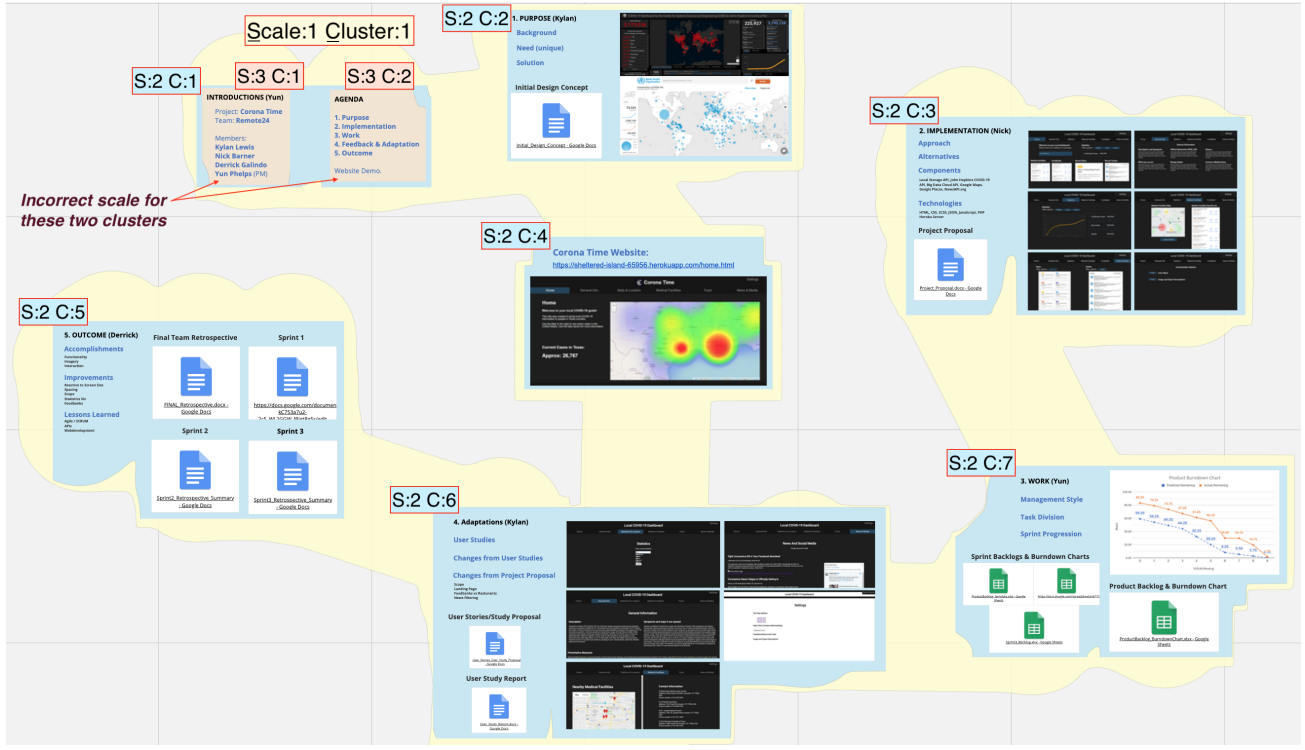
Fig. 4. Another example of scale and cluster recognition. The outermost scale comprises one cluster—including all design elements—which is rendered in yellow color. The next inner scale has seven clusters, which are rendered in blue. However, AI is not perfect. Here, the two clusters rendered in brown are incorrectly recognized to be at the next inner level, as their content is similarly legible as the content within the clusters rendered in blue.

an assignment page (see Figure 3 top) on the dashboard, it presents to them the students’ submissions and scale and cluster analytics derived through the AI analysis of submissions.

We link the dashboard presentation of the analytics with the specific design assemblages they measure. This makes results of AI recognition—for each instance of student design work—visible to the instructor (see Figure 3 bottom). When the instructor clicks a scale or cluster analytic, it opens the corresponding student design work instance within the multiscale design environment. An animation shows them the design assemblages for each scale and cluster. All clusters at the same scale are presented using the same background color, so as to help discern nested relationships (Figure 3 bottom, Figure 4).

:::info
Authors:

(1) Ajit Jain, Texas A&M University, USA; Current affiliation: Audigent;

(2) Andruid Kerne, Texas A&M University, USA; Current affiliation: University of Illinois Chicago;

(3) Nic Lupfer, Texas A&M University, USA; Current affiliation: Mapware;

(4) Gabriel Britain, Texas A&M University, USA; Current affiliation: Microsoft;

(5) Aaron Perrine, Texas A&M University, USA;

(6) Yoonsuck Choe, Texas A&M University, USA;

(7) John Keyser, Texas A&M University, USA;

(8) Ruihong Huang, Texas A&M University, USA;

(9) Jinsil Seo, Texas A&M University, USA;

(10) Annie Sungkajun, Illinois State University, USA;

(11) Robert Lightfoot, Texas A&M University, USA;

(12) Timothy McGuire, Texas A&M University, USA.

:::


:::info
This paper is available on arxiv under CC by 4.0 Deed (Attribution 4.0 International) license.

:::

Sign Up For Daily Newsletter

Be keep up! Get the latest breaking news delivered straight to your inbox.
By signing up, you agree to our Terms of Use and acknowledge the data practices in our Privacy Policy. You may unsubscribe at any time.
Share This Article
Facebook Twitter Email Print
Share
What do you think?
Love0
Sad0
Happy0
Sleepy0
Angry0
Dead0
Wink0
Previous Article Ethical hackers can be heroes: It’s time for the law to catch up | Computer Weekly Ethical hackers can be heroes: It’s time for the law to catch up | Computer Weekly
Next Article Hear That Sound? That’s the Sound of Savings: Snag 22% Off Apple AirPods Max and More Hear That Sound? That’s the Sound of Savings: Snag 22% Off Apple AirPods Max and More
Leave a comment

Leave a Reply Cancel reply

Your email address will not be published. Required fields are marked *

Stay Connected

248.1k Like
69.1k Follow
134k Pin
54.3k Follow

Latest News

This Is The Biggest Threat To Tim Cook’s Promise Of Apple AI Dominance – BGR
News
NIO Onvo SUVs reportedly bought for high-end ride-hailing service · TechNode
Computing
Your Google Play Points might be hiding a secret 0 Pixel 10 Pro discount
Your Google Play Points might be hiding a secret $200 Pixel 10 Pro discount
News
Accessibility in 2025: A Practical Guide to WCAG 2.2 With Real Examples | HackerNoon
Computing

You Might also Like

NIO Onvo SUVs reportedly bought for high-end ride-hailing service · TechNode
Computing

NIO Onvo SUVs reportedly bought for high-end ride-hailing service · TechNode

1 Min Read
Accessibility in 2025: A Practical Guide to WCAG 2.2 With Real Examples | HackerNoon
Computing

Accessibility in 2025: A Practical Guide to WCAG 2.2 With Real Examples | HackerNoon

0 Min Read
CATL’s €7.3 billion Hungary plant to begin production early next year · TechNode
Computing

CATL’s €7.3 billion Hungary plant to begin production early next year · TechNode

1 Min Read
Meet Ignatius Sani – HackerNoon Blogging Course Facilitator | HackerNoon
Computing

Meet Ignatius Sani – HackerNoon Blogging Course Facilitator | HackerNoon

5 Min Read
//

World of Software is your one-stop website for the latest tech news and updates, follow us now to get the news that matters to you.

Quick Link

  • Privacy Policy
  • Terms of use
  • Advertise
  • Contact

Topics

  • Computing
  • Software
  • Press Release
  • Trending

Sign Up for Our Newsletter

Subscribe to our newsletter to get our newest articles instantly!

World of SoftwareWorld of Software
Follow US
Copyright © All Rights Reserved. World of Software.
Welcome Back!

Sign in to your account

Lost your password?