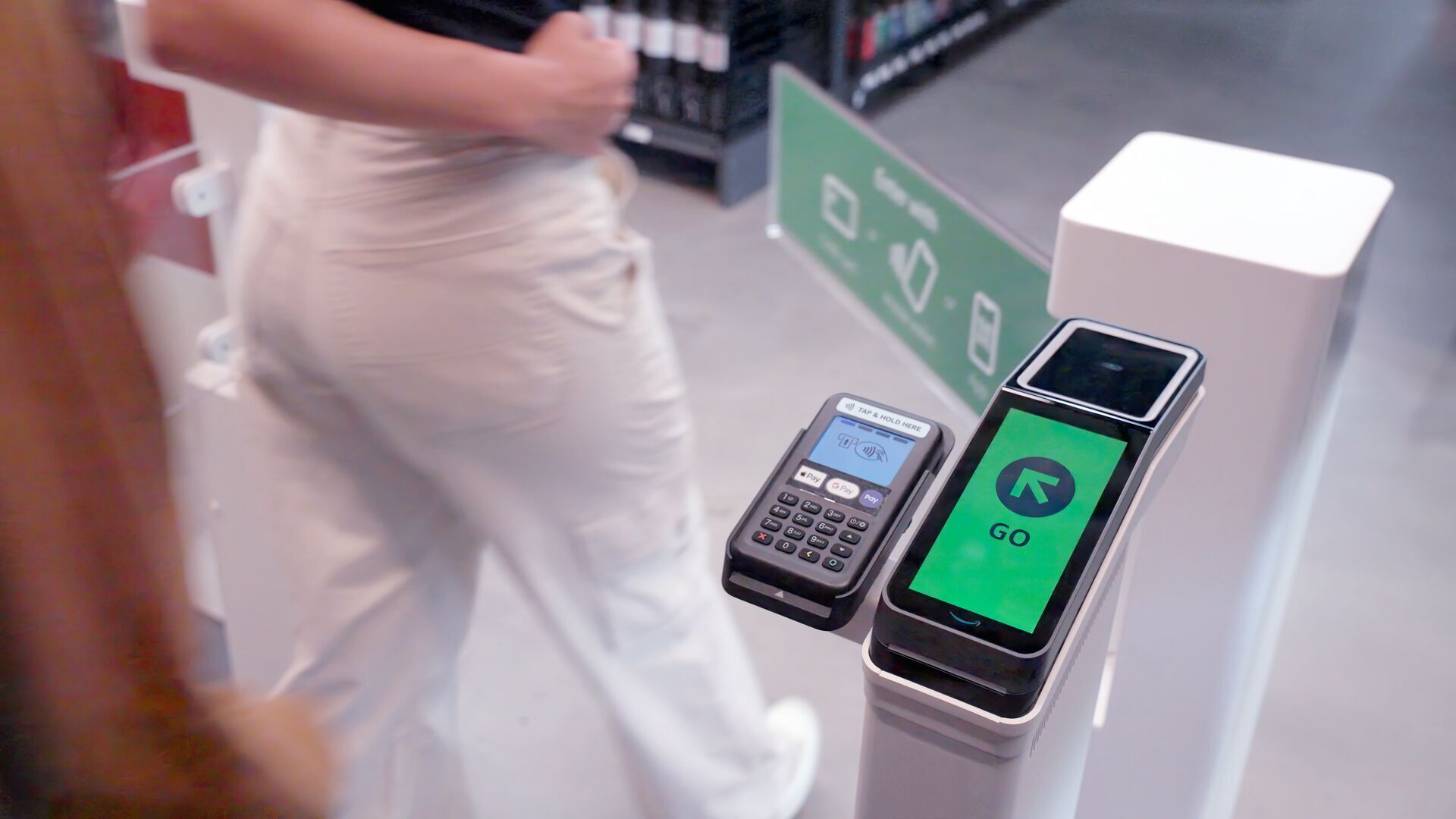
I’m a big fan of any technology that makes our lives easier. One example of this is Amazon’s Just Walk Out technology, which I consider to be the easiest check out experience available today. Customers tap their credit card on a reader, walk in a store, pick up whatever they want and then, as the name suggests, just walk out of the store and everything is charged to your account.
One of my goals at AWS re:Invent was to find what’s new with Just Walk Out and what to look forward to. At the event, I met with both Rajiv Chopra, vice president of JWO for AWS and Sarah Yacoub, senior manager of product marketing, to get an update.
Here are some of the key updates to Just Walk Out:
Technology deployment and infrastructure improvements
- Shift to “lane approach”: Instead of a full store retrofit with cameras covering the entire space, the current stadium deployments are using a “lane of cameras” effectively placed outside the concession area. This significantly reduces the infrastructure size, camera count, and build-out complexity, making it easier to attach to existing structures. It also obviates the need to do large-scale construction to deploy a Just Walk Out store.
- Reduced infrastructure footprint: Improvements have been made in the size of the additional MDF and backroom area required, leading to a smaller physical footprint.
- Cost reductions through technology optimization: Over the past few years, Just Walk Out has reduced deployment costs by approximately 50% through a combination of technology improvements and operational efficiencies. The AI algorithms have become exponentially more efficient, now handling variable ceiling heights (as low as six to seven feet), sloped floors, and inconsistent ceilings without requiring expensive general contracting changes. Installation has been simplified through retrofitting capabilities that reuse existing fixtures, gate plates that eliminate the need to core into cement (reducing permitting requirements) and streamlined camera plans requiring less low voltage wiring. These improvements reduce not just Just Walk Out costs, but total deployment costs including general contractor, electrician and designer expenses — making the technology more accessible across verticals.
Operational models and experience
- Just Walk Out becomes “just walk in”: In some travel locations, like Hudson Nonstop, the requirement to tap a credit card to enter was viewed by some consumers as a barrier to entry. This has now been removed by enabling the shopper to enter freely, browse, select items and the checkout/payment process happens at the exit instead of the traditional tap-to-enter model. This aims to reduce customer apprehension at the entrance but still results in the same frictionless experience.
- Shrink and loss prevention: Loss prevention is a huge metric for Just Walk Out. During my conversation, Yacoub mentioned that retailers using the technology have seen double-digit percentage decreases in loss, making it a significantly better solution compared to manned self-checkout, which is often subject to being tricked. The cameras see every activity from consumers but also acts as a psychological deterrent. For stores with high level of theft, such as CVS and Target could benefit greatly from Just Walk Out and presents a much better alternative than locking up merchandise. Cost has been used as an excuse by retailers, but the amount of loss would far outweigh the cost of Just Walk Out.
Market expansion and adoption
- Global presence: Just Walk Out, initially launched in the U.S., is now available in Canada, Australia, the U.K. and France, with more countries to come.
- Store count: The company is currently quoting over 300 locations and expects multi-store deals to continue increasing this number significantly in 2026.
- New verticals and value propositions:
- Stadiums: This continues to be a focus for Just Walk Out with many new stadiums being turned up in the U.S. and internationally, including Allianz Stadium in the U.K., Marvel Stadium in Australia — the first Just Walk Out store in the Southern Hemisphere — as well as Rod Laver Arena and Melbourne Cricket Ground in Australia, and venues in Canada such as Scotiabank Arena in Toronto and Scotiabank Saddledome in Calgary.
- Fulfillment centers/business and industry: Deploying Just Walk Out inside fulfillment centers, offices, and large factories to provide a 24/7 amenity to employees who have limited break times and no options nearby (food deserts).
- EV charging stations: Used at EV charging stations like Gridserve’s Electric Forecourts in the U.K. and IONNA’s Rechargery locations for convenience stores within rest areas, offering an unmanned space and a differentiator for the charging network.
- Healthcare: Deployments in hospitals for gift stores and convenience stores, often with badge pay integration for night shift staff, such as the University of California at San Diego Health’s McGrath Outpatient Pavilion.
- Universities: More than 60 locations are deployed, using meal dollars integration and offering specialized late-night selections (ice cream, snacks) in dorm residence halls, including UC San Diego with five campus stores.
Data and integration
- Loyalty integration: One of the biggest inhibitors to historical adoption was that Just Walk Out did not integrate with loyalty programs such as season ticket holder apps. A couple of years ago, one of the NHL team chief information officers mentioned that if he can’t let his best customers use the most convenient way to buy products, he didn’t want it. Chopra mentioned that this is no longer an issue and Just Walk Out can integrate with almost all loyalty and payment programs.
- Real-time access data: The other significant issue with Just Walk Out was there was no access to real time information. An NFL CIO explained to me that closest he could get to “real time,” was the data being stored in an Amazon S3 bucket the next day. Many retailers, which includes stadiums, like to have real time count of exactly what has been sold and Just Walk Out could not accommodate that. This issue has now been solved and fully integrates into inventory systems.
The biggest remaining issue with Just Walk Out is just consumer education and awareness. In some cases, the Just Walk Out brand isn’t front and center and takes a back seat to the store or a sponsor. This is common in stadiums and airports. When one flies into Harry Reid Airport in Las Vegas, the Hudson News location at the bottom of the escalator is a Just Walk Out-enabled store. Another example is at the Golden 1 Center, home of the Sacramento Kings, the store is branded, “PATH Grab and Go,” after the sponsor.
The issue with this is it’s very common for stadiums to have multiple grab-and-go systems and, though the experience is similar, there is a difference between Just Walk Out and competitors such as Ai-Fi and Zippin. The third-party branding leaves it up to the consumer to understand which system is in place and what the experience is.
The other challenge is just general awareness. I’ll often go to a stadium and see a line of people waiting in a regular checkout with only a handful of fans at a Just Walk Out store. Once consumers use it, they’ll generally use it again as the experience is so easy. This is where retailers, stadium owners and others should invest in some kind of “concierge,” that can help educate consumers.
Just Walk Out has grown in both terms of capabilities and deployment models and will be the future of retail. With advancements in AI and camera vision, self-service models can be fast and accurate and a “win” for customers, which means a win for the retailer.
Zeus Kerravala is a principal analyst at ZK Research, a division of Kerravala Consulting. He wrote this article for News.
Photo: Amazon
Support our mission to keep content open and free by engaging with theCUBE community. Join theCUBE’s Alumni Trust Network, where technology leaders connect, share intelligence and create opportunities.
- 15M+ viewers of theCUBE videos, powering conversations across AI, cloud, cybersecurity and more
- 11.4k+ theCUBE alumni — Connect with more than 11,400 tech and business leaders shaping the future through a unique trusted-based network.
About News Media
Founded by tech visionaries John Furrier and Dave Vellante, News Media has built a dynamic ecosystem of industry-leading digital media brands that reach 15+ million elite tech professionals. Our new proprietary theCUBE AI Video Cloud is breaking ground in audience interaction, leveraging theCUBEai.com neural network to help technology companies make data-driven decisions and stay at the forefront of industry conversations.