Advanced Micro Devices Inc. late today unveiled two new portfolios of x86 Ryzen processors today as it doubled down on providing AI chips across technology platforms.
For one, AMD introduced the Ryzen AI 400 Series processor (below), the latest iteration of its AI-powered personal computer chips, at the annual CES electronics conference in Las Vegas. It provides 1.3 times faster multitasking than its competitors and is 1.7 times faster at content creation. It features 12 central processing unit cores inside a core processor, along with 24 threads.
AMD also is updating its workstation-level Ryzen AI Max+ mobile processors with two new models: the 12-core Ryzen AI Max+ 392 and the eight-core Ryzen AI Max+ 388. They’re notable for a system-on-chip designs that employs a bank of shared memory that can be allocated ad-hoc between the main system memory and graphics.
On the data center front, the company also unveiled its full MI400 Series lineup, led by Helios, its blueprint for yotta‑scale compute, delivering up to 3 AI exaflops in a single rack for trillion-parameter training. The lineup also includes the Instinct MI440X, an eighth-graphics processing unit on-premises solution for enterprise AI training, fine-tuning and inference workloads, and the Instinct MI430X, a high-precision GPU solution for sovereign AI and HPC and hybrid computing. Finally, it disclosed details on the MI500 Series, planned for launching in 2027, which it says will deliver up to a 1,000-fold increase in AI performance over the Instinct MI300X.
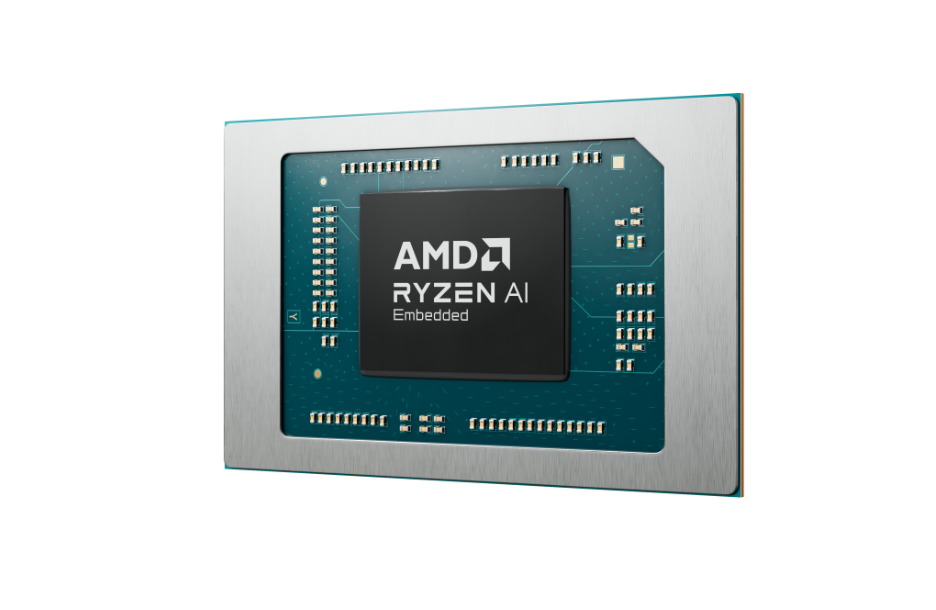
Meanwhile, the AI Embedded processors (pictured at top) offer higher-performance, lower-latency artificial intelligence to automotive, industrial and autonomous edge systems. The new Ryzen AI Embedded P100 and X100 Series processors combine AMD’s latest Zen 5 CPU cores, RDNA 3.5 graphics and XDNA 2 neural processing units into a single x86 system-on-chip that is designed for space and power-constrained embedded deployments.
The processors are intended to power next-generation digital cockpits, industrial automation platforms and physical AI systems, including autonomous machines and humanoid robotics.
“As industries push for more immersive AI experiences and faster on-device intelligence, they need high performance without added system complexity,” said Salil Raje, senior vice president and general manager of AMD Embedded. “The Ryzen AI Embedded portfolio brings leadership CPU, GPU and NPU capabilities together in a single device, enabling smarter, more responsive automotive, industrial and autonomous systems.”
The Ryzen AI Embedded P100 Series features four to six Zen 5 CPU cores and is optimized for in-vehicle infotainment and industrial human-machine interfaces. According to AMD, the P100 processors deliver up to a 2.2-times improvement in single-thread and multithread CPU performance over the previous generation, along with an estimated 35% boost in graphics performance powered by the RDNA 3.5 GPU architecture.
The graphics subsystem is designed to support immersive cockpit experiences, with the ability to drive up to four 4K displays or two 8K displays simultaneously at up to 120 frames per second. The offering also includes a dedicated video codec engine that enables high-fidelity streaming and playback without placing additional load on the CPU.
On the AI side, the P100 Series integrates an XDNA 2 NPU that delivers up to 50 trillion operations per second. Doing so allows for low-latency inference for workloads such as voice recognition, gesture control, computer vision and compact large language models.
The broader Ryzen AI Embedded portfolio also includes the higher-end X100 Series that scales to higher CPU core counts and delivers increased AI performance for more demanding physical AI and autonomous systems.
The entire software stack is built on the open-source, Xen hypervisor-based virtualization framework that securely isolates multiple operating system domains. The unified software stack allows for multiple operating systems, including Linux distributions, FreeRTOS, Android and Windows, to run securely in parallel.
For customers, the open-source foundation, long-term operating system support and ASIL-B-capable architecture are said by AMD to reduce costs, simplify customization and accelerate the path to production for automotive and industrial systems.
AMD Ryzen AI Embedded P100 processors featuring four to six cores are already with early-access customers, with tools and documentation expected to be available with production shipments expected in the second quarter. P100 Series processors featuring eight to 12 cores targeting industrial automation applications are expected to begin sampling in the first quarter. The X100 Series processors, which offer up to 16 cores, are expected to begin rolling out in the first half of this year.
With reporting from Robert Hof
Image: AMD
Support our mission to keep content open and free by engaging with theCUBE community. Join theCUBE’s Alumni Trust Network, where technology leaders connect, share intelligence and create opportunities.
- 15M+ viewers of theCUBE videos, powering conversations across AI, cloud, cybersecurity and more
- 11.4k+ theCUBE alumni — Connect with more than 11,400 tech and business leaders shaping the future through a unique trusted-based network.
About News Media
Founded by tech visionaries John Furrier and Dave Vellante, News Media has built a dynamic ecosystem of industry-leading digital media brands that reach 15+ million elite tech professionals. Our new proprietary theCUBE AI Video Cloud is breaking ground in audience interaction, leveraging theCUBEai.com neural network to help technology companies make data-driven decisions and stay at the forefront of industry conversations.