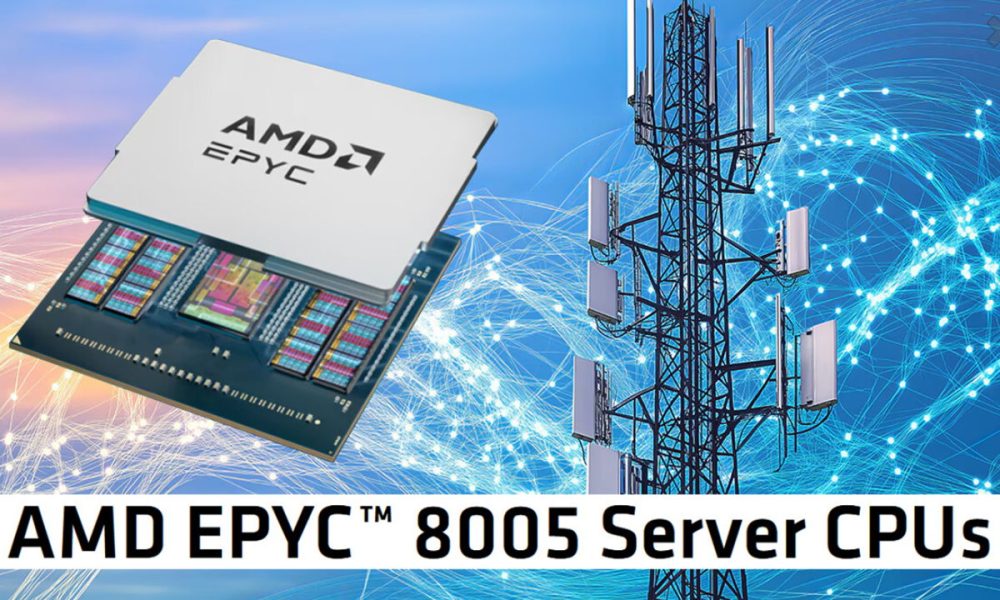
AMD has announced its EPYC 8005 series server processors. Codenamed ‘Sorano’, these new CPUs cover the gap between the high-end EPYC 9005 line under the Zen 5 architecture and the EPYC 4005 that the company focuses on as the entry-level range to the platform.
The new EPYC 8005 succeed the 8004 “Siena” and are aimed at single-socket platforms with an emphasis on telecom, edge and vRAN workloads, especially. Based on Zen 5 architecture, the series is designed with the performance per watt and performance per dollar, rather than maximum multi-socket scalability.
With these new server CPUs, AMD is targeting the telecommunications sector, where power and space limitations are key factors in base stations and distributed edge locations. AMD hasn’t yet released a full list of SKUs it will ship on this basis, but says the line will scale up to 84 cores in a single socket configuration, with SKUs that will operate with wattages up to 225 W.
AMD also highlights its wide thermal operating ranges and compatibility with NEBS (Network Equipment-Building System)-compatible platforms. Specifically for vRAN, EPYC 8005 incorporates specific LDPC (Low-Density Parity Check) decoding optimizations to improve Layer 1 acceleration for 5G workloads. AMD claims improved uplink performance and more efficient forward error correction processing, while maintaining the deterministic behavior required in RAN environments, thanks to the updated Zen 5 execution pipeline and vector capabilities.
EPYC 8005, driving the economics of vRAN
As mobile networks evolve toward open and virtualized architectures, “Many operators are finding that the biggest challenges no longer lie in technological availability, but in economics, use of resources in limited environments, automation and long-term scalability”they explain from AMD.
vRAN has proven its value in flexibility and supplier diversity. However, as deployments expand beyond testing and reach commercial scale, leaders are faced with new realities: rising energy costs, cloud-native deployments, and the complexity of operating highly distributed infrastructure with consistent performance.
Scaling commercial vRAN requires an infrastructure that balances performance, cost and flexibility. This is especially crucial in power- and space-constrained environments, from outdoor base stations to dense edge locations. As a result, energy efficiency and performance determinism are becoming central to infrastructure decisions.
This is where these EPYC 8005 server CPUs come in, designed with these priorities in mind:
- Wide thermal operating ranges to meet broad environmental requirements.
- Enables NEBS-compliant platforms for rugged, outdoor telecom deployments.
- High core counts per socket enable small form factors.
The EPYC 8005 “Sorano” CPUs promise a high performance with low power consumptionsupporting dense deployments where power budgets are fixed but performance demands continue to increase. The new CPUs should be available in the coming months. AMD will announce all models in the lineup and full specifications closer to launch.