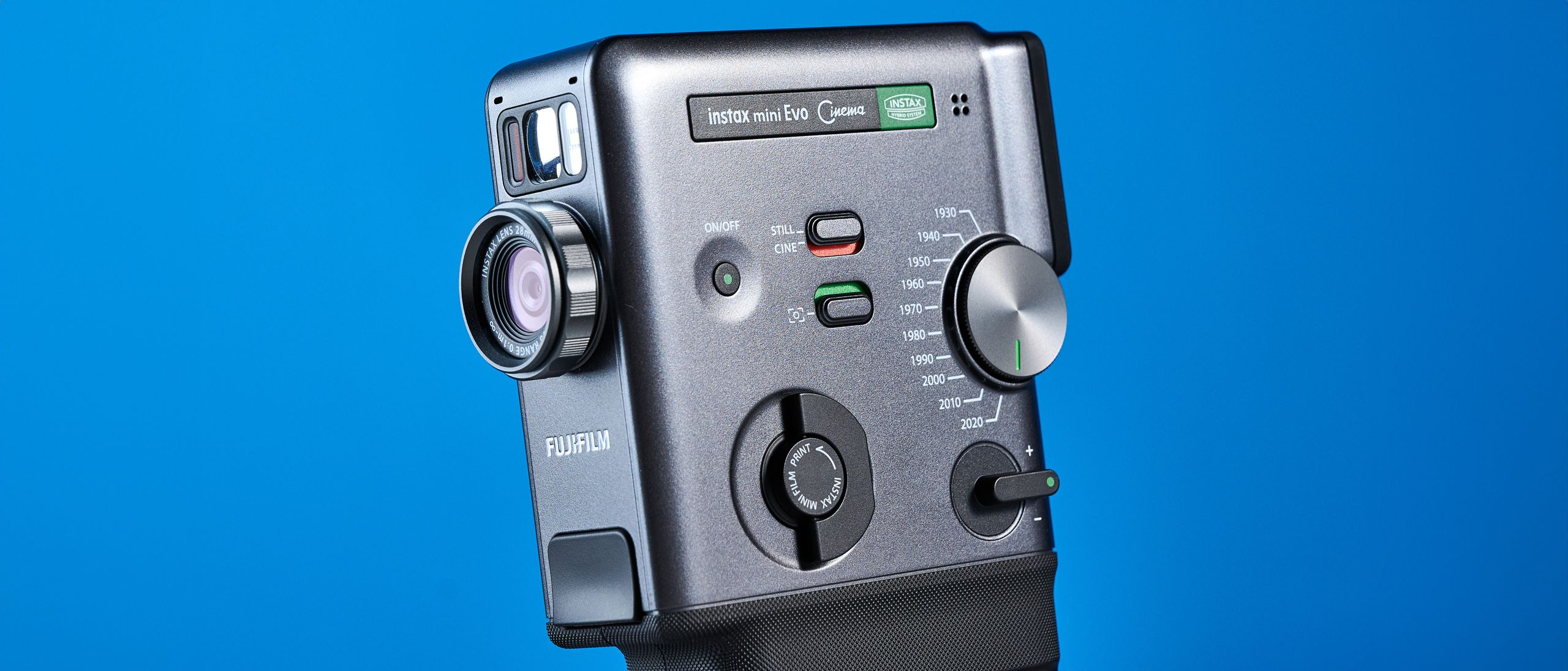
Fujifilm continues to set new standards for instant photography, and it has done it again with the Fujifilm Instax mini Evo Cinema. Announced on 14 January 2026, it is the world’s first-even instant camera that can record videos with audio, and capture stills and print them. Extremely well-built and easy to use,
The Instax mini Evo Cinema features a fancy Eras or Gen Dial, which lets you apply effects from the 1930s to the 2020s, and there’s a Degree Control dial to adjust the level of noise and contrast. With a revamped companion app and peerless image and video quality, there’s no doubt that this camera is an all-rounder.
Fujifilm Instax mini Evo Cinema review: Specs
|
Specs |
Fujifilm Instax mini Evo Cinema |
|---|---|
|
Price |
$409 / £329 |
|
Lens |
5MP 28mm |
|
Viewfinder |
Attachment included |
|
Monitor |
1.54-inch TFT color LCD monitor, approx. 170K dots |
|
Exposure control |
-2.0 EV to +2.0 EV (1/3 EV step) |
|
Shutter |
1/4-1/8000s (automatic) |
|
Aperture |
f/2 |
|
Shooting range |
10cm – ∞ |
|
Video |
600 x 800 / 24p | 1080 x 1440 (2020 Era) |
|
Flash |
Yes, built-in |
|
Flash refresh time |
7 seconds or less |
|
Flash range |
50cm – 1.5m |
|
Self-timer |
2s, 10s |
|
Internal storage |
50 photos, 10 clips |
|
Ports |
USB-C, 1x microSD / microSDHC card |
|
Power |
Rechargeable Lithium-ion |
|
Dimensions |
5.21 x 3.94 x 1.55 inches |
|
Weight |
9.52oz (camera only) |
|
Film used |
Instax mini film |
|
Film development time |
Up to 90 seconds |
|
Cost per print |
75¢ |
Fujifilm Instax mini Evo Cinema review: Cheat sheet
- What is it? The world’s first 3-in-1 instant camera that can shoot video, record audio and take photos
- Who is it for? Anyone who wants a versatile instant camera
- How much does it cost? Quite a bit! The Fujifilm Instax mini Evo Cinema is available for $409 / £329
- What do we like? The exceptional build and design, easy handling, Gen Dial and Degree Control for 100 effect combos, and the user-friendly companion app
- What don’t we like? It’s expensive, and the print lever is a little annoying
Fujifilm Instax mini Evo Cinema review: Price & availability
The Fujifilm Instax mini Evo Cinema is the latest addition to Fuji’s lineup of hybrid instant cameras. It joins the Fujifilm Instax mini Evo ($199) and the Fujifilm Instax Wide Evo ($349), and becomes the world’s first-ever instant camera that can shoot video — at the time of writing, at least. The Instax mini Evo Cinema feels like a cross between the Instax mini Evo and the Instax mini LiPlay+ ($234), which can record audio clips.
It is also Fuji’s most expensive instant camera yet, retailing for $409 / £329. Note that this doesn’t make it the most expensive instant camera ever, though, as the Polaroid i-2 costs a whopping $599. The Instax mini Evo Cinema comes in one color only: black and gray. But is it worth the money? Spoiler alert: yes. If you want an instant camera that can record video footage, and 100 effect combinations thanks to the new Gen Dial and Degree Control, it’s really the only product on the market. And these innovations help justify its otherwise steep price.
Fujifilm Instax mini Evo Cinema review: Design & build

If there’s one area Fujifilm excels in, it has to be the design and build department. The Fujifilm Instax mini Evo Cinema is built exceptionally well, with no hollow-sounding pings resonating when tapped on with fingernails. It’s a handsome camera too, covered in black and gray colors that give it a premium look. The stylized name and branding bring the camera into the modern age, and I like the departure from the Instax mini Evo’s retro-heavy design.
But make no mistake: this camera is still very much inspired by cameras of old. The first time I held the Instax mini Evo Cinema in my hands at a hands-on event in London, U.K., I instantly clocked that it looks like a Super 8 video camera — like the Camp Snap CS-8 ($139). It’s a blend of modern technology and retro aesthetics.

While the Instax mini Evo is very compact and the Instax Wide Evo is rather bulky, the Instax mini Evo Cinema is just perfect. It’s the Goldilocks of instant cameras. The Instax mini Evo Cinema measures 5.21 x 3.94 x 1.55 inches which makes it portable but lovely to handle, fitting perfectly in my medium-sized hands. Included in the box is a grip attachment that can be screwed into the tripod thread at the bottom, offering enhanced handling.
The Instax mini Evo Cinema isn’t very heavy either, weighing 9.52oz (body only), and I’ve had no problem carrying it around in my coat’s pocket or my bag. It’s actually lighter than the Instax Wide Evo which weighs 1.08lbs.

Like its stablemates, the Instax mini Evo Cinema’s internal memory can store up to 50 still images and 10 clips shot in 600 x 800. There’s a microSD / microSDHC card slot available if you want to extend the storage (and I recommend using one so that you don’t run out of space while you’re out and about).
Fujifilm Instax mini Evo Cinema review: Lens & monitor

The Fujifilm Instax mini Evo Cinema is fitted with a wide-angle 28mm lens (35mm equivalent), making it great for landscape shots as well as portraits. Its aperture is fixed at f/2.0, which is the same as the Instax mini Evo and wider than the Instax Wide Evo’s f/2.4 aperture, so it performs well in low-light conditions. As the aperture is fixed and the 1/4-1/8000s is set automatically by the camera, all you really need to do is point and shoot.

You’ll be relying on the 1.54-inch TFT color LCD monitor to frame your shots, and this screen has a resolution of approximately 170K dots. I know that doesn’t sound like a lot, especially because the Instax Wide Evo’s 3-inch screen has a resolution of 460K dots. But for its size, this is quite decent, and I was able to view the screen properly in bright sunlight as well as in the dark.

If you want to be able to see the screen in more detail, Fujifilm includes a viewfinder attachment in the box. It easily clips on to the monitor, and it magnifies the screen and basically acts as an optical viewfinder (OVF). This works well, especially when you want to be able to focus on a particular subject better, and it makes you feel like a film director using a Super 8 camera. I’d use it just for the cool factor, to be honest.
Fujifilm Instax mini Evo Cinema review: Controls

The Fujifilm Instax mini Evo Cinema has a lot more controls on its body compared to its stablemates. They are all located within easy reach on the left-hand side of the camera. As they’re well-laid out, you shouldn’t have any problems getting to grips with them, even if it’s your first time using an instant camera.
Let’s talk about the most attractive control on the Instax mini Evo Cinema first: the Gen Dial or the Eras Dial. As the name suggests, this dial lets you cycle between 10 decades, from the 1930s to the 2020s. Each era applies its own unique effect. Think, the graininess black and white footage from the 1930s; 8mm-inspired colors from the 1960s; YouTube overlay of the 2010s; and so on. I absolutely love the Eras Dial, having extensively played with it, and I think it’s a powerful tool for social media content creation.

These effects can be further fine-tuned via the Degree Control dial located around the lens on the front. You can rotate the dial to adjust the color, contrast and noise level. Combined with the 10 decade-specific effects, you can basically apply one of 100 different combinations to your footage and prints. The dial itself gives good tactile feedback when turned.

Other controls on the camera include a button to swap between “Cine” (video) and “Stills” (photos), a zoom lever to zoom in and out, a Frame switch that applies different frames depending on the era you’ve picked, and a print lever. Located under the monitor is a set of navigation buttons which are fairly self-explanatory. The shutter button is located under the lens so your index finger falls naturally on it, and I found it satisfying to press, requiring just the right amount of force so you don’t accidentally set it off.
The Evo-lution of the print lever on Fuji’s hybrid cameras continues as this time, the print lever takes the form of a tab that pulls out and turns, making the printing process immersive. It makes a sort of whirring sound, akin to the lever you find on film cameras to advance the roll. While it’s fun, I did find the Instax mini Evo Cinema’s print lever a little finicky, as it took a couple turns to execute the print command.
This is something I also discussed in my first impressions piece, and while I then thought that it was a fault with that particular unit, my second review unit proves it’s just a quirk of the camera. I don’t believe it’s a dealbreaker though, because the Instax mini Evo Cinema does more than enough to make up for this particular shortcoming.
Fujifilm Instax mini Evo Cinema review: Image & print quality

The Fujifilm Instax mini Evo Cinema’s image and print quality are outstanding — peerless, even. It captures lovely, mini photos with plenty of detail and fantastic color reproduction. Colors turn out bright and vibrant, as you can see in the photos above. These were taken with the 2020 era filter active, and the Degree Control turned up to 100%. This is also what photos typically look like when shot with a compact camera, like the Kodak PIXPRO C1 ($79).
Image 1 of 3


So what do the remaining nine decades look like? The gallery above shows all the effects, from 1930 through to 2010, with each era’s respective frame applied via the Frame switch. You get a timestamp for 1980 and 1990, for example. While these are good for stills, they’re even better when shooting videos, which I’ll talk about in the next section.

The Instax mini Evo Cinema also features autofocus with human face detection, just like the Instax mini Evo and the Instax Wide Evo. I tested this out by taking a mirror selfie (seen earlier), and the camera was quick to lock on to my face. When I photographed a model at the hands-on event, and my partner during my in-depth testing, the autofocus didn’t let me down then either, as you can see above.
With an f/2.0 aperture, the Instax mini Evo performs well in dimly lit environments too. There’s also a built-in bright flash, with a range of 50cm – 1.5m, and you can choose for it to trigger automatically or you can disable it completely. Having such a powerful flash — which refreshes in less than 10 seconds — helps you take better photos when lighting is challenging.
As for printing, prints are quick to develop, taking just under 90 seconds, but I recommend leaving them overnight for them to develop fully with vivid colors. You can also print images on your smartphone, so the camera acts as a printer.
Fujifilm Instax mini Evo Cinema review: Video quality
The Fujifilm Instax mini Evo Cinema’s biggest selling point is that it can record videos — and it’s the only instant camera that can do so, at the time of writing. There are two formats available: 600 x 800 at 24p, or 1080 x 1440 when using the 2020 decade effect. You can record up to 15 seconds. A progress bar on the monitor lets you know how many seconds you’ve recorded, and this turns red when you have just five seconds remaining, which is quite helpful.

Watch On
The video above was shot with the 1960s era effect active, and I think the video looks great. Autofocus works well in video too, as the camera was quick to focus on the model’s face and keep focused until I finished recording. Once you’ve shot your video, you can choose the cover image via the monitor, and add the QR code in one of the four corners, and print it out. This QR code can then be scanned by anyone, anywhere in the world, and they’ll be able to watch the video (as it gets saved to the cloud).

Watch On
My favorite era to shoot in, though, is the 1930s, in which the black and white footage resembles Fuji’s Acros film simulation. The graininess and jittering footage makes it look like it was shot on an old camera. It’s similar to the black and white mode on the Camp Snap CS-8.
Alongside shooting video, the camera also records audio which sounds loud and clear. To test this, I recorded my partner speaking, and in the video above, you can hear that her vocals are clear, with every word discernible. I also edited the clip and added filters using the Instax mini Evo app, which I’ll discuss in detail in the next section.
Ambient sounds are recorded well too. In the clip above, the water gushing at the Pulteney Weir in Bath, U.K. sounds great and clear.
The Instax mini Evo Cinema is a formidable camera for stylized social-friendly images, and I’d even go as far as to recommend it over the Fujifilm X half ($849) which, while good in its own right, isn’t as versatile as Fuji’s latest instant camera. If you don’t want to spend nearly $900 doubloons on the X half, the Instax mini Evo Cinema is a fantastic alternative — for half the price.
Fujifilm Instax mini Evo Cinema review: App

The Fujifilm Instax mini Evo Cinema utilizes the Instax mini Evo app, available for free on iOS and Android. If the app sounds familiar to you, you’d be right. It’s the same app the Instax mini Evo uses, and with the launch of the Instax mini Evo Cinema, Fuji has given the app a much-needed makeover. It looks better than ever now.

It’s a highly detailed app, sporting a simple interface with plenty of signposting. For the Instax mini Evo Cinema, you get an array of features including but not limited to image and video transfer, remote shooting, and direct print (for printing straight from your smartphone). Within the app, you can edit videos too by combining clips, adding opening and closing titles, and adding poster-style covers.
Fujifilm Instax mini Evo Cinema review: Film cost

Similar to the Fujifilm Instax mini Evo and other mini instant cameras, such as the Fujifilm Instax mini 12 ($79) or the Lomography Lomo’Instant Automat ($159), the Fujifilm Instax mini Evo Cinema utilizes Instax mini film.

A double pack of film (20 prints) generally costs $16 / £14 so it’s quite affordable, and you’ll be spending approximately 75¢ per print.
Fujifilm Instax mini Evo Cinema review: Battery life

One thing that hasn’t changed since the launch of the Fujifilm Instax mini Evo is the battery life of Fuji’s hybrid instant cameras. Just like its stablemates, the Fujifilm Instax mini Evo Cinema utilizes a rechargeable Lithium-ion battery, and the camera can print approximately 100 images between charges. Charging it with a 30W USB-A to USB-C charger takes just under two hours too.
I couldn’t drain the entire battery in my testing — I printed 30 photos with the battery indicator on the monitor showing two bars remaining. Not too shabby at all.
Fujifilm Instax mini Evo Cinema review: Verdict

No other instant camera can do what the Fujifilm Instax mini Evo Cinema can — simply because no other instant camera can record video like it can. Capable of recording lovely footage with different filters relevant to 10 decades, the Instax mini Evo Cinema is an utter delight. It’s built exceptionally well and handles beautifully, and its controls are easy to get to grips with.
Alongside being able to shoot videos, it can also capture 5MP images and print them on Instax mini film, making it a 3-in-1 instant camera. While the print lever is a little finicky, and the camera isn’t for those on a budget, it’s well-worth the premium. The Instax mini Evo Cinema has quickly become the instant camera to beat.