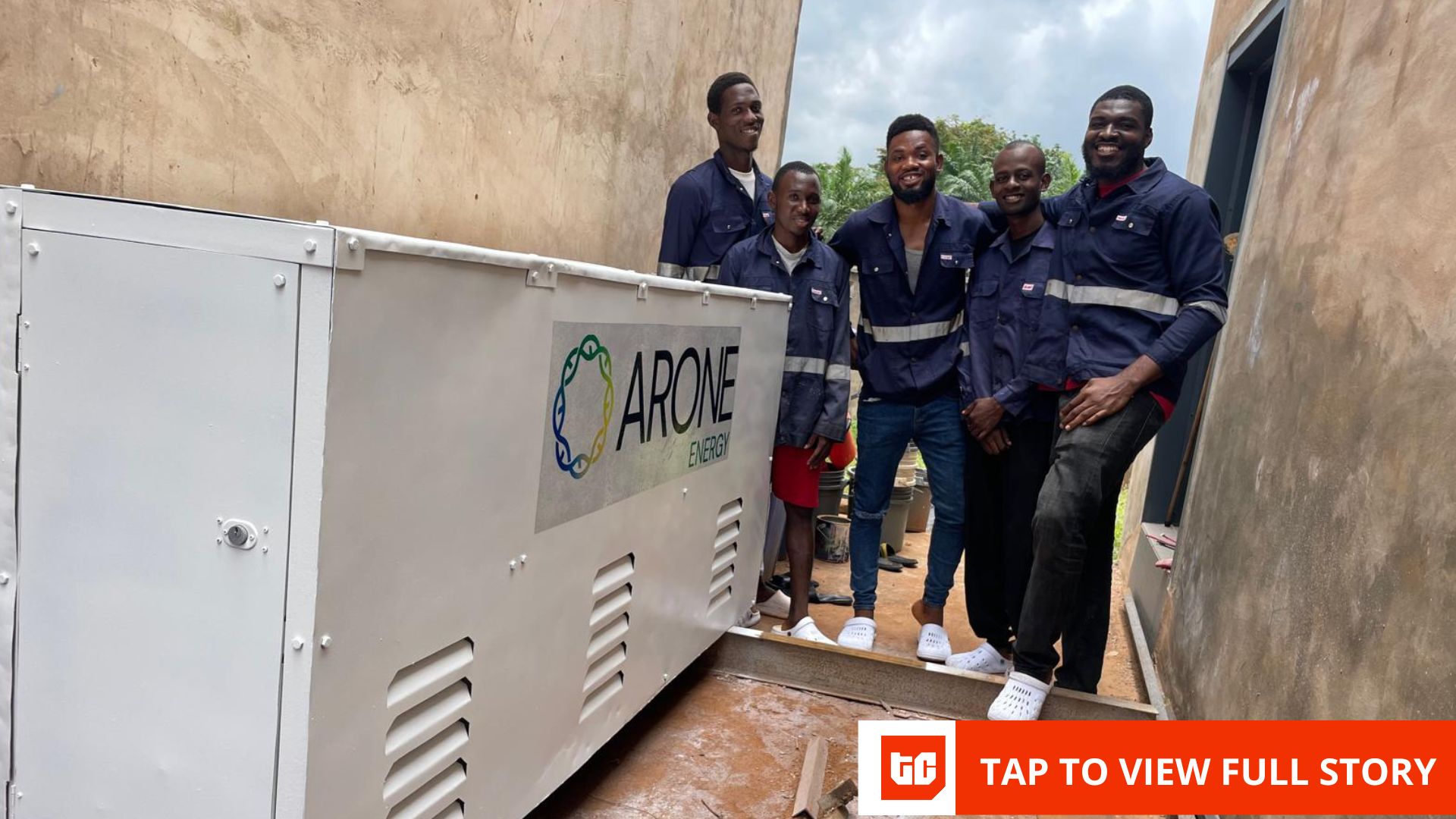
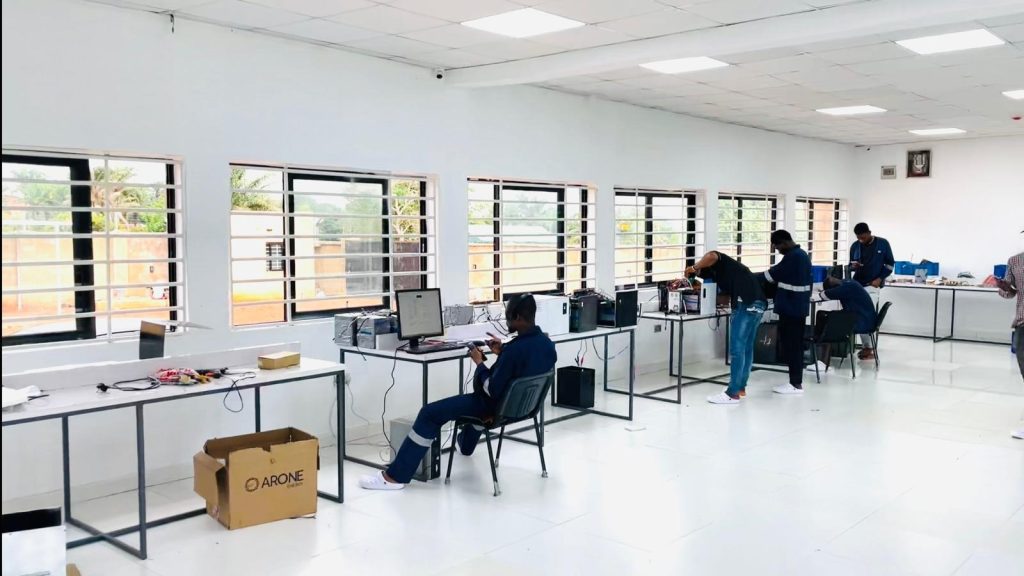
In a 2,000-square-metre facility in Nsukka, Enugu State, in southeastern Nigeria, engineers assemble airframes, test control systems, and fine-tune battery modules to prove a point: Nigeria can build hard tech.
Arone Technologies, founded in 2018 by AI engineer Emmanuel Ezenwere, is one of the few Nigerian startups attempting to manufacture drones and modular solar energy systems locally. The company is betting on hardware, from autonomous aerial logistics to portable solar systems, built largely in Nigeria.
That ambition is set to scale through a ₦12.95 billion ($9.52 million) partnership with the state-owned Institute of Management and Technology (IMT), Enugu. Over the next four years, both partners plan to establish what they describe as Nigeria’s first tech manufacturing plant dedicated to defence, aerospace, robotics, AI, and renewable energy, an entire industrial hub built within the IMT campus.
“We’re building solutions that enable energy security and enable smart living,” Ezenwere told in an interview. “Our primary focus is energy security and artificial intelligence.”
Arone was founded “way before AI became sexy,” as Ezenwere puts it. The company’s early mission was practical: solving Nigeria’s last-mile healthcare delivery problem.
Arone’s journey began in 2018 with a ₦3 million ($2,200) grant from Roar Nigeria, the University of Nigeria, Nsukka’s tech hub, alongside a $5,000 angel investment. It later raised a $100,000 seed round from Energia Ventures and AfriClim Accelerator, as well as investments from angel investors.
For a company that once watched its capital evaporate in a drone crash, the ₦12.95 billion ($9.52 million) manufacturing partnership marks a dramatic evolution.
Solving the last-mile problem
Nigeria has more than 30,000 primary healthcare centres, many located in rural communities with poor road infrastructure. Deliveries of blood, vaccines, and emergency medication can take hours, sometimes too long.
Arone’s answer was autonomous drones capable of carrying up to 5kg of medical supplies over distances of up to 200 kilometres. Through a network of “Avports”, autonomous vehicle ports stationed at blood banks and distribution hubs, drones can take off, deliver to remote clinics, and return without human intervention.
A trip that might take one hour and fifteen minutes by road can be completed in about 15 minutes by drone.
The company’s early cargo drone, capable of carrying 20kg, was among the first of its kind in Nigeria. Its maiden flight in 2019 was successful. The next one crashed.
“We were thrilled with the accomplishment,” Ezenwere recalled. “But the reality was that the crash cost was greater than the capital we had raised.”
The setback forced the team to rethink how to build hardware in Nigeria. Instead of chasing perfect, finished products, Arone began breaking systems into manageable modules, refining and iterating gradually. It also pivoted toward niches that could sustain revenue, including security applications.
Today, Arone claims it works with the Nigerian Defence Research and Development Bureau and the Air Force, supplying drones for surveillance and security use cases.
Manufacturing in a difficult environment
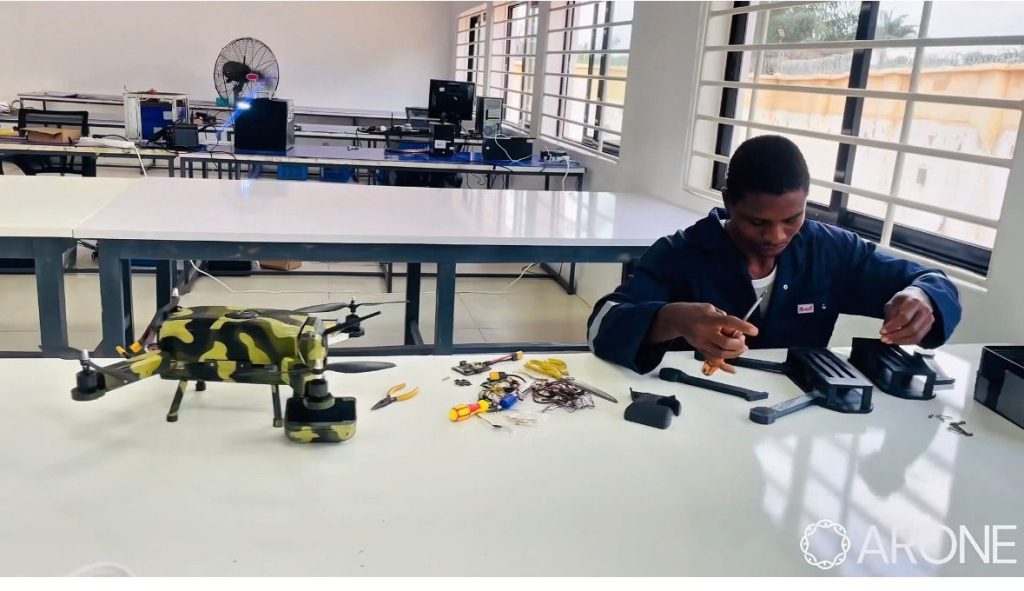
Arone engineers at work in the Nsukka factory. Image source: Arone
Building hardware in Nigeria is not for the faint-hearted. Ezenwere describes a landscape where every layer must be questioned: talent, materials, capital, and market readiness.
“It’s not just manufacturing,” he said. “It’s the full food chain, research, development, manufacturing.”
When asked what “manufacturing” means for Arone, Ezenwere is careful. No modern hardware company builds everything from scratch. But Arone says over 50% of its drone systems are indigenous.
The company designs and builds its airframes locally, develops its control systems and software in-house, and owns its AI models. Motors and batteries are still sourced externally, though the company says it is working toward deeper localisation.
For its AI surveillance platform, QView AI, Arone owns the entire software stack. The models combine custom-built systems with open-source components, but without third-party ownership of the final product. For enterprise clients, including government institutions, the system can be deployed on-premise, scaling from a few gigabytes of RAM to terabytes, depending on requirements.
The strategy reduces exposure to currency fluctuations and import markups, though not entirely. “We are exposed,” Ezenwere admits, “but the level of exposure is reduced.”
The cost advantage is significant. Arone’s Aurora drone, equipped with thermal imaging capabilities for night surveillance, costs around ₦3 million ($2,190). Comparable foreign drones with similar specifications can cost upwards of $10,000.
“Why would someone interested in security applications choose to spend $10,000 when they can get the same capability locally?” he asked.
Powering beyond drones
As Arone scaled its drone operations, it encountered another Nigerian constraint: electricity.
That constraint birthed its second division: modular energy systems. Its flagship product, Luminar 2.0, is a portable, suitcase-sized solar energy system designed to power appliances and critical equipment during outages.
The largest Luminar model delivers 3KVA and 2000 watt-hours, enough to power a microwave, television, and fan, sufficient for a middle-sized household. The systems use lithium iron phosphate (LiFePO4) batteries with smart thermal management, designed to withstand temperatures up to 45°C and operate for five to seven years.
As of late 2025, Arone says it has deployed over 1.35 MWh of modular energy systems across all 36 states in Nigeria. Vaccine refrigerators are among the critical appliances powered by the systems during blackouts.
Energy security, Ezenwere argues, is inseparable from technological independence. “It’s a mission for us to build an ecosystem that will transform Nigeria from a consuming nation to a producing nation.”
Under the partnership with IMT, Arone will provide intellectual property and product designs, while IMT provides funding and infrastructure. Production targets include 5,000 Aurora drones per year, over 30,000 Luminar energy systems annually, and more than 200 QView AI servers.
Beyond manufacturing output, the partnership aims to train more than 20,000 students. The goal is not merely to produce factory workers but future industrialists.
“The objective is not just to train production workers,” Ezenwere said. “It’s to train people who will eventually build other industries.”
Arone’s facility, located near the University of Nigeria, Nsukka, initially had to transport students by bus daily to build practical exposure. Many engineering graduates, he notes, end up pivoting to web development or unrelated software skills because there are few opportunities to practice hardware engineering.
“It’s not their fault,” he said. “There’s no consumption of that talent.”
By embedding manufacturing and training within the IMT partnership, Arone hopes to create a pipeline where engineering degrees translate into real industrial output.
Implementation, Ezenwere says, has already begun, with a month-by-month roadmap spanning four years.
For Arone, success isabout shifting Nigeria’s industrial trajectory.
If the plan works, Enugu could become a hub for indigenous aerospace and energy manufacturing. Thousands of students would gain hands-on hardware experience. Security agencies and healthcare providers could rely less on imported systems. And Nigeria would inch closer to producing more of what it consumes.
In a country where software dominates the startup narrative, Arone is making a contrarian bet that real transformation may require factories as much as code.
“We care a lot about sustainability,” Ezenwere said. “Not just sustaining our company, but transforming Nigeria.”


-xl-xl.jpg "iPadOS 26.3 ships with new location privacy-limiting feature")