

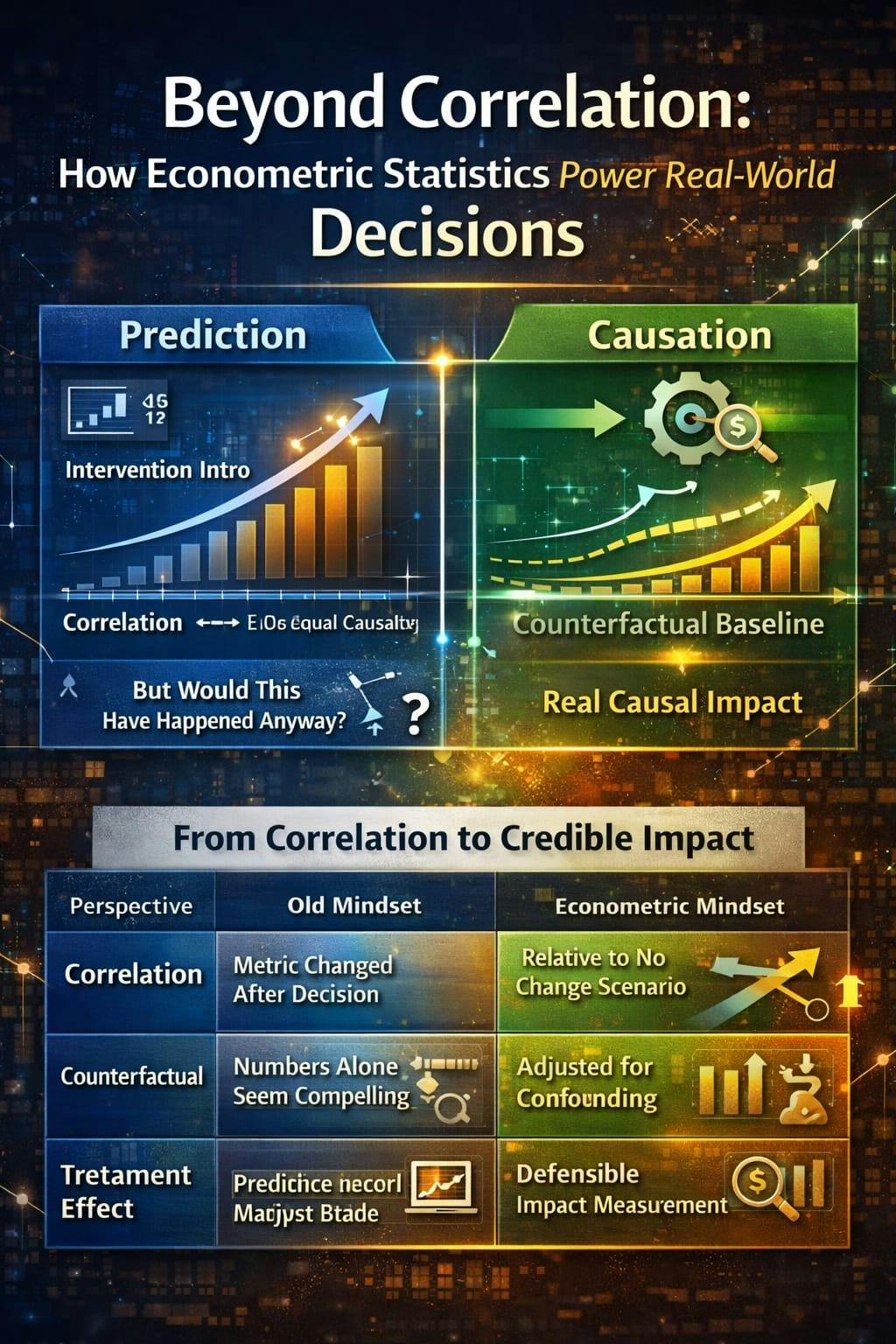
The chart looked convincing. A clear, upward slope, a quick shift right after a new feature rollout, and a healthy percentage increase in bold. Heads nodded in the meeting room. There was a remark: “This clearly worked.” Then the discomforting follow-up:
“But how do we know this happened because of the feature?”
That question too often asked too late, or not at all — is where econometric statistics intervenes, quietly, to affect the outcome of real-world decisions.
The Seduction of Correlation
Many contemporary organizations are surrounded by correlations. Dashboards light up with patterns: More engaged users spend more, regions with higher adoption grow faster, customers exposed to specific messages churn less. Correlations are cheap to compute, easy to visualize, and dangerously easy to trust.
The trouble is not with correlations being wrong. The issue is, they are incomplete.
Correlation tells us two things move together, but it does not tell us why. It doesn’t indicate which direction influence flows. And crucially, it doesn’t reveal what would have transpired if a choice had never been made.
This ambiguity might be OK in low-stakes situations. In these high-stakes contexts — pricing, creditworthiness, healthcare, policy, and investment in products.
Real Decisions Need Real Impact
Econometric statistics was born out of a necessity. Economists faced a very basic issue far before big data or AI was born: They could not conduct controlled experiments on entire economies. They had to deduce cause from incomplete, observational data.
That same challenge is today’s hallmark of contemporary tech, finance, and public policy.
When a company announces a new algorithm or a price adjustment and changes a supply chain strategy, it is essentially running an experiment without a control group. The world keeps moving. Markets fluctuate. Users adapt. External shocks occur.
Econometrics empowers the tools to deal with this mess and extract convincing evidence of impact.
A simple but powerful thought: The counterfactual
The cornerstone of econometric thinking is a deceptively simple notion:
- Every decision has an alternative universe in which that decision was never made.
You cannot see this alternative world in real time. But you can estimate it.
Econometric procedures build counterfactuals — statistical accounts of what likely would have occurred had an intervention not been applied. The difference between what actually happened and something assumed as a baseline is the true effect.
This is the step away from correlation. Instead of whether measures changed, econometrics only wonders if they changed relative to what could have happened normally.
When Correlation Leads Leaders Astray
Imagine a city well invested in smart traffic systems. Over the next year, congestion has decreased. Headlines celebrate success.
But an econometric analysis tells a more cautious story. Fuel prices increased during the same timeframe. Adoption of remote work rose. Population growth slowed. When analysts adjust for these factors, based on similar cities and historical trends, the system’s real contribution is much smaller.
Lacking that analysis, leaders would either overstate their achievements or misallocate potential profits for reinvestment. With it, they get a more real sense of how well it worked, by how much, and in what conditions.
How Econometric Statistics Arrives at the Decision
Instead of predictive models being applied to maximize accuracy, econometric models are used to test claims.
Here you have to grapple with things like:
Were treated and untreated groups truly comparable? n Was the trend already moving in this direction? n Did the effect continue, or was it temporary? n How sensitive are results to assumptions?
These kinds of questions slow conversations, however they also make them a whole lot more reliable.
The reality is that econometric analysis has the power to transform not only answers but confidence levels in practice. Leaders figure out which results are robust, which are fragile, or which should not inform strategy.
Beyond Models: A Change in Thinking
Econometrics is not just a skillset; it is a new way of thinking.
It replaces statements like:
“This metric increased after we took the plunge.” with:
“Relative to a credible counterfactual, this intervention increased outcomes by X, within uncertainty bounds.”
This reorientation shifts the definition of success. Wins are more often celebrated when movement survived scrutiny than when numbers moved.
Eventually, an organization with this kind of mindset becomes more disciplined. They make more careful experiments, scale more selectively, and learn more quickly from failure.
Another Point: Decisions as Experiments
One of the quiet revolutions that econometrics introduces is the notion that every decision is an experiment, whether recognized or unrecognized.
Consumer elasticity is tested with a pricing update. Product redesign tests user behavior. A change of policy tests institutional incentives.
But neglecting this truth is not a matter of eliminating uncertainty. It just obscures it. Uncertainty with econometric statistics can be made clear and manageable.
By treating decisions as experiments, organizations stop asking, “Did this work?” and start asking, “What did we learn?”
What It Means for the Age of AI
To the extent that AI systems automate decisions at scale, the cost of blurring correlation with causation grows significantly more costly. Algorithms can amplify biases, enhance false clusters, and build feedback loops that appear to be effective until they fail.
Econometric methods serve as a stabilizing force. They perform post-deployment outcome audits. They draw a fine line between algorithmic lift and external trends. They make sure optimization has a real-world impact.
In that sense, econometrics isn’t in competition with AI: it keeps it honest.
The Quiet Competitive Advantage
Most organizations that have mastery of econometric reasoning seldom advertise it. There are no showstopper demonstrations of counterfactual robustness checks with flashy demos. But over the years, these organizations make fewer catastrophic mistakes.
They avoid phantoms of scaling. n They make investments in changes that really matter. n They establish credibility with regulators, investors, and the public.
But more importantly, they develop institutional memory rooted in evidence, rather than anecdote.
The Bottom Line
Correlation is so tempting because it’s so easy. It provides rapid solutions in a complex world. But real decisions require more than mere convenience.
Econometric statistics gives the “more.” It adds rigor to ambiguity – structure into chaos; and evidence into intuition. Data is transformed from an instrument of storytelling into one of decision-making.
A world full of correlations seems to forget that the real advantage happens to those able to say, confidently and with humility:
“It was us who helped achieve this outcome.”
This is the power of breaking from the correlation mode.


