For years, builders in tokenization have been waiting for a decisive signal that traditional finance would not just experiment with private blockchain infrastructure, but integrate with it into decentralized finance. That signal arrived when BlackRock’s tokenized money market fund, BUIDL, began trading on Uniswap through UniswapX in partnership with Securitize.
This was not a sandbox pilot. It was a $2.1 billion tokenized US Treasury fund connecting directly to decentralized liquidity rails. The development was reported by Fortune, which noted the significance of BlackRock extending its tokenized fund strategy into decentralized finance infrastructure. Details on the integration with UniswapX were reported by Uniswap Labs, outlining how BUIDL became accessible through decentralized exchange rails. Yahoo Finance also covered the scale and structure of the fund, emphasizing its position as one of the largest tokenized Treasury vehicles to date.
The significance is structural. When the world’s largest asset manager, overseeing roughly $14 trillion in assets under management according to BlackRock’s public filings, connects regulated, yield-bearing Treasuries to a decentralized exchange, it validates the pipes. Infrastructure matters more than access restrictions. While participation remains limited to qualified institutional buyers under securities rules, the architecture proves that compliant real-world assets can operate natively within DeFi systems.
The Tokenized RWA Market Is Already Scaling
The rise of tokenized real-world assets, often referred to as RWAs, is measurable. According to RWA.xyz, tokenized Treasuries, private credit, and other RWAs have grown into the tens of billions of dollars in on-chain value excluding stablecoins. Tokenized US Treasuries alone have crossed multi-billion-dollar levels in circulation over the past two years.
Boston Consulting Group has projected that tokenized assets could reach $16 trillion by 2030 under certain adoption scenarios. Citi has similarly estimated that tokenization could represent a multi-trillion-dollar opportunity by the end of the decade.
US Treasuries have led this expansion because they are familiar, yield-bearing, and relatively straightforward to structure within compliant wrappers. They are a logical bridge asset between traditional capital markets and blockchain-based settlement infrastructure.
BlackRock’s BUIDL fund moving onto Uniswap demonstrates something critical. Traditional assets are no longer confined to closed institutional tokenization platforms. They can connect directly into decentralized liquidity networks.
That is the turning point.
Why This Matters for the Tokenization of Gold
Gold represents one of the largest and oldest real-world assets in existence. The World Gold Council estimates that total above-ground gold stocks exceed 200,000 metric tons. At prices near $5,000 per ounce in early 2026, that equates to a market valued in the tens of trillions of dollars.
Central banks alone added more than 1,000 metric tons of gold in recent years, according to World Gold Council data, marking some of the strongest official sector accumulation in decades.
Yet gold’s operational infrastructure remains largely analog.
Physical bullion sits in vaults. Settlement relies on intermediaries. Liquidity is constrained by geography and custody structures. Even gold-backed exchange traded products operate within traditional market hours and clearing systems.
In financial terms, gold has been powerful but structurally passive. It preserves value, but it does not move efficiently inside digital capital markets.
Tokenization transforms gold from static inventory into programmable capital.
When gold is issued in a compliant, fully reserved, and auditable tokenized format, it gains capabilities that physical bullion alone cannot offer. It can move 24 hours a day. It can integrate into digital wallets. It can serve as collateral within lending protocols. It can participate in automated market making and cross-border settlement networks.
Early examples already exist. Paxos Gold (PAXG) and Tether Gold (XAUT) have demonstrated that blockchain-based gold ownership is technically viable and can scale, with billions in cumulative issuance since launch. However, large-scale institutional integration into decentralized liquidity pools has remained limited.
BlackRock’s move provides the blueprint.
If regulated Treasuries can operate directly on decentralized exchanges under compliant frameworks, gold and other RWAs can follow.
What This Signals for Real-World Assets
The implications extend far beyond Treasuries or gold.
Tokenized RWAs introduce structural advantages that traditional systems struggle to match:
Continuous liquidity rather than restricted trading hours n – Faster and more transparent settlement n – Programmable compliance and ownership tracking n – Composability across lending, derivatives, and liquidity protocols
For mining companies, real estate developers, private credit funds, and commodity issuers, this represents a capital markets evolution. Assets that once required regional intermediaries and manual reconciliation can integrate into global on-chain liquidity networks.
The total addressable market underscores the magnitude. The global bond market exceeds $130 trillion. Gold represents tens of trillions in value. Global real estate is estimated in the hundreds of trillions. Even limited on-chain penetration across these asset classes would exceed the current size of decentralized finance.
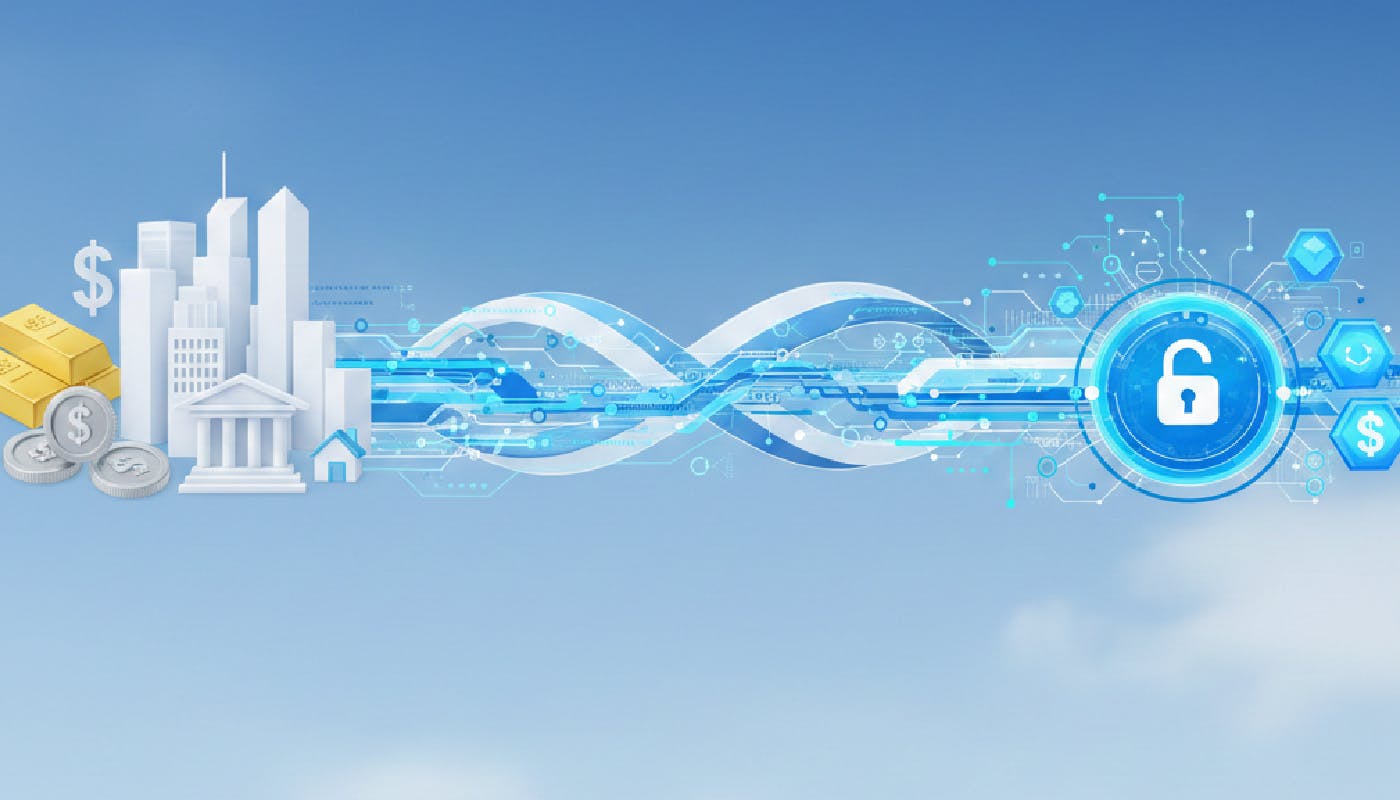
The RWA thesis is not about replacing traditional markets. It is about upgrading their settlement layer.
What This Means for DeFi
Decentralized finance has often been criticized for reliance on volatile collateral and cyclical token incentives. The integration of tokenized Treasuries and eventually gold alters that composition.
Higher-quality collateral strengthens lending markets. Real-world yield reduces dependence on inflationary token emissions. Institutional participation increases regulatory credibility and liquidity depth.
When productive, yield-bearing assets flow into DeFi, the ecosystem matures. It becomes less speculative and more capital efficient.
BlackRock’s decision to connect BUIDL to Uniswap signals that decentralized exchanges are evolving into distribution and liquidity infrastructure for regulated assets.
Convergence Is the New Architecture
Traditional finance is not disappearing. Decentralized finance is not remaining niche. The two are converging at the infrastructure layer.
BlackRock did not tokenize Treasuries merely to digitize them. It connected them to decentralized exchange rails because liquidity and settlement innovation are accelerating there.
For those building in tokenized gold and other real-world assets, this moment confirms what many have anticipated. The bridge between TradFi and DeFi is no longer conceptual. It is operational.
Gold is a natural next step. It is globally recognized, deeply liquid, and historically trusted. When it becomes fully interoperable within decentralized infrastructure, it will no longer be a passive store of value sitting in vaults. It will be programmable, mobile, and integrated into the digital financial stack.
This is infrastructure being rebuilt in real time.
The question is no longer whether real-world assets will move on-chain. The question is how quickly the largest asset classes in the world will adopt the rails that have now been validated.