We haven’t been back to the Moon since the Apollo 17 mission in December 1972. That mission may not sound particularly familiar to you, and that’s completely normal. Of all the times we have approached or walked by our satellitemost people remember the Apollo 11 mission for Neil Armstrong’s famous phrase, “It’s one small step for a man, one giant leap for mankind,” and, possibly, Apollo 13, not because it was a success, but because one of the oxygen tanks exploded and, fortunately, the astronauts managed to save themselves.
Fifty-three years later, we are closer than ever to revisiting the one that illuminates us when the sun goes down. We will do so with the Artemis II mission, scheduled to launch as soon as February 2026. But this return is not without challenges. And we are not talking about the delays of the Artemis program, which are not always really delays, but about a piece that is as common as it is indispensable: the vehicle that takes astronauts from their bedrooms to the spacecraft that will transport them to the Moon. And someone has come to the rescue of NASA.
Returning to the Moon is not just a matter of rockets
Historically, astronauts have used the well-known Astrovan to get around from the operations building to the launch pad. From the space shuttle Columbia mission STS-9 in 1983 to the end of the program with the Atlantis mission STS-135 in 2011, a 1983 Airstream Excella modified specifically to transport astronauts was used. And since NASA has not had its own system to launch astronauts into space since the end of the shuttle program, SpaceX and Boeing, the two American contractors that have assumed this role, have used their own vehicles, turning the historic Airstream Excella into a museum piece.
The Artemis program became a good excuse to take a step towards modernity and incorporate, of course, an electric vehicle to transport astronauts. Under this premise, NASA announced in July 2022 that the astronauts of the Artemis program would move in vehicles from Canoo Technologies, an American startup. The fleet would be made up of three vans based on the Lifestyle Vehicle (LV), a model that, strikingly, had not even begun to be sold at the time of the announcement. Even so, there was a vote of confidence and, of course, a contract involved that required compliance.
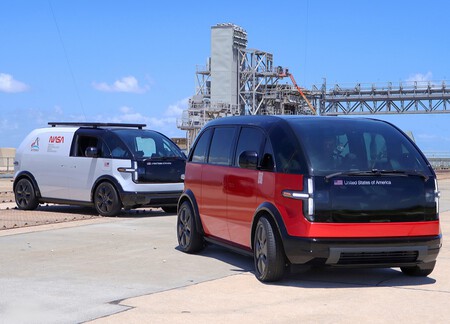
The Canoo vehicles that NASA bought
Everything seemed to be progressing without visible setbacks, but things were getting complicated inside. In summary, the company published a press release on its website, which can only be viewed on Internet Archive, in which it voluntarily filed for Chapter 7 of the United States Bankruptcy Code. This implies the cessation of its operations and the liquidation of all its assets. The vehicles had already been delivered to NASA, but using them left one question in the air: if a technical problem arose, who would respond? It was time to make a decision.
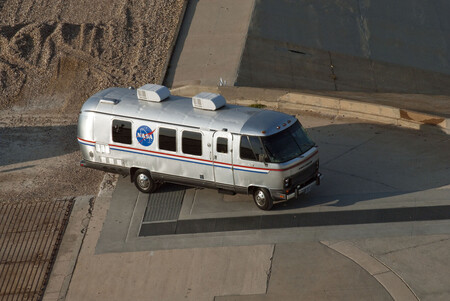
La Astrovan original
With the “countdown” underway for the launch of Artemis II, the US agency’s options were not many. Go out and find a new contractor? NASA had already paid for three Canoo vehicles that now lacked operational support. So there were two alternatives left at home: use the Tesla Model X used by SpaceX or resort to Boeing’s Astrovan II. Finally, NASA opted for this second option, at least as explained by the agency itself in a statement provided to the Orlando television network Spectrum News 13. The solution is to temporarily rent the Boeing vehicle for, at least, the Artemis II mission, while other options for the future are evaluated.
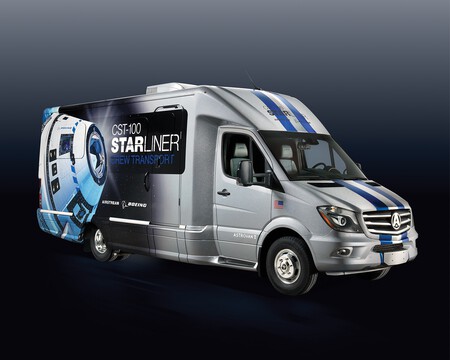
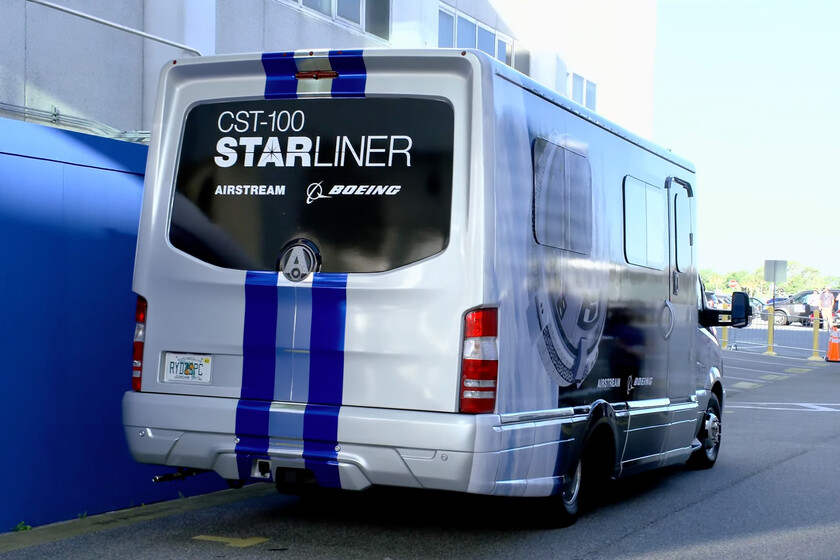
Boeing’s Astrovan II
It is worth remembering that, although the transportation of astronauts before a mission may seem like a minor detail, it is not at all. It is a highly tense situation in which everything must flow with millimeter precision, and the comfort and conditions of the crew are key. So much so that these vehicles are adapted to meet NASA’s strict specifications and have everything necessary so that astronauts can move around with the Orion survival system spacesuits. It’s not as simple as getting into any car and that’s it.
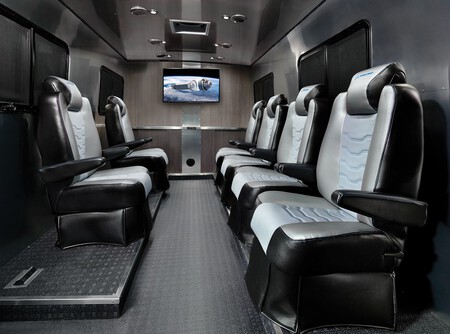
Boeing’s Astrovan II
The Astrovan II is the result of a collaboration between the caravan firm Airstream and Boeing. It is, in essence, a modified Mercedes-Benz Sprinter 4500, powered by a Mercedes-Benz 2.0 liter diesel engine and four cylinders with turbo. It features custom seating, USB charging stations, 110V power outlets, and a live TV broadcast system, as well as being ready to welcome astronauts in their suits. As expected, there are those who are in favor and those who are critical of this decision, but on paper it seems the most logical option.
And if you’re wondering if the Astrovan II has ever been used before, the answer is yes. The vehicle debuted on the Boeing Crew Flight Test (Boe-CFT) mission, launched on June 5, 2024. Barry “Butch” Wilmore and Sunita “Suni” Williams were transported in it from the Kennedy Space Center to the launch pad of the Starliner Calypso capsule. That was, precisely, the mission in which the capsule had problems and the astronauts ended up returning to Earth aboard a SpaceX ship.
Images | NASA | Boeing | Canoo
In WorldOfSoftware | We have filled the Earth’s orbit with satellites. And now the risk of a catastrophic collision is very high