
I have been working as a Business Analyst (BA) in teams of various scales for over 7 years. During this time, I’ve frequently encountered a misunderstanding of the BA’s role and tasks from a developer’s perspective. In this article, I want to share my experience to help developers build effective communication with their BA and extract maximum value from this collaboration.
1. Introduction
Throughout my professional journey, I’ve often seen the opinion that a Business Analyst is just a bureaucrat who formats technical tasks according to a specific template. While it’s true that a BA must follow certain rules when writing user stories, their role is much broader. Let’s look at the definition provided by the BABOK (Business Analysis Body of Knowledge):
“A business analyst is any person who performs business analysis tasks, regardless of their formal job title, focusing on enabling change by defining needs and recommending solutions that deliver stakeholder value, which involves discovering, analyzing, and aligning information to solve problems and achieve goals.”
As we can see, the primary task is defining needs and values, not just a formal task description.
You’ve likely encountered cases where a developer receives a task, works on it, and in the end, it turns out that despite full compliance with the requirements, it’s not what the client wanted at all. For example, the task was about a new button to send data to a database, but in reality, an API integration with a neighboring department was needed.
This is one of the BA’s most critical missions: to understand not just what the client wants, but why they need it and what problem the new feature is supposed to solve.
Ideally, a BA serves as an “API” between the world of business and the world of development. They don’t just collect wishes and write stories; they understand the underlying needs, prioritize tasks in the backlog, and discuss them with the dev team. Often, a task that seems trivial to the business requires immense capacity from development. If the BA communicates this after a sync with developers, the client might lower the priority or drop the feature entirely, saving everyone time.
2. The BA as an “Information Noise” Filter
Let’s look at the path a task takes from idea to implementation and how a BA accompanies it.
-
Ideas are born from business KPIs: Ideally, a business need drives every idea. However, business stakeholders can’t always validate an idea from a technical standpoint. Sometimes, an idea that costs hundreds of dev hours brings minimal profit.
-
Business presents ideas to the BA: At this stage, the BA acts as a filter: they check what needs are being met, consider alternative scenarios, and ask clarifying questions. The goal is to only move forward with feasible features that solve real problems.
-
BA discusses requirements with the team: This is a crucial step. The team looks at the task from a different angle and notices what the business misses: corner cases, limitations, security constraints, or architectural bottlenecks.
-
BA finalizes requirements and creates User Stories.
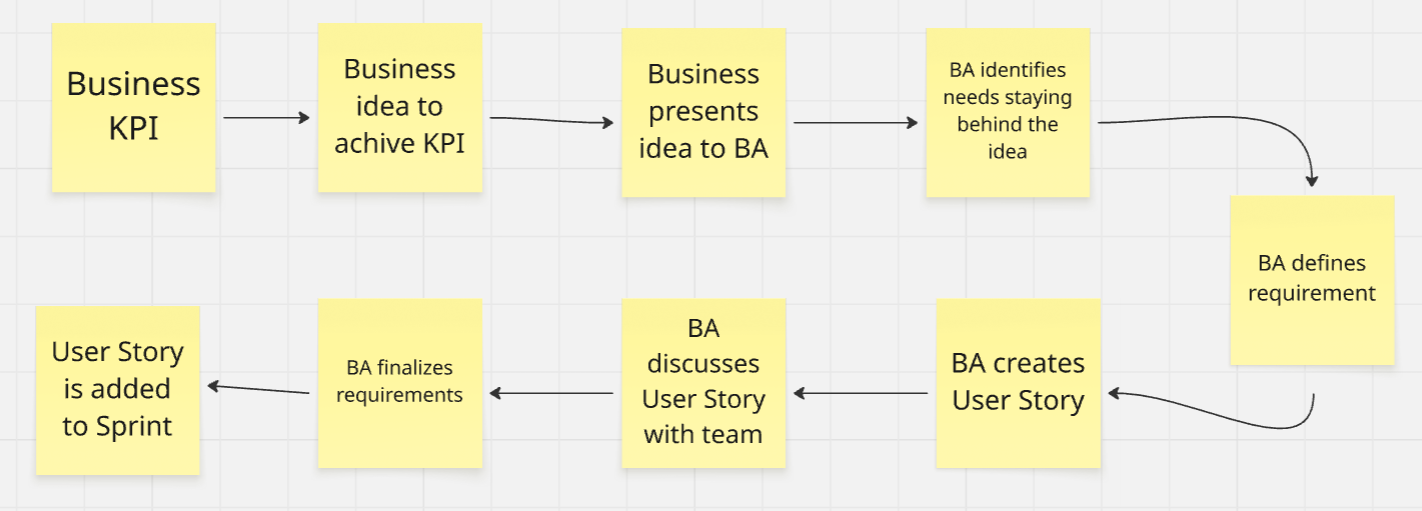
In this scenario, the BA isn’t a bureaucrat; they are a detective, a negotiator, and a facilitator.
3. The Anatomy of Quality Requirements
There is no single answer to what a “perfect” task description looks like, as it depends on the BA’s efforts, the developer’s seniority, and the team’s composition. However, a good task usually includes:
- Business Value: Developers must see the “Big Picture.” If the BA doesn’t know why we are building this, they need to go back and ask.
- Acceptance Criteria (AC): These must be unambiguous, complete, testable, and clear.
- Blockers and Dependencies: The BA should identify if anything prevents the team from starting now and mention all inter-team dependencies.
- Diagrams and Schemes: Visualizing logic saves time. A Sequence diagram for an API or a BPMN diagram for business logic can highlight weak spots instantly.
- Mockups/Wireframes: Even rough sketches help developers and designers visualize the interface.
- Corner Cases: Help your BA by suggesting corner cases you’ve encountered. Discussing them early “cushions the fall” for developers and QAs later.
Quality requirements are not a BA’s dictatorship; they are a contract that protects the developer from chaos.
Comparison: Good vs. Bad Task
| Criterion | Bad Task (The “Ticket to Nowhere”) | Good Task (The “Roadmap to Success”) |
|—-|—-|—-|
| Context/Goal | “Need to add a PDF export button.” | “An accountant needs to export monthly tax reports in PDF format from Table A in Section B to close the reporting period without manual work.” |
| Acceptance Criteria | “The button should work, PDF should download.” | 1. Button is located in the corner of Table A. n 2. File format: PDF. n 3. User can save the file locally or email it directly to the tax office. |
| Edge Cases | Empty. (You’ll find out about them from QA on Friday evening). | Describes what happens if there is no data, if the user lacks permissions, or if the connection fails. |
| Tech Dependencies | “Ask Alex from the other team.” | Attached Sequence diagram for API interaction and links to endpoint documentation. |
| Visuals | “Just make it like last time.” | Link to a Figma mockup or a Wireframe. |
4. How to “Exploit” Your Analyst (Practical Tips)
- Don’t ignore Refinement sessions: Yes, a million meetings distract from coding, but task preparation is part of the work. Questions asked now save hours of debugging later.
- Example: In one project, active dev and QA participation in refinements reduced the “bug return rate” from 20% to 3%.
- Come prepared: Ask your BA to send the list of stories in advance. Read them and note down immediate questions.
- Put on the user’s shoes: When reading a feature description, imagine you are using it. What steps are confusing? What technical hurdles might arise?
- Never forget to ask “Why?”: My advice to developers: ask “Why are we doing this?” It helps you understand the user’s needs, and you might suggest a more efficient technical solution.
- Give feedback: If you consistently lack information, tell the BA. If you have suggestions for User Story formatting, share them. Technical feedback is especially vital — if a task seems impossible, flag it immediately to find a workaround together.
- Be active: Refinement is a joint effort, not a BA’s stand-up performance.
- Understand the business: Ask the BA for domain materials. Understanding how the business works will drastically expand your product perspective.
5. Success Metrics
A BA’s work directly impacts several KPIs:
- Cycle Time: Fewer unclear requirements mean faster delivery.
- Success Indicator: Tasks don’t sit in “On Hold” or “Clarification Needed” for weeks.
- Developer Happiness: It’s much more pleasant to work when requirements are clear.
- Success Indicator: No frustration over “building for the trash can” or requirements changing three times mid-sprint.
- Project ROI: Errors at the requirement stage are the most expensive.
- Success Indicator: The product launches its MVP on time without bloated budgets for features nobody uses.
6. Conclusion
A Business Analyst is not a boring bureaucrat stamping out tickets; they are your reliable partner in building new features. Product development is not just about writing and testing code—it’s about solving real problems for real people.
The questions you ask today help the whole team deliver a great feature tomorrow. Don’t be afraid to ask “weird” or “uncomfortable” questions. Demand context, clarify the business intent, and be a partner to your BA to achieve results with fewer iterations.
A BA is not just a machine that converts ideas into requirements—they are a treasure trove of knowledge about the product, the business, and the domain. Don’t miss the chance to learn from them.