The logical assumption about wearing headphones while driving is that it’s a big no-no. Not only might they distract you from what’s happening on the road, but covering your ears also makes it challenging to hear things around you, which is crucial while driving.
You can have a conversation with someone via Bluetooth speakerphone using the car’s speakers while you enjoy the open road. Is it really that much different as compared to wearing an earbud for sound clarity, or for private conversations while others are in the car? According to the laws in some states, there’s no difference between the two. But that’s not true for every jurisdiction.
What’s more, in any situation, paying attention to the road ahead — and your surroundings — is the most important factor in the equation, regardless of the law. Hearing aids necessary for improving your hearing are always permitted in the U.S., since they are medical devices designed to enhance hearing, not impede it. However, concerning the wearing of a pair of earbuds, or single earbuds, laws differ from state to state.
What different laws say about driving with earbuds in
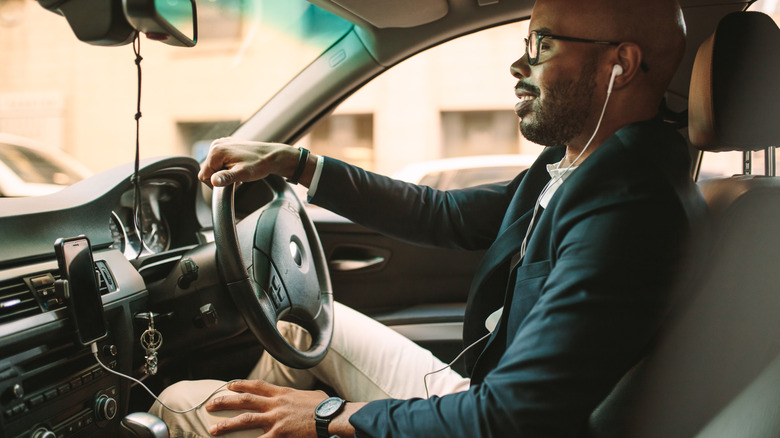
When it comes to permissibility for wearing a single headset or earbud while driving, California, Alaska, Louisiana, Maryland, Massachusetts, Minnesota, Virginia, and Washington have outright bans. All but Washington note specifically that headphones or earbuds cannot cover both ears. Washington doesn’t permit any headset or earphones that are connected to an electronic device while driving, either in both ears or a single ear.
There are partial restrictions in other states that explicitly note that you can drive with a single earbud in, even if the others above (Washington excepted) imply it. These include Florida, Illinois, New York, Georgia (allowable for communication purposes), Rhode Island, Ohio, and most recently, Colorado. As long as both ears aren’t covered and the driver can still hear surrounding traffic, it’s okay to pop in a single bud.
All other remaining states don’t explicitly have laws pertaining to wearing earbuds or headphones while driving. But this is always subject to change as legislation and rules pass. Further, if you are stopped, an officer could still issue a fine pertinent to other rules, like distracted driving or unsafe operation of a motor vehicle, with the earbuds being a contributing factor.
Err on the side of caution
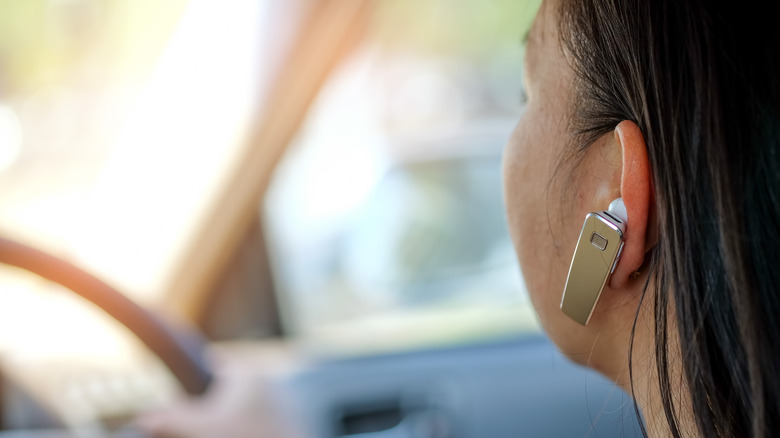
Whenever possible, use the vehicle’s built-in Bluetooth speaker and platforms like the latest Apple CarPlay or Android Auto. But if you must use an earbud, where permitted, pop in a single one and look for on-ear buds that still provide some situational awareness versus completely plugging your ear canal. This way, you’ll still hear things like emergency vehicle sirens, horns, railroad crossing signals, approaching cars, screeching tires, and pedestrians.
It’s worth noting that having a conversation alone in a vehicle can be distracting, in general. If you need to pick up a quick call, do it. But pull over for longer, more intense chats. This will help you avoid something called inattention blindness, which is when you might see — and even hear — a hazard on the road but aren’t able to mentally process it because your attention is elsewhere. This is possible whether you’re wearing earbuds or not.