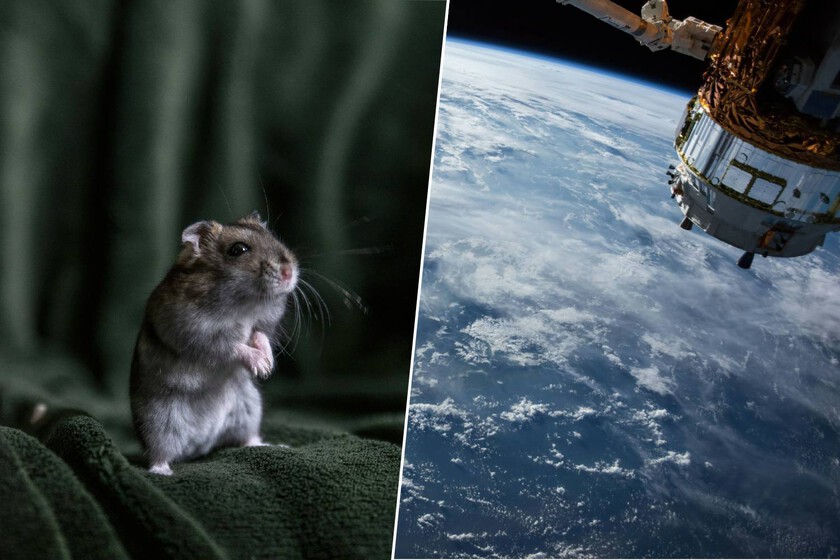
For years, the big question in space biology has not been whether we can have tomatoes and lettuce in orbit to populate other planets, but whether our bodies will continue to be functional after returning from the vacuum of space. Something that above all interests us in order to reproduce. And in order to solve it, China sent a mouse that was at the Tiangong station to see if it was subsequently capable of having babies and if they came with any serious alterations.
Some babies for history. The result of this trip to the Tiangong station has been a success, since on December 10, 2025, a laboratory of the Chinese Academy of Sciences (CAS) witnessed an apparently everyday but scientifically extraordinary event: the birth of nine baby mice.
The special thing was logically not the birth, but the fact that his mother had been in space for several weeks (albeit with some problems) subjected to microgravity and cosmic radiation. Now, six of these babies have survived and are growing normally.
It was not without incident. The experiment was a priori quite simple: launch four mice (two males and two females) into space on October 31 and leave them there for two weeks. All this accompanied by adequate food for the duration of the mission. But in the end there were major problems that forced the stay in space to be extended.
And this was a huge inconvenience, since the critical shortage of solid food for the mice could literally cause the mice to die and the mission to be a disaster. And that is why on Earth they began to look for the most suitable food to feed these animals and the result was liquid soy milk, which was the only thing available at the station.
Completely monitored. In order to have good traceability of what the mice do in space, scientists kept the mice monitored with artificial intelligence at all times. In this way, it was possible to know at the moment that they ate and even the stress patterns they presented, the circadian rhythms and possible anomalies in real time.
And everything was taken care of in detail, to the point that the soy milk was supplied with a negative pressure pumping system to prevent liquid bubbles from floating around the cabin.
The progression. Once this problem was resolved, on November 14, 2025, the animals returned to earth and natural conception occurred. The result was that 9 calves were born and only six survived in good health.
The problem of microgravity. Until this experiment, there was a well-founded fear in the scientific community: that ionizing radiation and the absence of gravity would “break” something in the hormonal axis or in the integrity of the DNA of the gametes. Something that would prevent us from reproducing normally, which would prevent, for example, the colonization of Mars.
Precisely, cosmic radiation acts as a shower of high-energy particles that can cause double-strand breaks in DNA. On Earth, our atmosphere protects us, but at 400 km altitude, mice (and humans) are exposed to a much higher dose. Researcher Wang Hongmei highlights that the fact that the offspring are viable suggests that the cellular repair mechanisms of mammals are capable of compensating for the damage suffered during short-duration flights.
A competition. As with everything related to space, there is a great rivalry between the United States and China. In this way, if we look back we see that China had already managed to partially develop mouse embryos in space in 2020. Subsequently, in 2019, NASA conducted researchers on the International Space Station to analyze the loss of bone and muscle density in space.

What’s next. The experiment does not end with childbirth. Now, scientists monitor what they call “second-generation effects.” The aim is to determine if these six mice will develop health problems in the medium term or if their fertility will be affected when they reach maturity.
In this way, if these mice do not present infertility, we can see that space travel is not a sentence of sterility. China’s next big step will be to attempt the reproductive cycle in orbit: conception, gestation and birth without setting foot on Earth. Something that will be essential to understand if humans in space can have any kind of possibility of reproducing without the protection of our beloved atmosphere.
Images | Frenjamin Benklin NASA
In WorldOfSoftware | Thinking that we are alone in the universe is arrogant. The question is why the aliens haven’t contacted us yet