China has one goal between its eyebrows: to become the first world power. It is clearly an ambitious objective, but in the latest Five-Year Plan they detail the roadmap that must be followed to achieve that goal in the period 2026-2030.
The five-year plans are a very communist tradition that was not born in China, but in the Soviet Union, but that the Asian giant began to implement in 1953. It consists of setting guidelines to achieve certain objectives in all the main areas of the country. And one of those objectives is to be sovereign in artificial intelligence.
This does not involve having models or chips to train those models: it involves an industrial renewal of all the legs of the system that range from how it is designed, how it is applied, how it is powered and, above all, how AI is taught.
And, to comply with it, China is clear that this is not just a matter for students: teachers must be on the hook.
Teachers, learn AI to teach AI
In April of this year, the Chinese Ministry of Education launched, with the support of other government agencies, the “AI+ Education Action Plan” program. This is a national plan to integrate AI throughout the educational system with the aim of building “an AI literacy system for all levels of schooling and throughout life.”
The Ministry states that we are entering a new era in which teaching and learning must be reconfigured to ensure that all students acquire basic knowledge of AI. That is, it is clear that AI is important and that it is being used in classrooms around the world, but China is aiming for a profound update of the educational program.
With this, they show that They consider AI a pillar of the future of education And, if students must obtain knowledge in AI and then be able to apply it in a world in which they will coexist with these systems, someone must transmit that knowledge to them. That will be the new job of the teaching staff.
All primary and secondary school students in Beijing receive at least eight class hours of AI courses per academic year – Li Yi, director of the Beijing Education Commission
This revision of the educational plan specifies that the program will incorporate AI exams into teacher qualification exams. In fact, this is not something that starts now. In 2025, the Ministry of Education published two guides on the use of AI and generative artificial intelligence for primary and secondary schools.
That same year, the Administration organized specific training sessions in AI for directors of primary and secondary schools in which he emphasized the need to reinforce the digital and AI skills of teachers so that they can take advantage of their functions.
In the end, everything is framed in that desire to have a world-class educational system by 2035 because this extends beyond primary and secondary school. This “literacy in AI” mandates incorporating AI also in extracurricular services, as well as in vocational training and universities, becoming in these cycles a general basic course with programs and degrees aligned with the industrial transformation driven by AI.
“We teach children to use LLMs to solve problems and most importantly: think critically, question whether the AI’s answers are correct, and verify information from multiple sources” – Yao Xiaoying, principal of a primary school in Shenzhen
And you may be wondering what teachers should apply to comply with this “AI literacy.” Here things are a bit diffuse because there is talk of promoting the use of teaching systems throughout the educational process to automate tasks (such as tutoring, questions and answers and corrections), as well as analyzing teaching practices so that their workload is reduced and they can spend more time training young people.

For the adult population there is also a plan: carry out learning courses so that they adapt and are not left behind.
Difficulties
The truth is that there has been a debate about this situation for some time. Given the uproar caused by this, the Minister of Education came to the fore to prohibit students from using AI to complete their assignments. As we said before, AI should only be a supervised support tool.
Because basically there is a question of class and resources, and there are already those who warn that AI can widen the social gap. While in large cities where parents may have more resources and educational level, families and the center can do a good job in training in AI so that children know how to use it and question the answers.
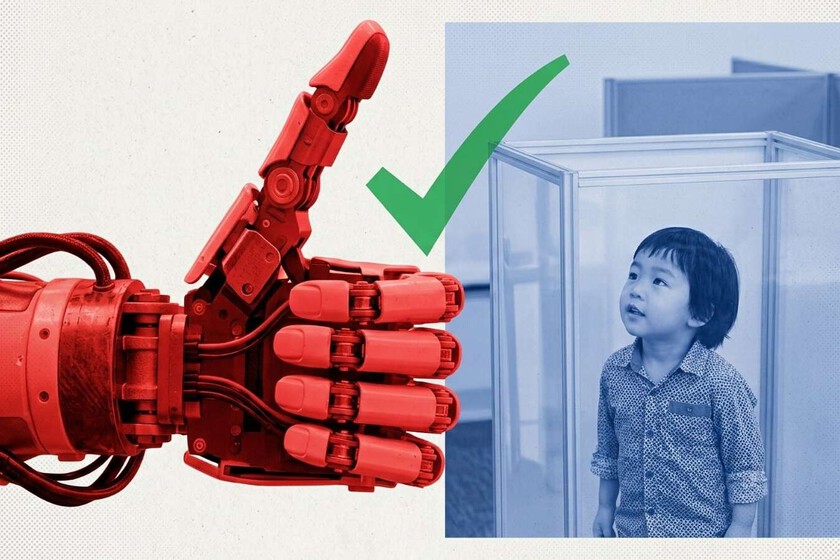
However, in more rural areas where there may be a lower educational level, families have lower incomes and parents must work more hours, students run the risk of being “locked in” in cubicles that have begun to flourish in several locations in which there is a tablet that proposes tests and supervises the children’s answers, but that does not teach or explain the subject.
There are also those who point out that almost as interesting as knowing the Government’s plans for teaching AI to both teachers and students is checking the speed at which all this goes from a political document to the reality of the classroom.
In | China continues to draw up five-year plans in the old communist way. Objective: tech self-sufficiency