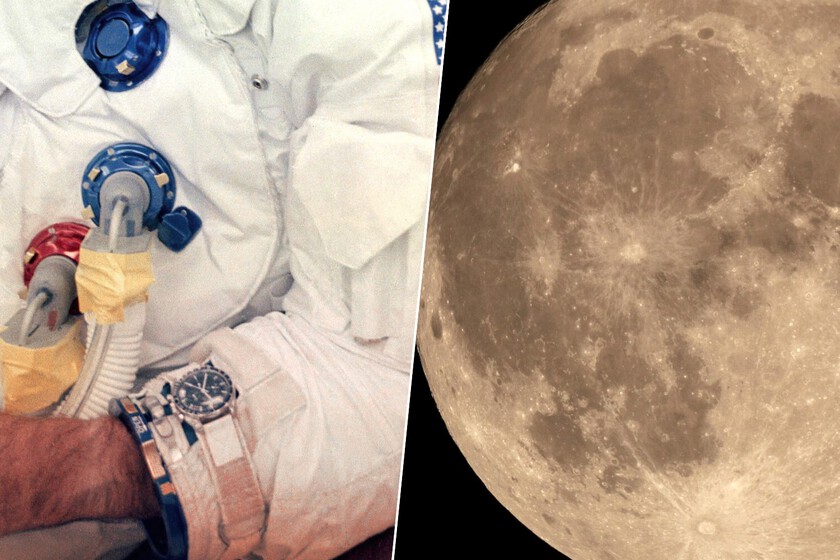
58.7 microseconds. That is the daily margin of error that separates a terrestrial clock from one on the Moon. This time lag seems ridiculous, but it has been troubling aerospace engineers for decades. The reason? That ‘sigh’ can be crucial on a mission, the difference between a perfect landing and a disaster. And while in the West we continue talking about the problems of the Artemis mission, in China they have found the solution for that time lag.
It is called LTE440, and it is another example of China’s methodical advance in the new space race.
Microsecond piggy bank. If you have seen the movie ‘Interstellar’, looking for information about how time passes away from Earth, you may have come across the theory of general relativity formulated by Albert Einstein. Simply put, the passage of time is relative, and the speed at which it passes depends on two factors: gravitational field intensity and orbital speed. The stronger the gravity, the slower time passes, and that is why it moves a little faster on the Moon than on Earth.
The net result of that orbital effect is a slight advance in lunar clocks. One of between 56 and 58.7 microseconds per day, or 0.000058 seconds. It seems tiny and negligible, but in the end, the sum of 58 microseconds each day is there. 0.0017 seconds per month. 0.021 seconds per year. It is still little, but in terms of the space industry, it is unacceptable.
LTE440. This synchronization between the lunar and terrestrial clocks has been one of the headaches of space engineering for years. In 2024, the International Astronomical Union established that the Moon should have its own temporal reference. Meanwhile, time has passed and an answer has arrived: LTE440, or ‘Lunar Time Ephemeris’.
It is a software developed between the Purple Mountain observatory together with the University of Science and Technology of China. And it arrives to solve two of the historical problems in that lunar timing:
- Precision: Complex missions require total accuracy (not with a Casio, but with atomic clocks), and the solutions until now did not allow such precision.
- Complex calculations: Current solutions were not very accessible and engineers had to do laborious calculations and mathematical operations to solve jet lag.
Absurd accuracy. The accuracy of LTE440 is estimated to be less than 0.15 nanoseconds before 2050 and its cumulative errors will remain below 1/20,000,000 of a second even after a thousand years. But more important than this is that the research team has made obtaining the calculations as simple as doing a single operation. Thus, the LTE440 software will allow you to directly and easily compare lunar time with Earth time.
opening doors. Okay, great, but… really that much for 56 microseconds? Having the current aspiration of creating a communication network and missions both with the Moon and interplanetary, one of the most logical applications is that of a global network of lunar clocks. Another is to allow extremely precise remote control missions to be carried out from Earth. China and Russia, for example, plan to build an International Lunar Research Station by 2035, and LTE440 opens the door to more precise ground-based satellite operations.
But also something more tangible and easier to understand: establishing a navigation system similar to GPS on the Moon. It is something that does not exist, but that seems crucial for future space missions. Because this is not about establishing colonies on the Moon, but about taking advantage of the satellite. For example, to research there, but also to obtain resources that can be used on Earth.
And a system like LTE440 is an open door for the development of the navigation technologies necessary to bring these missions to fruition.

The US looks closely. As we say, China has one eye on the Moon and space, and that is something that the United States is following with interest. China is taking giant steps and the United States has come to feel that it is being left behind. Artemis II is the American response, a program full of problems and delays, but it seems to be working.
On the other hand, and as with the terrestrial situation, the United States considers that China’s advance in space is not a mere scientific issue, but a threat to the country’s national security. They have gone so far as to point out that the Space Force will do “whatever is necessary to achieve space superiority.”
Therefore, LTE440 is, at the same time, a technological milestone, a great step for humanity in the new space race and a threat to those interests of the United States. Now, as we read in SCMP, the software is still in an early phase, so it has yet to be applied in real-time navigation solutions.
Images | Tomruen
In WorldOfSoftware | Hubble continues to discover amazing things about the universe: a starless galaxy dominated by dark matter