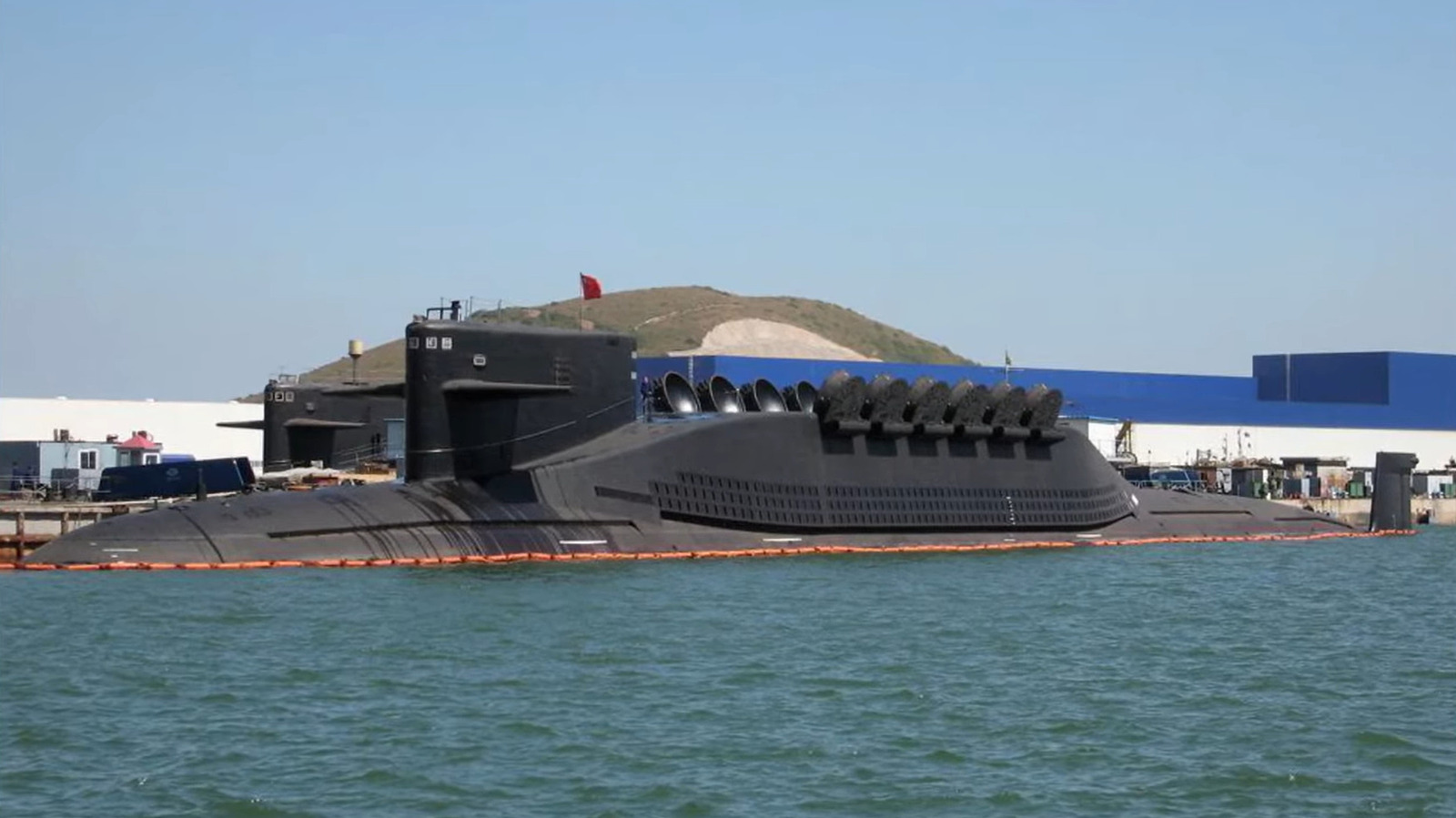
The world’s largest naval force continues to bolster its fleet, this time adding a new class of nuclear-powered submarine. China has harnessed the world’s most advanced dual-purpose shipbuilding industry to rapidly scale the People Liberation Army Navy’s (PLAN) fleet of increasingly advanced warships. And while adding its most advanced aircraft carrier since 2012 grabbed headlines, China’s submarine program may have just as great an impact on its geopolitical ambitions.
Its improvements could move Beijing closer to building a nuclear submarine fleet comparable to those deployed by the U.S. and Russia. Historically, China’s submarine fleet has lagged behind its rivals in both capabilities and numbers, fielding mostly noisy, diesel-electric tactical submarines. However, improvements to the Bohai shipyard have been shockingly effective. Now, Beijing outpaces Washington in submarine production. Still, China’s previous ships have paled in comparison to modern American subs.
First reported by Naval News in early February 2026, satellite imagery has given Western observers a glimpse at PLAN’s most advanced nuclear submarine yet. Dubbed the Type 095, the submarine is thought to be an upgrade over China’s previous classes of subs, namely the Type 093B and Type 094. Although little is known about Beijing’s highly secretive submarine procurement pipeline, with details about the Type 095’s missile system, torpedo arrangement, and sonar capabilities extremely limited, experts believe that the larger, more capable warship could constitute China’s first true challenge to the U.S.’s subsurface dominance. Likely empowered by improved hydrodynamic shaping techniques, the submarine will feature a more voluminous hull, improved acoustics, larger subsystems, and a quieter propulsion system.
A murky but revealing image
Satellite images showed the submarine at the launch bay of Bohai shipbuilding yard. Observers initially believed it was an upgraded version of China’s Type-093B, but the 110-meter-long submarine’s high waterline suggests either a single or hybrid hull configuration and a wider diameter. The results are a more voluminous interior and a likely displacement between 9,000 and 10,000 tons, making it the largest submarine in China’s fleet.
Although little is known about the submarine’s configuration, available reports suggest that the Type 095 will improve PLAN’s subsurface capabilities. For instance, experts believe that the submarine will use a pump jet propeller to reduce noise signatures and avoid sonar detection. The submarine could further reduce noise during transit through hull-mounted dive planes, and its likely inclusion of advanced acoustic technologies, like sonar-fooling anechoic tiles and improved engine vibration isolation systems, has some analysts believing that the 095 will overcome Beijing’s noisy submarine problem. To boot, the addition of an X-tail rudder could increase underwater maneuverability, while its 200 megawatt natural circulation nuclear reactor could enable more prolonged underwater missions.
Little is known about the submarine’s weapons systems, though images show an unfinished space behind the sail, which could be indicative of a vertical launch system that could launch Beijing’s new YJ-19 hypersonic missile or the anti-ship ballistic YJ-20 missile, but that’s uncertain. An alternate possibility is a weapons system known as a tri-pack, in which one tube contains three launch cells. Some have suggested that the Type 095 will have eight torpedo tubes, with four slotted on both sides of the bow, potentially creating space for a larger sonar system.
China’s subsurface future
Experts predict the 095 will be used primarily for underwater warfare against other nuclear submarines, similar to the United States’ Seawolf subs. Although a VLS would enable anti-ship and land attacks, Western strategists don’t expect the 095 to be used as a cruise missile submarine. However, given a lack of verifiable design details, most predictions should be taken with a grain of salt. The upgrade is indicative of Beijing’s expanding naval firepower.
Historically, China’s naval shipbuilders focused on smaller ships to patrol the shallow littoral waters of the South China Sea– a focus that stunted its submarine fleet. Even during its recent production boom, which saw the PLAN grow into the world’s largest navy in just over two decades, China built just six nuclear submarines by 2022. However, upgrades at its Bohai facility significantly escalated in China’s subsurface ship manufacturing capabilities, launching roughly three nuclear submarines per year since 2022. According to a February 2026 report by the International Institute for Strategic Studies, China’s nuclear submarine production now surpasses that of the U.S., rolling out 79,000 tons of displacement from 2021 to 2025, compared to only 55,000 by the U.S.
This increase in production has accompanied a steady expansion of the PLAN’s naval ambitions, as China increasingly looks to push its navy outside its immediate area of influence. The Type 095’s likely multi-operationality could facilitate these goals, providing anti-ship defenses, land attacks, covert operations, and intelligence collection capabilities to pair with the PLAN’s expanding carrier and tactical strike groups. And although America’s subsurface fleet is still superior, the widening production gap has some worried. Still under development at Bohai, the Type 095 will likely launch within the next year.