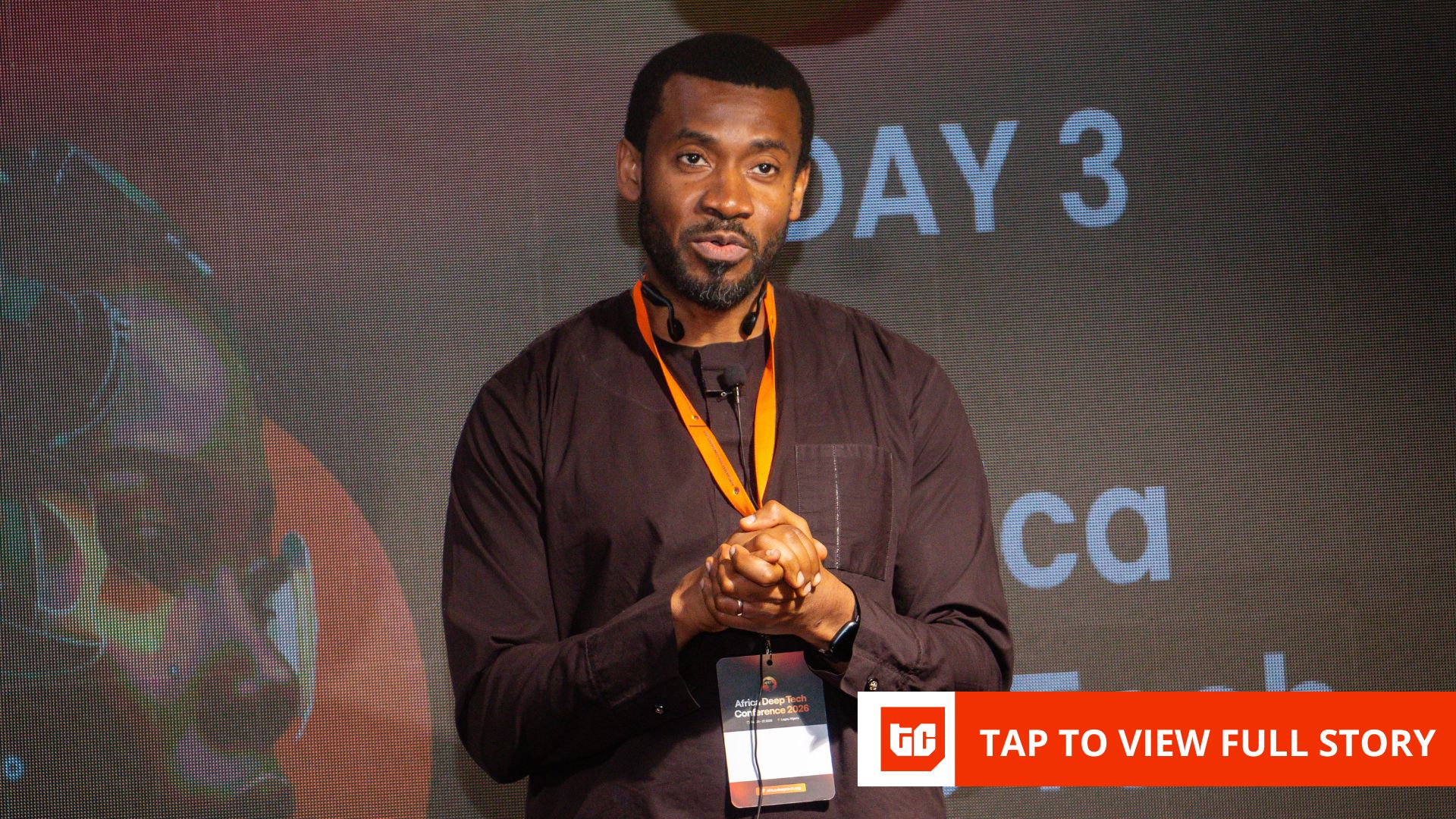
Chukwuemeka Afigbo is making a long-term bet: Africa’s most ambitious technologists are not constrained by a shortage of ideas, but by a shortage of structured pathways. He is the convener of the Africa Deep Tech Foundation (ADTF) and a former developer programs leader at Google and Meta.
His thesis is straightforward: build those pathways—even imperfectly—and deep tech will begin to emerge. In this context, deep tech refers to artificial intelligence innovations grounded in fundamental scientific advances, complex engineering, and original research, rather than in the simple application of existing software tools.
That conviction is now taking institutional shape. The Foundation’s first in-person Africa Deep Tech Conference, held in Lagos on February 25, 2026, marked a public inflection point for what had, until recently, been a largely private network.
For nearly three years, ADTF operated as a quiet brain trust of about 180 to 190 members across Africa and the diaspora, builders, investors, researchers, doctors, policymakers, and entrepreneurs bound by a single requirement: you must be African and committed to advancing deep tech on the continent.
The premise is structural. Africa’s talent pool is not in doubt; its support systems are. Data from Insight in 2025 estimates that artificial intelligence could add $1 trillion to Africa’s GDP by 2035. Yet only about 5% of African AI practitioners have access to the computational infrastructure, GPUs and other high-performance hardware required for serious research.
Nigeria has the human capital to build deeptech companies, but the infrastructure needed to support them remains limited. According to the World Economic Forum, about 3.5 million young Nigerians enter the labour market each year, yet only around 11% of the current workforce has advanced digital skills. While talent exists, the systems that translate technical expertise into scalable, research-driven companies remain underdeveloped.
ADTF’s response is to close those gaps by connecting engineers with scientists, founders with regulators, and early-stage builders with mentorship and peer accountability. This is anchored on a belief that Africa’s participation in building AI will hinge on institutions capable of sustaining long-horizon technical work.
“Even though the group is currently dominated by Nigerians, about 30–40% of our core members are non-Nigerian Africans in the diaspora. We hope to grow that share even further,” Afigbo told in an interview in Lagos.
Only in the past year has the group begun to step into the open. It started with a webinar-style “open day,” offering outsiders a glimpse into the group’s internal conversations. Encouraged by the response, the Foundation launched an Innovation Challenge themed around solving constraints.
“We had over 2,000 registered participants from 14 countries across the continent,” Afigbo said. “From that pool, we received about 350 serious, high-quality submissions — not casual chat entries or incomplete applications. We reviewed them and shortlisted 167 entries. From there, we selected 16 semi-finalists, paired them with mentors, and put them through another round of judging. After that process, we shortlisted 98 finalists.”
Sixteen semifinalists advanced to mentorship and evaluation, finalists pitched live, and four winners ultimately emerged.
The total prize pool was $20,000, modest by many standards. But for Afigbo, the amount was never the point.
He argues that Africa’s deep tech gap is not always about billions of dollars. It is about survival capital at the earliest stage.
An idea, he says, may be worth $10. A prototype, perhaps $100. A minimal viable product (MVP) could jump to $10,000. The critical moment is between prototype and early validation, when builders often abandon their ambitions for stable jobs because the runway simply runs out.
That is where the ADTF plays.
Afigbo’s thesis is that in any large population, about 7% are unusually motivated toward a given pursuit. Some people learn to code on mobile phones, who spend 50 hours on YouTube mastering obscure tools, who might use their last savings to attend a conference because they believe something bigger is possible.
In Africa, those tracks are weak or non-existent. The 7% eventually become part of the 93%. The potential inventor of a breakthrough robotics company becomes a solid Android engineer at a bank. The future semiconductor pioneer becomes a mid-level developer in a fintech. Productive, yes. Transformational, perhaps not.
“The least you can do,” Afigbo said, “is give them a community.”
Even if funding is scarce, the community can extend a builder’s runway—six months, a year—long enough for serendipity, mentorship, or small capital to intervene.
That intervention model reflects Afigbo’s own experience in Silicon Valley, where ecosystems tend to amplify unconventional ideas rather than question them.
At Google, Afigbo worked to replicate some of that enabling environment for African builders. He played a key role in designing and scaling developer-facing initiatives tailored specifically to the continent’s realities, programs that acknowledged funding gaps, infrastructure constraints, and the early-stage nature of many local tech ecosystems. Among the initiatives he helped expand were Google Launchpad Africa, a startup accelerator, and the growth of Google Developer Groups (GDGs) across the continent.
These experiences also exposed how short-term incentives shape Africa’s innovation landscape. Investors tend to back sectors like fintech because the revenue model is familiar and proven. Deep-tech fields—such as semiconductors, advanced materials, or biotech—lack comparable local reference points. Without precedents to anchor expectations, capital often becomes more cautious and patience thinner.
Yet precedent is emerging. Across the continent, necessity-driven innovation is reshaping what deep tech looks like.
ChipMango is building local chip design capacity in Nigeria, partnering with universities to push Africa into the hardware value chain. Signvrse uses AI-powered 3D avatars to translate speech into sign language in real time. NovFeed converts organic waste into high-protein fish feed to tackle food insecurity.
Envisionit Deep AI automates radiology diagnostics in rural clinics. BasiGo and Spiro now manage large fleets of electric buses and motorcycles supported by battery-swapping networks.
Regional hubs are evolving, too. Kenya has become the continent’s top venture capital destination, raising over $1 billion in 2025, driven largely by green tech and e-mobility.
Nigeria remains the heart of AI and fintech, with dedicated AI data centres coming online. South Africa leads in biotech and enterprise software. Egypt is positioning itself as a bridge for deep tech manufacturing between Africa and the Middle East.
Still, structural bottlenecks remain severe. Africa faces a $330 billion credit gap for small and medium enterprises. Youth digital literacy is rising, but senior engineers capable of managing high-density GPU clusters or advanced synthetic biology labs remain scarce. The AI revolution compresses timelines further; every year lost may feel like two.
Afigbo knows time is not a luxury. He remembers when mainstream tech in Nigeria looked implausible. In 2009, building Android apps for venture funding seemed far-fetched. By 2025, that ecosystem matured. Deep tech today resembles tech circa 2010: misunderstood, underestimated, dismissed as unrealistic.
The difference now is velocity. AI breakthroughs are accelerating globally. Africa cannot afford a decade-long incubation cycle.
That urgency shaped the structure of the inaugural conference. The first day targeted learners and aspiring builders—those still mastering foundational tools but capable of much more. The message: learning React is not the ceiling. You are already in the 7%.
The next sessions focused on active builders, connecting robotics engineers with materials scientists, AI researchers with hardware tinkerers. The final day aimed at the mainstream: investors, corporates, government agencies, academia.
Early responses from regulators suggest openness. Officials from the Nigerian Communications Commission (NCC) signalled interest, noting that conversations around emerging technologies are fragmented and siloed. The National Information Technology Development Agency (NITDA) requested a proposal for review. Galaxy Backbone Limited, a government-owned provider of shared digital infrastructure and connectivity services, has expressed interest in collaborating on artificial intelligence initiatives. The Nigerian Upstream Petroleum Regulatory Commission also asked for formal engagement.
For Afigbo, regulatory imperfection is part of the maturation process. He points to fintech as precedent, an industry that scaled across Africa despite fraud risks, patchy enforcement, and constantly evolving legal frameworks.
Systems, he argues, harden under stress. Intellectual property disputes and policy gaps will surface, but they signal motion and iteration, not collapse.
His wager, then, is not built on passion alone, nor on philanthropy. It is built on leverage. Capital stretches differently in Africa. The $1 million it might take to support a single researcher in Silicon Valley, factoring in infrastructure, compliance, and living costs, can sustain multiple high-quality engineers in Nigeria for longer. The cognitive talent is comparable; the cost structure is not.
“If someone in Silicon Valley, Boston, MIT, or Harvard says, ‘I’m working on a new kind of plastic because I believe it could do XYZ,’ the response is usually, ‘Interesting—tell me more. How can I help?” Afigbo said. “That’s the default mindset. But here, if you say the same thing, the reaction is more like: ‘How will this make money in two weeks? Will it pay your salary next month? If not, maybe you should rethink it.’ And that pressure doesn’t just come from family and friends—it’s embedded in the entire environment.”
Still, he is clear-eyed about the limits of enthusiasm. Passion can move an ecosystem forward, but it cannot substitute for capital. What it can do, he says, is carry builders to the next bus stop, long enough to move from idea to prototype to early validation.
Once a critical mass survives that stretch, the conventional capital stack—grants, venture funding, institutional backing—can step in with greater confidence.
He does not claim certainty about the final destination. “We know we are going to Abuja,” he said metaphorically. “We just don’t know what we will meet between the toll gate and there.”
For now, the mission is clear for him: find the 7%, keep them alive, connect them, and make their presence visible. Because once people see that defence tech companies, semiconductor startups, biotech labs, and electric mobility fleets are not anomalies but part of a pattern, the narrative shifts.
Afigbo continues to be active in Silicon Valley as Senior Director of Developer Success at Okta, a San Francisco–based cybersecurity firm, a role that enables the Africa Deep Tech Foundation to forge connections across global tech ecosystems. The community itself is backed by a fully registered non-profit, run by Afigbo and supported by a strong group of volunteers who share the mission.
The goal is to build toward full-time operational support for its initiatives by next year, strengthening both its African base and its transatlantic links.
The Foundation’s focus is primarily on early-stage deep tech talent rather than established startups, which explains its emphasis on top-of-the-funnel initiatives that help move builders from prototype to MVP.
Still, several more mature companies have benefited directly or indirectly from its programs, including Terra Industries in Nigeria, Cure Bionics in Tunisia, StriveEV in Nigeria, FarmSpeak Technologies in Nigeria, and Ascendance EV in Nigeria.