
By using this site, you agree to the Privacy Policy and Terms of Use.
Accept
World of SoftwareWorld of SoftwareWorld of Software
  • News
  • Software
  • Mobile
  • Computing
  • Gaming
  • Videos
  • More
    • Gadget
    • Web Stories
    • Trending
    • Press Release
Search
  • Privacy
  • Terms
  • Advertise
  • Contact
Copyright © All Rights Reserved. World of Software.
Reading: Claude just demonstrated it with Firefox
Share
Sign In
Notification Show More
Font ResizerAa
World of SoftwareWorld of Software
Font ResizerAa
  • Software
  • Mobile
  • Computing
  • Gadget
  • Gaming
  • Videos
Search
  • News
  • Software
  • Mobile
  • Computing
  • Gaming
  • Videos
  • More
    • Gadget
    • Web Stories
    • Trending
    • Press Release
Have an existing account? Sign In
Follow US
  • Privacy
  • Terms
  • Advertise
  • Contact
Copyright © All Rights Reserved. World of Software.
World of Software > Mobile > Claude just demonstrated it with Firefox
Mobile

Claude just demonstrated it with Firefox

News Room
Last updated: 2026/03/06 at 10:24 PM
News Room Published 6 March 2026
Share
Claude just demonstrated it with Firefox
SHARE

For years, finding serious vulnerabilities in complex software has been a task reserved for specialized researchers who spend weeks or months examining millions of lines of code. That scenario is beginning to change. Artificial intelligence models are no longer limited to generating code or helping to debug it, they are also beginning to detect security flaws on their own. A recent example has been shown by Anthropic with Claude Opus 4.6, its most advanced model, when it was tested with Firefox. The experiment is especially striking because Firefox, managed by Mozilla and used by hundreds of millions of people, is one of the most audited open source projects in the web ecosystem.

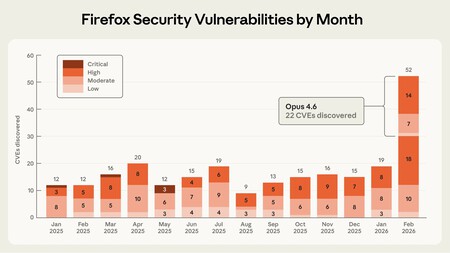
Analyze the Firefox browser code. During two weeks of testing, the system identified 22 different vulnerabilities, according to information published by both organizations. Mozilla assessed 14 of them as high severity flaws, meaning they could have served as a basis for attacks if someone had developed the appropriate exploit code. According to those responsible for the project, most of these problems have already been solved in Firefox 148, the version published in February, while the rest will be corrected in future versions.

Inside the experiment. Claude’s work was not a simple automatic search for errors. According to Anthropic, the team first used the model to try to reproduce historical vulnerabilities recorded in Firefox, a way to test if it was able to recognize real failure patterns. Then they moved on to the most interesting part of the experiment: asking it to analyze the current version of the browser to locate problems that had not yet been reported. The process started in the JavaScript engine and then expanded to other areas of the code. In total, the analysis covered thousands of files from the project, including several thousand C++ files, generating a long list of findings that were subsequently reviewed by the researchers.
Firefox

A striking fact. Claude found more high-severity bugs in two weeks than the browser usually receives in about two months through its usual investigation channels. During the process, the Anthropic team submitted 112 unique reports to the project’s bug tracking system, although not all were confirmed vulnerabilities. Part of Mozilla’s job was precisely to review, debug and classify those findings before determining which ones had real security implications. The experience ended up becoming a direct collaboration between both organizations to review the results and prioritize corrections.

Guest Wi-Fi networks seemed like a safe haven to connect. AirSnitch has just proven that they are a drain

The other half of the problem. The Anthropic team also wanted to see how far the model could go beyond detecting errors and turning those failures into real attacks. To do this, they asked him to develop exploits capable of taking advantage of the discovered vulnerabilities. The experiment included hundreds of runs with different approaches and cost approximately $4,000 in API credits. Still, the result showed a clear difference between the two capabilities: Claude only managed to generate two working exploits in a simplified test environment, without some of the defenses present in a real browser.

Beyond the specific case of Firefox, the experiment reflects a change that is beginning to worry and interest the security community at the same time. AI-based tools are rapidly improving at detecting vulnerabilities in complex software, which could help developers fix bugs more quickly.

Images | Anthropic | Rubaitul Azad

In WorldOfSoftware | iPhones were supposed to be the most secure cell phones in the world. It was supposed


Sign Up For Daily Newsletter

Be keep up! Get the latest breaking news delivered straight to your inbox.
By signing up, you agree to our Terms of Use and acknowledge the data practices in our Privacy Policy. You may unsubscribe at any time.
Share This Article
Facebook Twitter Email Print
Share
What do you think?
Love0
Sad0
Happy0
Sleepy0
Angry0
Dead0
Wink0
Previous Article zero accidents since its installation in France zero accidents since its installation in France
Next Article Android App Sideloading Is About To Completely Change (Again), And I’m Worried – BGR Android App Sideloading Is About To Completely Change (Again), And I’m Worried – BGR
Leave a comment

Leave a Reply Cancel reply

Your email address will not be published. Required fields are marked *

Stay Connected

248.1k Like
69.1k Follow
134k Pin
54.3k Follow

Latest News

The Complicated Truth About The Price Of 3D Printing Houses – BGR
News
Dumpster-fire RAM crisis claims another handheld console casualty
News
Apple tested whether AI could improve App Store search results – 9to5Mac
News
Today's NYT Mini Crossword Answers for March 7 – CNET
News

You Might also Like

GIGABYTE expands its telecommunications infrastructure
Mobile

GIGABYTE expands its telecommunications infrastructure

3 Min Read
zero accidents since its installation in France
Mobile

zero accidents since its installation in France

6 Min Read
Proofpoint Unveils AI-Enabled Archiving and Discovery Suite for SMBs Nuclei
Mobile

Proofpoint Unveils AI-Enabled Archiving and Discovery Suite for SMBs Nuclei

3 Min Read
“DocuWare delivers trusted AI for real business processes”
Mobile

“DocuWare delivers trusted AI for real business processes”

5 Min Read
//

World of Software is your one-stop website for the latest tech news and updates, follow us now to get the news that matters to you.

Quick Link

  • Privacy Policy
  • Terms of use
  • Advertise
  • Contact

Topics

  • Computing
  • Software
  • Press Release
  • Trending

Sign Up for Our Newsletter

Subscribe to our newsletter to get our newest articles instantly!

World of SoftwareWorld of Software
Follow US
Copyright © All Rights Reserved. World of Software.
Welcome Back!

Sign in to your account

Lost your password?