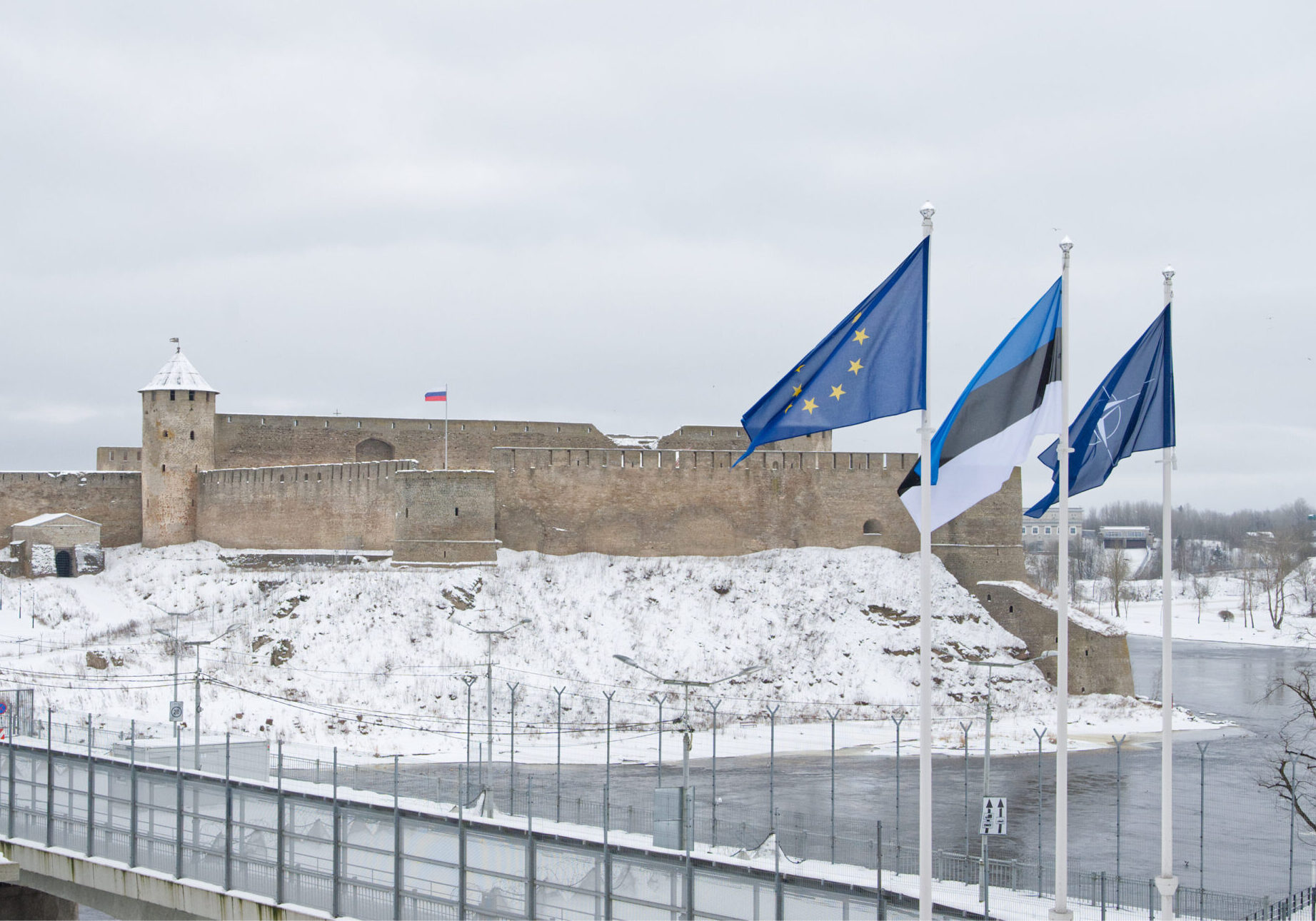
In recent weeks, references to a pro-Russian separatist movement in neighboring Estonia have begun appearing with increasing frequency on social media. The so-called “Narva People’s Republic” clearly echoes the “People’s Republics” established by the Kremlin in eastern Ukraine during the early stages of Russia’s invasion in spring 2014. However, not everyone is convinced that this virtual movement is worthy of serious attention.
Estonia’s Internal Security Service, which has earned considerable respect in recent years for a string of high-profile counterintelligence successes, has dismissed the “Narva People’s Republic” initiative as an information operation. Meanwhile, the Estonian Foreign Intelligence Service doubts any direct Russian government involvement.
A journalist from the Estonian newspaper Postimees recently managed to infiltrate a Telegram chat group and expose the “Narva People’s Republic” as a tiny operation being run by someone likely outside Estonia with apparent ties to St. Petersburg. Given the small scale of the campaign, there is a lively debate in Estonia and across social media over whether highlighting it is a sensible precautionary measure or counterproductive.
Many have inevitably drawn comparisons with Russia’s invasion of Ukraine and the role played by fake separatist movements created by the Kremlin to justify Moscow’s expansionist agenda in eastern Ukraine’s Donbas region. When separatist propaganda about “People’s Republics” first began appearing in Ukraine in the years prior to the onset of Russian aggression in 2014, it was not initially taken seriously.
Recent references to a “Narva People’s Republic” appear to refer to the entire Ida-Viru County in northeastern Estonia rather than the city of Narva alone. Like Ukraine’s Donbas, Ida-Viru County was subject to an extended period of russification. During the Soviet occupation following World War II, large numbers of Russian-speakers from various parts of the Soviet Union were settled in Narva and in newly built Soviet industrial cities in the region.
With a current population that remains dominated by Russian-speakers and ethnic Russians, this would seem to make Ida-Viru County ripe for the Kremlin’s influence operations and grievance politics. However, the Estonian government has invested significantly in the region’s economic development and cultural integration.
Also, the fact that many residents of Estonia’s northeast have family links to Russia means they are well aware that they currently enjoy a far better standard of living than most people across the Narva River in the Russian Federation. With Estonia, like Ukraine, one must avoid the fallacy of conflating language with loyalty.
Eurasia Center events

The fact that a grassroots separatist movement is unlikely to develop in Ida-Viru County will not necessarily prevent Russia from using the separatist narrative to advance its agenda. When efforts to cultivate a local separatist movement in the Donetsk and Luhansk regions of Ukraine proved insufficient in 2014, the Kremlin sent in Russian citizens and military personnel without insignia. Soon after, they were followed by an undeclared invasion force.
Russia’s goal in Estonia might not be military conquest. It is often suggested that Moscow could aim to test NATO’s collective security commitments and discredit the alliance by launching a relatively minor incursion and claiming a small chunk of Estonian territory on the pretext of protecting compatriots. This would be much easier said than done, however, given Estonia’s heavily monitored border, where even the smallest infraction is noticed quickly. In such a case, Estonia would not wait for NATO to respond.
Estonian officials can be prickly about any portrayal of their country as particularly vulnerable or overly reliant on others for security. Since Russia’s 2014 invasion of Ukraine, there have been endless articles asking “is Narva next?” This framing has been met with strong pushback from Estonian security experts.
Similarly, war games exercises resulting in a quick Russian takeover of the Baltic region have been criticized by Estonian officials as lacking understanding of the Baltic states’ own security posture to the point of being insulting. In common with nearby Finland, Latvia, and Lithuania, Estonia employs a whole of society “total defense” concept that should not be underestimated.
Due to the enormous losses it is sustaining in Ukraine, Russia’s military is currently thought to be in no position to launch an invasion of Estonia. In its annual report for 2026, Estonia’s Foreign Intelligence Service, while clear-eyed about the Kremlin’s expansionist ambitions, assessed that Russia has no intention of militarily attacking Estonia or any other NATO member state in the present year, or likely the next.
It is no wonder that Estonia’s foreign and defense policy has been focused on marshaling support for Ukraine as it confronts Russian aggression. It is also easy to understand why elements in Russia would like to create the impression of a looming threat to Estonia. So far, Estonia’s reaction to social media chatter about a supposed separatist movement has been typically phlegmatic. As this narrative has drawn media attention, we can expect to see it pushed further and recycled. Estonia’s NATO allies should follow Tallinn’s lead and react by remaining alert but calm.
James Rice is a doctoral student at the Institute of World Politics and former legislative director for US Senator Chuck Grassley.
The views expressed in UkraineAlert are solely those of the authors and do not necessarily reflect the views of the , its staff, or its supporters.

The Eurasia Center’s mission is to enhance transatlantic cooperation in promoting stability, democratic values, and prosperity in Eurasia, from Eastern Europe and Turkey in the West to the Caucasus, Russia, and Central Asia in the East.
Image: Benjamin Furst / Hans Lucas via Reuters Connect