
From my time working in UX, I’ve seen accessibility go from a side note to the core of the job. A 2024 survey of thousands of professionals showed that 85% of organizations now consider digital accessibility a competitive advantage (Level Access, 2024). Additionally, a separate 2024 survey noted that while resources are often lacking, nearly half of organizations now rate it as a top priority (State of Digital Quality, Applause 2024).
n
Figure 1 Global Inclusive UX: Compliance and Opportunity
Nowadays, digital platforms decide who can actually use essential services – like banking, healthcare, and school – and who ends up left behind.
This change is happening everywhere. More places are adopting WCAG 2.1 standards to ensure interfaces are easy to use, even in new markets. Inclusive UX isn’t just the right thing to do; it’s also smart business. I’ve seen designers who once cared mainly about how things looked now thinking about fairness, digital skills, and access for users with all sorts of abilities.
Results from this effort are beginning to show. The 2025–2026 State of Digital Accessibility Report confirms that the industry has reached a consensus: 88% of experts believe accessibility enhances reputation, 91% believe it improves the user experience, and 90% believe it increases customer happiness.
In this setting, UX professionals are always discovering what inclusive design looks like. I had the opportunity to collaborate with a UX designer who places a strong emphasis on accessibility, human-centered design, and clear images. Observing people at work makes it clear how minor, thoughtful choices can make technology accessible to all.
The Growing Need for Accessible and Inclusive Digital Systems
Today’s digital products have to work for people of all languages, ages, abilities, and levels of tech experience. But many platforms still expect users to have fast internet, strong reading skills, or certain visual and motor abilities – not everyone has these.
Global studies from organizations such as Nielsen Norman Group and the W3C show that inclusive design helps people complete tasks, lowers the chances they give up, and builds long-term trust. As more fields go digital – especially education, healthcare, and government – accessibility isn’t just a nice extra. It’s the base that lets everyone take part in a meaningful way.
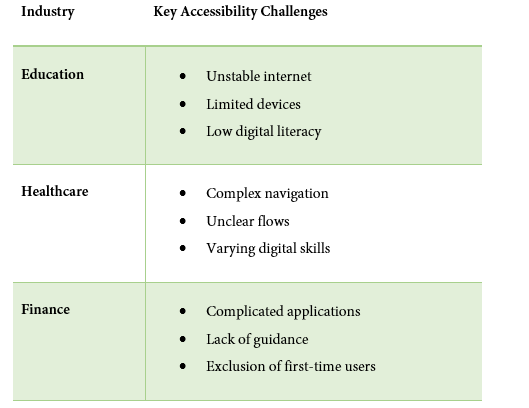
In practice, I’ve found that designing for inclusion means accounting for real lives, different bandwidths, and varied digital comfort levels. The most meaningful products make the digital world accessible to everyone.
Improving Access to Education in Underserved Regions
One of the sectors where inclusive UX can drive immediate and measurable change is education. In many rural regions, students face challenges such as unstable internet connectivity, limited access to devices, and a shortage of localized learning resources – all of which can widen the opportunity gap.
In a project for a rural education platform in Thailand (Tiny Sprout Education), modular learning flows and simplified navigation improved access for students with low bandwidth and varying digital literacy (W3C Accessibility Guidelines). Narrative-led UX also boosted engagement for younger learners new to digital learning.
Soon after it launched, Tiny Sprout was picked up by two partner schools and reached hundreds of students. This showed how designing interfaces around real-world limits can really boost usability and adoption.
More importantly, the project taught a bigger lesson I’ve seen in my work: inclusive digital systems aren’t built just by making things look nice. They come from carefully understanding the context, the constraints, and the wide range of needs of the people they are meant to serve.
Accessibility in Healthcare: Designing Systems for Real Users
In healthcare platforms, I’ve seen accessible UX – like simplified appointment scheduling and clear navigation – boost patient efficiency and repeat engagement (Nielsen Norman Group, 2023).
The redesign focused on making navigation clearer, simplifying appointment scheduling, and creating flows that work for users with different levels of digital skills. Internal testing showed big gains in how quickly tasks were completed and a rise in repeat bookings. This proves that accessible design helps not just patients, but also improves how operations run.
Financial Inclusion Through Human-Centered UX
In the same way, accessible design in financial apps can give first-time users and those often left out of traditional banking more power. Simple flows and clear instructions boost both adoption and confidence.
This project shows a bigger truth: accessible financial systems can give people who’ve faced barriers a real chance to use and benefit from financial services.
Where Inclusive UX Is Headed Next
As digital experiences keep changing, inclusive design is moving past checklists and compliance. The next wave of accessible UX focuses on:
- Supporting users who speak different languages and come from different cultures. This matters a lot for global SaaS products.
- Optimizing for mobile-first and low-bandwidth situations, which is critical in emerging markets.
- Making things easier to understand with clear, story-like flows that help people finish tasks.
- Designing for people with low digital skills so it’s easier for them to use and adopt.
- Creating interfaces that feel predictable, intuitive, and confidence-building, which helps reduce mistakes.
Visual clarity and inclusion don’t have to conflict. A good interface is more than just aesthetically pleasing. It draws people in, guides them in the proper path, allays their fears, and gives them confidence that they can manage. That is the true essence of inclusive design.
As more industries go online, the demand for equitable and accessible user experiences will only increase. Designers who are concerned with empathy, clarity, and making technology accessible to everybody will create the next generation of digital systems. They will design tools that are really inclusive in addition to being aesthetically pleasing.
References
Level Access. (2024). The sixth annual state of digital accessibility report: 2024-2025. https://www.levelaccess.com/resources/the-sixth-annual-state-of-digital-accessibility-report-2024-2025/
Applause. (2024). State of digital quality 2024: Accessibility, performance, and the user experience. https://www.applause.com/resources/reports/state-of-digital-quality-2024/
Level Access. (2025). The state of digital accessibility report 2025–2026. https://www.levelaccess.com/resources/state-of-digital-accessibility-report-2025-2026/
MIUX Studio. (2025). Tiny Sprout Education: Storytelling-driven platform for global mentorship. UX Design Awards. https://ux-design-awards.com/winners/2025-2-storytelling-driven-platform-for-global-mentorship
Kendrick, A. (2022). Inclusive design. Nielsen Norman Group. https://www.nngroup.com/articles/inclusive-design/
World Wide Web Consortium. (2025). Web Content Accessibility Guidelines (WCAG) 2.1. W3C. https://www.w3.org/TR/WCAG21/
Nielsen Norman Group. (2023). Accessible design for users with disabilities. https://www.nngroup.com/articles/accessible-design-for-users-with-disabilities/
World Wide Web Consortium. (2024). Web content accessibility guidelines (WCAG) 2.1. https://www.w3.org/TR/WCAG21/
n