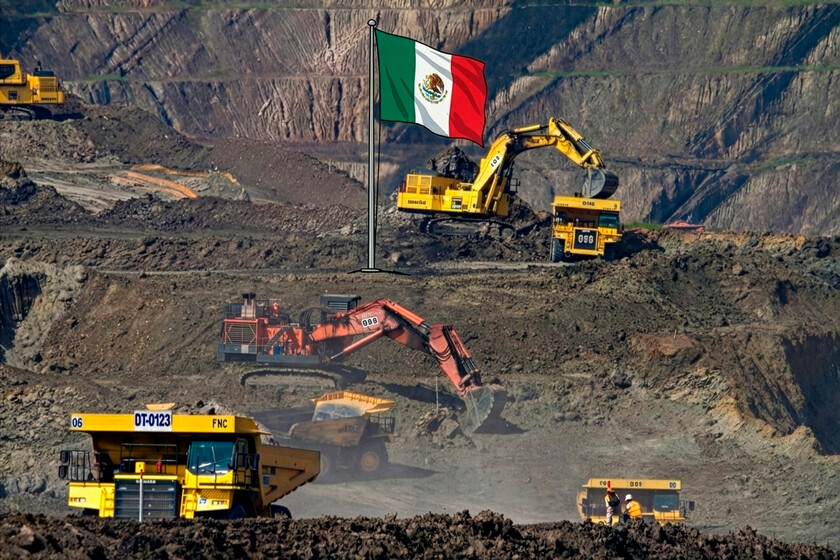
For years, the so-called critical minerals have remained out of the focus of public debate, despite the fact that entire industries and a good part of the economic security of countries depend on them. Its relevance does not respond only to a technological issue, but also to geopolitical tensions, fragile supply chains and strategic decisions that today condition industrial development. In this context, Mexico has begun to put specific figures, names and limits on its own exposure, opening a conversation that goes far beyond mining and directly reaches its productive future.
What exactly is considered a critical mineral. These are elements present in nature whose demand is high while their availability is limited, either due to geological restrictions inherent to finite resources or due to external factors such as geopolitical tensions and trade blockades. That combination of scarcity and dependence makes them sensitive pieces for contemporary industry. They not only intervene in everyday electronic devices, they also determine energy efficiency, component durability and thermal stability in multiple technologies.
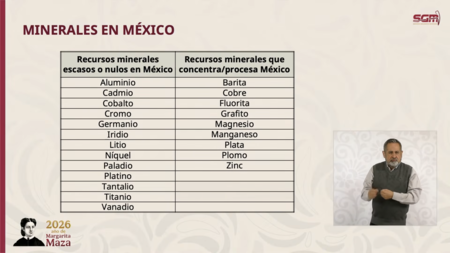
Image shared by the Government of Mexico
The concrete photography of Mexico. The Mexican Geological Service has defined which materials are scarce or directly non-existent in the national territory, or without technical and economic conditions today to produce them viably, a diagnosis that allows foreign dependence to be measured with sufficient precision. The list is not small and concentrates a good part of the inputs associated with electronics, energy and various advanced industrial chains. These are the 13 minerals classified as scarce or non-existent resources in the country:
- Aluminum
- Cadmium
- Cobalt
- Chrome
- Germany
- Iridium
- Lithium
- Nickel
- Palladium
- Platinum
- Tantalio
- Titanium
- Vanadium
The reverse of the diagnosis. Mexico has a relevant mining base in certain materials where there are not only reserves, but also extraction and processing capacity, which allows it to sustain its own industrial chains and participate in international markets. This dimension is key to avoiding a reading solely focused on external dependence and understanding that the resource map combines shortcomings with operational strengths. According to the Mexican Geological Service, the minerals that the country concentrates or processes are the following:
- barred
- Copper
- Fluorite
- Graphite
- Magnesium
- Manganese
- Plata
- Lead
- Zinc
The diplomatic channel and the geopolitical board. The diagnosis of available resources has not remained internal. Mexico has brought the issue of critical minerals to the field of international politics with a specific goal: to ensure access to materials that are necessary for its present and future industry. This was explained by Marcelo Ebrard, Secretary of Economy, when detailing the country’s participation in different forums and coordination spaces, including areas linked to the United Nations. The strategy, as he stressed, does not seek to offer its own reserves, but rather to be part of the decisions that will determine how these supplies are guaranteed in an increasingly competitive environment.
Coordination with the northern neighbor. The United States Trade Office (USTR) announced that its ambassador, Jamieson Greer, and Marcelo Ebrard agreed on an action plan aimed at building a preferential trade scheme for critical minerals, which includes everything from the identification of priority materials to the exploration of adjusted minimum border prices for imports and consultation on how to incorporate these minimum prices into a binding plurilateral agreement. The cooperation seeks to respond to global market distortions that have left North American critical mineral supply chains vulnerable to disruption. The initial calendar, it should be noted, establishes a work horizon of two months to analyze measures before defining subsequent steps.
Lithium. State ownership and pending viability. Among the minerals that explain the Mexican position, lithium occupies a unique place. The Constitution establishes that only the State can exploit it, a decision that reinforces its strategic nature but, at the same time, coexists with technical and economic limits. As President Claudia Sheinbaum pointed out, there is already a technology developed at the Mexican Petroleum Institute to obtain lithium in clays, although “today it is not economically viable, it is very expensive.” This combination of state control and production difficulty illustrates why guaranteeing access to critical materials remains an open question for the national industry.
In conclusion. The image that emerges is not that of a country without resources, but of an economy that must precisely manage its material dependencies in an increasingly demanding international environment. Mexico has relevant mining capabilities and, at the same time, faces clear limits on essential inputs for the technology and energy industry. Between both extremes is a strategy that combines internal diagnosis, diplomatic action and technological development still in process. The result does not close the debate, but it does define the context in which the country must work.
Images | Dominik Vanyi + Nano Banana
In WorldOfSoftware | What are rare earths, the elements that move the technological world and separate China from the West